There are scenes in blockbuster teen movies from the 1980s and 1990s that wouldn’t fly today. I think of Revenge of the Nerds, that classic raunchy coming-of-age tale about pocket protector-wearing geeks no woman would ever touch with a three-foot slide rule. You might recall the heroes of the story install hidden cameras in a sorority house in order to spy on naked, skinny, blonde cheerleaders. In triumph, the Byronic dirtbag yells, “We’ve got bush!”
In our purportedly more enlightened age, Hollywood has forsaken making risqué teen comedies for vulgar imps; instead the vulgar imps have taken their raunch to the lawless internet. The powers of AI have multiplied their mischief. Their latest prank is to tell Grok, an AI chatbot on X.com, to edit photographs that feature women – especially photographs featuring prominent women – so they are stripped to their underwear or bikinis. A mischievous howl has spread across social media feeds. “We’ve got slop!”
It was fairly easy to make sexualized images of real people with other AI chatbots or photo-editors until they too added safeguards
The whole lurid carnival of politicians, celebrities, news anchors and other innocent bystanders in their knickers and bras has led to multiple rounds of escalating tit for tat between British Prime Minister Keir Starmer and Elon Musk, X’s chief executive. Starmer threatened to ban the platform entirely in the UK, telling a radio interviewer, “I’ve asked for all options to be on the table.” Musk hit back in a post stating, “Censorship is the hallmark of an actually fascist state.”
The tit for tat continued. The UK’s Technology Secretary Liz Kendall threatened Musk’s company in a speech, saying, “Under the Online Safety Act, sharing intimate images without someone’s consent, or threatening to share them, including images of people in their underwear, is a criminal offense for individuals… and for platforms.” In response, the internet imps began posting images of Kendall in Union Jack-themed bikinis. For his own turn in the volley, Musk slammed the UK for arresting more than 12,000 people for political social media posts in 2023. He reposted a fake picture of Starmer in a bikini (which he eventually deleted) and then reposted another user’s comment: “Bikini pics on X? Labour OUTRAGE! Rape gangs on our streets? Labour silence. That is the nature of the monsters in government.”
Labour’s rage against the slop machine came to a head on January 14, when Starmer, speaking in parliament, called the AI-generated content “disgusting and shameful.” He promised to strengthen existing legislation and to pursue the government’s investigation into X further.
It then became a worldwide scrum. California’s top prosecutor piled on. Unable to resist an opportunity to flog Musk, the Democrat announced that state Attorney General Rob Bonta’s office would also open a probe into the company’s spread of sexualized images of real people. Indonesia and Malaysia blocked the overly obliging chatbot. Canada and Australia’s top privacy watchdogs announced investigations.
By the end of that day, backing down, X announced it was disabling Grok’s strip-to-bikini feature. In a post, the company explained it had “zero tolerance for any forms of child sexual exploitation, non-consensual nudity and unwanted sexual content.” The appeal against sexualization of child images is, rightly, a winning argument. X insists that any such activity is banned on its platform, and any “safeguard lapses” which may have occurred have now been addressed.
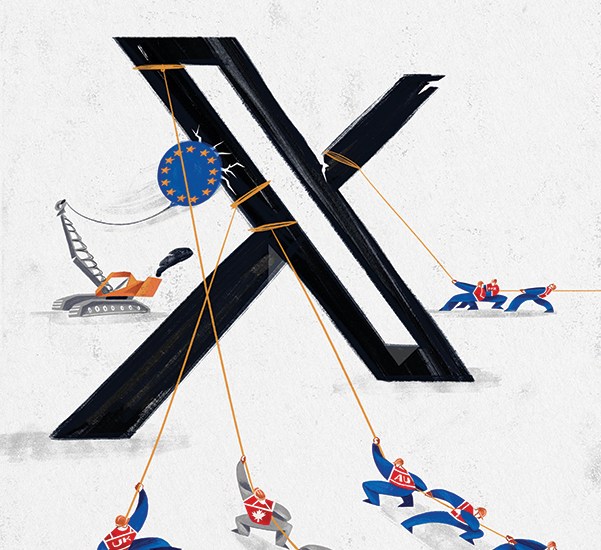
But the dust is still settling. Despite X’s retreat, the UK government says it is still investigating the company for breaching the Online Safety Act. Ofcom – the United Kingdom’s communications watchdog – may yet levy substantial fines. Other governments might also ensnare X in protracted legal battles.
The intensity of Labour’s response was so wildly out of proportion to the offense that one couldn’t help but notice that Starmer and his sanctimonious cohort were grasping at bikinis as a small pretext to exterminate X entirely. It was the sort of overreach that makes you wonder if the real crime in the eyes of the British government wasn’t the deepfakes but the existence of X itself.
And why is X the scapegoat here? It was fairly easy to make sexualized images of real people with other AI chatbots or photo-editors until they too added safeguards. And yet no bans have been issued, nor investigations launched into these other companies.
X has proven to be a sharp thorn in the side of Labour. Users besides Musk have ridiculed the party’s aggressive online speech laws that have sent harmless jokers or critics to prison. X has also broadcast Labour’s vilification of the opposition parties. In one example during this same week, the government commissioned a video game to teach the young that loving one’s country and questioning endless immigration constituted a dangerous form of extremism.
The game cast a purple-haired goth girl named Amelia as the seductive villain. In a single day, X users elevated Amelia to a viral patriotic icon in AI-generated videos. The government, in embarrassment, took the game offline.
It doesn’t take a strategist to see it would be politically convenient for Starmer to silence his critics under the guise of safety.
Whatever one’s opinion of X, it remains one of the last vast arenas where free speech is at its best. Within its boundaries, the mainstream media must compete with citizen journalists, and intellectuals have to trade barbs with clowns. Here, news erupts in real time, and ideas – the good, the bad, and gloriously idiotic – collide without prior approval.
To shut the whole platform down because a handful of fools shrieked “We’ve got bush!” is to confess a humorless authoritarianism so obtuse it borders on farce. It’s as if Starmer, in a fit of moral panic, decided to burn down the entire library just to get rid of a few dog-eared copies of Playboy hidden on the top shelf. To be fair, Musk’s personal barbs against Starmer only inflamed the Prime Minister’s hatred of him and swelled the UK government’s urge to control. And the company did take one clumsy half-step at first by limiting Grok’s undressing feature to paid subscribers only. But of course individuals should not use Grok to generate puerile, sexualized images of real people. That’s why the company modified Grok not to do this. Some people feel humiliated, and no one should use someone else’s likeness for gain, for sport or even for squalid social media likes without their consent.
Sick, AI-generated child sexual images are obviously out of bounds. But the frontier of “appropriate” use remains an unmapped wilderness contested by raunchy trolls and the perpetually offended. Rules of engagement will emerge.
One important point needs to be emphasized, however. Across the Atlantic, we Americans shift the burden. Moral responsibility and legal liability rest solely on the individual, not the platform. If you get defamed or libeled on X, you do not sue X. You sue the person who libeled you. There are even exceptions to rules of privacy. The bougie private gym Equinox began running ads on New Year’s Eve featuring AI-generated slop of Justin Trudeau pole-dancing and the Pope sporting a Balenciaga puffy parka. No one batted an eyelid.
Anyone with common sense can see the humor in putting Donald Trump or Starmer in a bikini. And if you want to see me in a bikini – well, just slide into my DMs.