When the earthquake is big, the porcelain rattles far and wide. And that’s exactly what’s happening now… in Cuba, Colombia, Mexico and even Greenland.
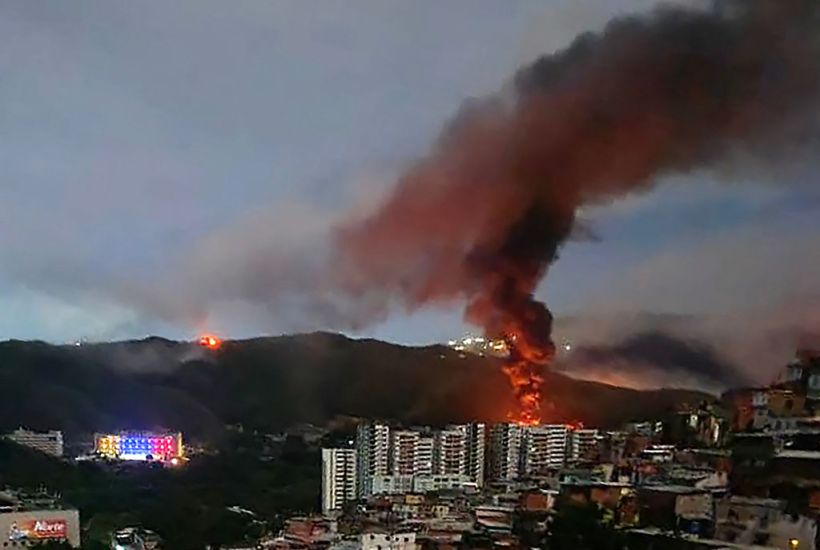
The plates are rattling after the Trump Administration’s swift, successful mission to capture Venezuelan strongman Nicolás Maduro and his wife, Cilia Flores, who was allegedly a major figure in the country’s international drug trafficking. Both husband and wife now face criminal charges in the US.
Who else is rattled? Well, the Democratic Party for one, but they are shaking with anger. They say that the raid was illegal and that they should have been consulted before any military action. The Trump Administration responds, quite plausibly, that no consultation was required, that disclosure to Congress would have leaked and jeopardized the mission, and that Congress was not notified in previous cases, notably the 1983 invasion of Grenada and the 1990 capture of Panama’s dictator, Manuel Noriega, who faced similar US warrants.
At home, both political parties face risks from the Venezuelan action. The Democrats, who begin every calculation with “what do we hate most about Trump now,” have managed to position themselves as supporters of a malign dictator who overrode a local presidential election, cozied up to China, Russia, Iran, and Cuba, and protected a brutal international drug cartel. Nice friends you got there.
The risk for Republicans is that US troops might be needed for a costly, long-term occupation since, despite Maduro’s ouster, his regime remains in place. If the US has to send in more troops to maintain order, if it is forced to maintain a significant ground force, the Democrats will say, quite rightly, “We told you so.” Voters will agree.
Ultimately, how voters react will hinge on two developments, both of which are still up in the air. Can the US find a supportive and effective government in Venezuela? That local support is vital if the US is to avoid a bloody, expensive occupation. Second, can US oil companies resume substantial production and do it quickly enough to affect US gas prices, at least before the 2028 election? Production cannot be restored much faster because Venezuela’s essential infrastructure degraded under the country’s corrupt, socialist leaders and because the local petroleum is difficult to process. It is “heavy oil,” which requires refining capacity. The good news is that Venezuela’s oil reserves are massive, dwarfing those of every other country, including Saudi Arabia. Trump stresses that bonanza and hardly mentions the restoration of the country’s democracy.
What about the global impact of the US action in Venezuela? Those begin with a clear message. When the Trump White House issues a threat, you better listen. Iran’s leaders didn’t and paid the price. Maduro was next in line. Trump has shown he is willing to use overwhelming force when our interests are at stake, and he believes he can do so without long-term entanglements.
Foreign leaders also saw that the US gave its foes ample warning. Trump acted only after trying to negotiate a safe exit for Maduro. When he refused, he ended up in a perp walk in Brooklyn.
The outcome strengthens Trump’s reputation for resolve and, as a result, the credibility of US threats around the world. You no longer hear the meme so popular only a few months ago: “Trump Always Chickens Out. After the swift strikes against Iran nuclear facilities and now the Venezuelan leaders, the TACO meme is dead. The poultry have come home to roost.
Whether this newfound reputation for resolve – and for success at low cost – endures will depend on whether the US can achieve its long-term goals in Venezuela without a burdensome, long-term commitment there. If the US gets bogged down, as it did in Afghanistan and Iraq, if US troops start dying on foreign soil, Trump will pay the price politically at home and abroad. Those troubles would undermine his willingness to act in other hot-spots and, thus, his credibility to issue effective threats.
Outside of Venezuela, where else is the porcelain rattling?
Cuba, for one. The communist regime there depends on economic and military support from Russia and Venezuela. Those are not strong partners these days. Russia can’t help much because it is tied down in Ukraine. Venezuela had been helping by sending oil in exchange for troops to protect Maduro. Now, that deal is dead, putting the Cuban regime in grave danger. The thugs in Havana must shudder when they look north at Trump and his tough-minded Secretary of State, whose family escaped from the island.
Although the US has a massive navy assembled in the Caribbean, it is unlikely to turn that force toward Cuba before the operation in Venezuela is complete. That means a successor government subservient to US interests. The more stable a pro-American government in Caracas, the nearer the day of reckoning in Havana.
Colombia is also endangered by the US action in Venezuela. Like the Maduro regime next door, it is a poster child for state-sponsored narco-terrorism. Until now, the US concentrated on Venezuela, though it has taken out some Colombian drug lines to North America in the Pacific. Now, with the Venezuelan pipeline stopped, the US can now devote more resources to stopping the flow from Colombia. Beyond that, direct intervention is unlikely.
Mexico can also expect to feel more US pressure. The key problems there are the drug cartels and their export of cocaine and fentanyl to US markets. The fentanyl is made from precursor chemicals shipped from China.
Mexican President Claudia Sheinbaum, who immediately denounced Trump’s action in Venezuela, is really caught between demands from Washington and threats from her country’s powerful cartels, which have proved willing to kill political leaders who cross them. One possibility would be direct US strikes on drug-processing plants inside Mexico.
Greenland, which is formally a Danish colony, also feels increasing pressure from the Trump administration. The US wants more control over the country to block the trans-Arctic naval routes used by Russia and possibly to exploit mineral resources.
Seizing Greenland would be easy, militarily. It would be difficult politically. Grabbing territory from a NATO ally would send tectonic shockwaves through the alliance and might end it. Still, Trump doesn’t seem to care much for America’s European partnership (the longest alliance in modern history). And he has just proven he is willing to carry through on his threats, though the threats to seize Greenland have been vague.
One common theme here is Trump’s focus on the Western Hemisphere, where he wants to exclude rival powers. That strategy put the US at odds with China, which has been building ties across South America and the Caribbean. China is also feeling the pinch from Trump’s trade restrictions. The only good news for Beijing is that it will benefit enormously from lower world oil prices. (Those hurt Russia and are compounded by sanctions on Russian oil exports.)
The real question for China, Russia, Israel, Saudi Arabia, and Taiwan is whether Trump’s focus on America’s backyard will reduce Washington’s deterrent posture in Europe, the Middle East, and East Asia.
One area where that posture remains strong is the Persian Gulf. Trump has been very clear that America is “locked and loaded” and ready to bomb Iran again if the Mullahs and IRGC try to rebuild their nuclear and missile capacity.
Beyond that, long-time American allies are uncertain about America’s new direction in foreign policy. Their concerns are underscored by Trump’s increasing pressure on Ukraine. It’s not hard to see the stark change in US policy, where containing Moscow had been the stable North Star for eight decades. That star has dimmed, and allies are bound to wonder what other changes are in store. What will Trump’s new direction mean for them?
They are right to wonder.