The great American activist Aldo Leopold once argued that to be a modern environmentalist was to suffer a world of wounds as you endured the losses inflicted on one cherished organism after another. No one, then, can suffer more anguish than the campaigner for the world’s fishes.
In this wide-ranging, heartfelt, meticulously assembled account of our oceans Rose George shows why. She tells us that there are four million fishing vessels worldwide, the most appallingly efficient belonging to China, the EU, Taiwan, Japan, Russia and the USA. It is primarily these giant industrial regimes that have driven four-fifths of the planet’s fishes to the edge of sustainable limits. Much of this damage was done decades ago.
Even in the 1970s the North Atlantic fisheries were declining. Populations of cod, perhaps the ultimate fish icon for Britons, have now been reduced by a minimum 90 per cent. Our beloved fish and chips owe almost nothing to the once bio-rich waters girdling these islands. Most of our cod now comes from Russia; or did, until the Ukraine war. Nine out of ten tunas have similarly been harvested worldwide.
What confirms George’s portrait of systemic nihilism is that we have inflicted these historical losses but then redoubled our efforts. Since 1970 there has been a ninefold increase in fishing capacity. We hunt more intensively for less and less but also deploy ever more damaging techniques, dredging being one. This entails dragging heavy, toothed scrapers across the seabed, effectively ploughing it, so that they smash and destroy all bottom-dwelling life as they gulp down target species. Dredging is as inefficient as it is destructive and one oceanographer has likened it to hunting for a hummingbird with a bulldozer.
To counter these effects, many countries have secured Marine Protected Areas. Most of these supposed no-take zones exist largely on maps or between bureaucrats’ ears, while illegal, unreported and unregulated fishing vessels routinely violate their boundaries. To date, the sum of administrative wisdom on international fisheries has secured an ocean area equal to 1 per cent of the whole.
The author instinctively understands that battering us with brutal data is only partly effective. After all, governments and international organisations have known about the problems for years but go on granting unsustainable catch quotas to their respective national fleets. Our own present administration is doing exactly this as you read. What George does to enrich her message is to go out and mingle with fishermen to give her book balance and credibility, but also to add the warmth and humour of a human story.
She shows us the dangers inherent in the life of the average trawlerman. Since 1900, the single port of Hull has experienced 5,000 drownings. Just as hard are the lives of the ‘fish wives’ – the spouses of the men on the boats and the vast majority of modern factory employees. If not exposed to danger, they face tough, often underpaid conditions as well as institutionalised misogyny and prejudice.
George steers briefly off course to illuminate these ‘secondary’ fish workers and to reinstate one of their lost heroines. Weighing 17st and christened Big Lil by the British press of the 1960s, Lilian Bilocca campaigned with colleagues to end the neglect commonplace among trawler owners, who routinely sent crews to sea without radios, lifejackets or a back-up system in moments of crisis. Big Lil met various Labour ministers, addressing them as ‘Petal’, and, having secured her demands, returned triumphantly to Hull – to be sacked and deluged with abuse.
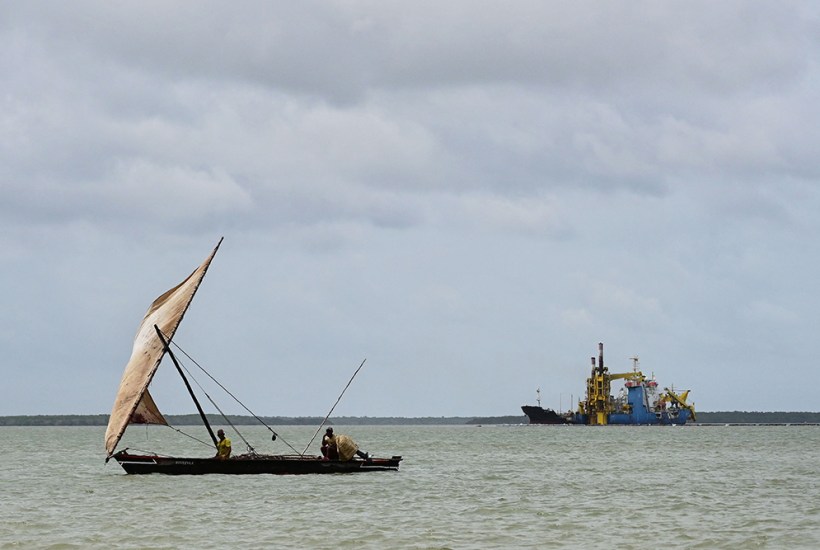
George suggests that if there is any hope it lies partly in the recent agreement known as the Global Ocean Treaty, which is the latest attempt truly to confront the problems. Yet the book’s primary source of optimism is its stories of local inshore fishermen, many of whom work from small boats with methods that are sensitive to their quarry. By number they represent three-quarters of all the vessels operating in Britain, yet receive just 4 per cent of the total national quota. For this community, sustainability isn’t some new-fangled innovation; it is embedded in deep tradition.
Readers should be aware that this book requires a mastery of maritime acronyms. On one spread alone I found APO, MSC, NOAA, RFMO, WWF, PSMA and IUU. George has a further penchant for short, arrhythmic, repetitive sentences (‘There was door-knocking and rousing and there was drama’) which are meant to strike a modern, incisive note but just get in the way of her otherwise excellent storytelling. All in all, this is an important book, communicating its message as much through stories of ordinary fisherfolk as the devastating power of facts.
Got something to add? Join the discussion and comment below.
You might disagree with half of it, but you’ll enjoy reading all of it. Try your first month for free, then just $2 a week for the remainder of your first year.