T he darkest day in the history of cartooning must surely be 7 January 2015, when two Al-Qaeda gunmen attacked the offices of Charlie Hebdo in Paris, murdering 12, driven by its blasphemous depiction of the Prophet.
What great act of remembrance and resistance did we witness then, with a controversial cartoon published by the Sydney Morning Herald and the Age on the just-gone 11th anniversary of the massacre? Did it remember the victims? Bemoan the continuing insidious erosion of free speech in the West, including teachers being beheaded and forced into hiding for giving lessons about the massacre? Or perhaps, closer to home, it involved a critique of the scourge of murderous Islamist extremism in honour of the 15 victims murdered in the Bondi Beach massacre that occurred three weeks earlier and targeted a Hanukkah celebration?
Well, no. In a totally brave intervention, Cathy Wilcox’s cartoon lampooned the response to that antisemitic atrocity, in particular, the demand for a royal commission, and added her own flourish with an antisemitic conspiracy.
Under the heading ‘Grass roots’, the Israeli Prime Minister is playing a drum labelled ‘Royal Commission into Antisemitism’. In front of him are prominent Australians, ostensibly including Jacinta Price, John Howard and Rupert Murdoch. These figures hold up, seemingly on grass (see what our clever cartoonist has done?), members of civil society – lawyers, businesspeople, sportspeople, ‘Labor has-beens’ and so on – calling for a royal commission, with a dog saying, ‘Don’t mention the war.’
The clear message is that a bunch of chumps marches to the drumbeat of archvillain Netanyahu calling for a royal commission and not talking about ‘the war’. But it’s what the cartoon unintentionally communicates that is much more telling.
In the time-honoured tradition of the best antisemitic cartoons – think Nazi or Soviet-era octopus, puppeteer and shadowy hand motifs – the Jew is blamed for whatever the cartoonist finds objectionable. If I don’t like it, the Jew is behind it, and if the Jew is behind it, I don’t like it.
It suggests that the cartoonist does indeed not like the chorus of demands for a royal commission. It portrays collective organisation, agency and action of Jews (see also: Israel) and their supporters as uniquely and inherently suspicious and unworthy. If a wide variety of Australians were calling for a royal commission to investigate an antisemitic terrorist attack, it can only be because they were manipulated and orchestrated by the Jew, not that they acted out of principle, organically and independently, to express their genuine concerns. Correlation equals causation when it comes to the Jews. It’s always a conspiracy, never a coincidence.
It says that Wilcox has so little sympathy for Jews and so little concern for their fate in her country that three weeks after the jihadist rampage on them, she mocked and even subverted the support for them and the call to understand what caused it and how it might be prevented from happening again.
And it exemplifies how endemic and entrenched antisemitism is in Australia’s liberal media and cultural milieu that no one at the relevant mastheads put a stop to the publication of a tenacious and pernicious antisemitic canard three weeks after a fatal antisemitic terrorist attack.
Days later, the customary ‘we’re sorry if you felt hurt’ apology appeared in the Age. After commenting that many readers found the cartoon ‘thought-provoking’, it noted ‘that many others in the community, particularly Jews, were deeply hurt and offended by it… and for this pain, we sincerely apologise’.
It did, of course, cause hurt and pain. But while it might have been nice if the cartoonist could have restrained herself for a little longer than three weeks before compounding the Jewish community’s hurt, that is not the problem with the cartoon. The dangerous antisemitism in a deadly climate is the problem, and the lack of reckoning with it in the statement is a moral failure.
Instead, the statement went on to explain that ‘Wilcox’s intention was to scrutinise the almost immediate politicisation following the horrific attack at Bondi…. Her depiction of Benjamin Netanyahu, for example, is premised on his condemnation of Anthony Albanese in the hours after the attack, declaring the prime minister’s recognition of Palestine “pours fuel on the antisemitic fire”.’
While it is legitimate to debate whether Netanyahu’s comment was fair or helpful, that is not the premise of the cartoon, and it is intellectually dishonest to portray it as a political critique. There is no evidence that the advocates of a royal commission were doing Netanyahu’s bidding but what passes as ‘political critique’ of Israel these days is rather expansive – libel, the ‘international Jew conspiracy’, doxxing, exclusion, discriminating, firebombing synagogues, supporting proscribed terrorist groups, inciting violence and even gunning down Jews at a Hanukkah event is all just a response to Netanyahu or ‘the war’ the cartoon’s dog admonishes us not to mention. And because – repeat the mantra, folks – it is not antisemitic to criticise Israel, none of this ‘political critique’ can be antisemitic.
Ironically, while the all-encompassing ‘political critique’ is wielded against Jews to whittle away the very notion of antisemitism, it is notable how often the response to antisemitism is said to be a ‘politicisation’ – often apparently these days in the service of stifling criticism of Israel, as the cartoon implies. The antisemite, of course, has never been bothered by internal contradictions or the need for logic, but is bothered by Jews demanding the same rights, understandings and protections that are bestowed on real oppressed minorities.
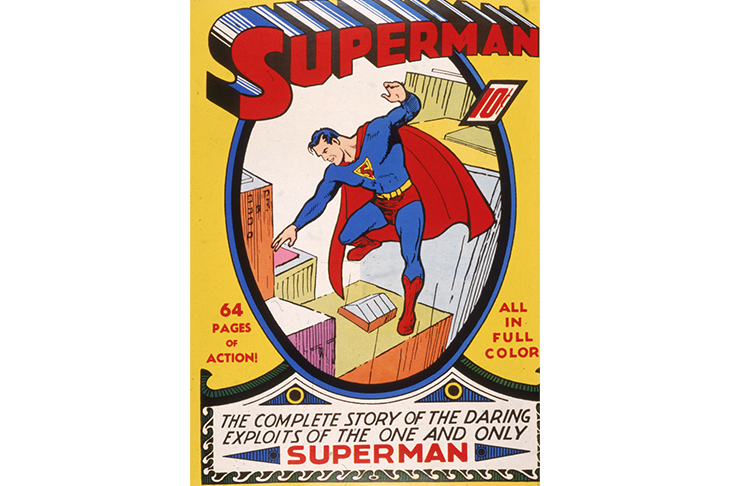
Which brings us back to Charlie Hebdo. For those who don’t wish to live in fear but do have an impulse to convey their cartoonish interpretation of the world, Jews are an easy target. There you have the perennial villain with cosmic powers, a vessel for all flights of fancy that the creator wishes to indulge in. I prefer the wish-fulfilment fantasy of two Jewish immigrant teenagers from Eastern Europe who came to America, Jerry Siegel and Joe Shuster. Superman was their creation, the sole survivor from a destroyed world, created by them to heal the world and fight fascist oppression. We need him more than ever.
Got something to add? Join the discussion and comment below.
It's always a conspiracy, never a coincidence
You might disagree with half of it, but you’ll enjoy reading all of it. Try your first month for free, then just $2 a week for the remainder of your first year.