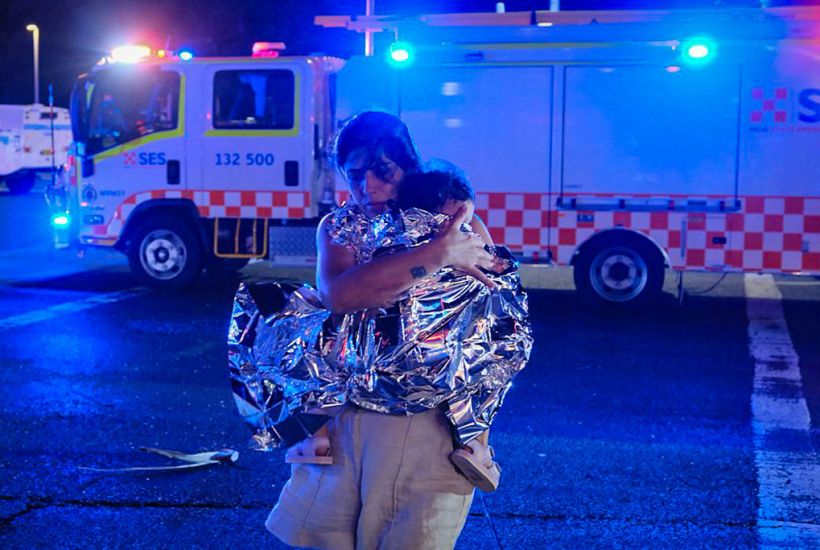
The Bondi murders painted a picture constituted out of the contrast between shade and light. This was the chiaroscuro massacre. But, perhaps because we have become desensitized by endless dark descriptions of mass killings over the years, our attention was as much on the moments of brightness on that Sydney beach: the onlookers who grappled with the shooters, the lifeguards who sprinted towards danger, those who shielded strangers with their own bodies. These acts of heroism seemed all the more remarkable because of all we have been led to believe about how people act in emergencies.
This can be summarised in one word: panic. When the going gets tough, ordinary people fall apart. They act selfishly and disproportionately, neglecting or even endangering others in the attempt to save themselves. What self-respecting Hollywood disaster film would be complete without a scene where the crowd flee for the exits, screaming and waving their hands in the air – thereby clogging those exits and turning a crisis into a tragedy? The message is clear. We, the people, are the problem in an emergency, apart from a very few exceptional individuals who stand out from the crowd – such as the heroes of Bondi beach.
All this makes for a compelling spectacle. But it is almost entirely wrong. In recent years, those who have examined human behavior in emergencies have shown that people tend to look after each-other – strangers as well as kin – rather than look after themselves. If events turn tragic, it is generally either because of structural problems (badly designed spaces with inadequate exits that are often blocked or even locked), poor information which directs people towards rather than away from danger, or else because people are loath to abandon others and stay with them until it is too late.
What is more, even when facing violence, the norm is for people to intervene in order to prevent harm. This extends from fights outside bars, to terrorist attacks. For instance, an analysis of a notorious knife attack on the London Underground showed not only that the attacker was directly confronted but that others, less physically able, helped in what ways they could – distracting the attacker, directing people away from danger – and that they all effectively coordinated their actions.
Even in the most extreme circumstances, then, “panic” is more ideology than reality – an ideology which blames the public for the failings of authority.
The basis for such acts of kindness and solidarity is less to do with the qualities that a few people have within them than with what happens between people in an emergency. We all have some experience of this at some level. In a snowstorm, you suddenly find yourself talking to neighbors you only nodded at before, you help each other in digging out your cars. Because the storm affects everyone, it leads to a sense of common fate which in turn leads to a sense of shared identity. In short, an emergency transforms “me” into “we”. Those who, psychologically, were previously “other” become encompassed in our extended social identity. Their fate becomes our fate. Their benefit becomes ours. This is the basis of empathy and helping and also the expectation of helping from others which not only inclines but empowers us to act beyond our everyday limits.
These processes were central to understanding how people reacted to Covid, where infection prevention measures were, for most people, more about protecting others (notably the elderly and immune-compromised) than about protecting themselves. Accordingly it was not risk to self but risk to community that motivated adherence and a sense of identification with the community was a key predictor of adherence.
A variety of studies using a variety of methodologies from experimental (more able to tease out cause and effect) to historical (more applicable to the phenomena of interest) demonstrate the link between shared identity and solidarity in emergencies. To take just one example of the latter, twice the Nazis tried to deport the jews of Bulgaria to the death camps. Twice they were foiled by mass opposition. Looking at the arguments used to mobilize this opposition, one thing stands out. Jews are rarely referred to as such, but rather as a “national minority”. If the word “jew” is used, it is to stress that they are fully Bulgarian in law and in sentiment. In sum, the Nazis are not trying to deport “them” but to deport “us” and opposition is an act of self-defence.
In other words, acts of altruism and solidarity do not reflect the abnegation of self-interest but rather the extension of the self (and hence of self-interest) to encompass the other. Hence it becomes less exceptional, confined to a few “special people”. It is something of which we are all capable.
None of this is to take anything away from those whose actions stopped the Bondi massacre from being even more murderous. But the danger of putting them on a pedestal is that it puts them – and their interventions – beyond the rest of us.
The victims of Bondi were targeted as jews, but as jews they were no less Australian (and human) than anyone else. The killers targeted “us”, not “them”. Seeing the whole picture depends on the right combination of light and shade. If hatred starts by narrowing the boundaries of community, society must respond to ensure kindness and solidarity flow from extending these boundaries so that these groups are re-included. Such collective heroism can make a big difference.