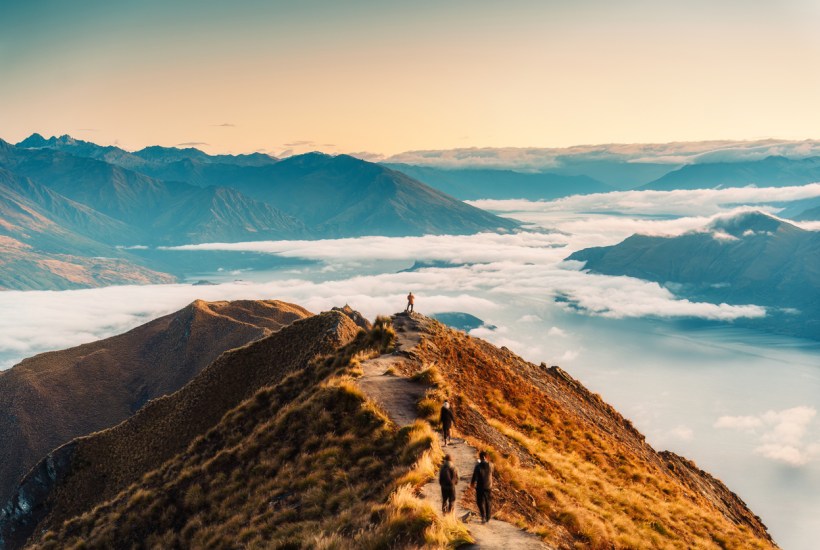
‘I still think New Zealand the most beautiful country I have ever seen,’ Agatha Christie marvelled in 1922. Evidently she’s not the only one. A century on, the great crime writer’s ‘astonishing’ verdict on the country in the South Seas echoes and re-echoes, most dependably in the familiar media rankings of the ‘best’ places in the world for Brits to make a Christmas getaway. New Zealand, it seems, is forever top of the pops.
New Zealand’s scenery, when you finally get to see it, is undeniably beautiful, but for British tourists much of the splendour can be undeniably familiar
Whether measured by the views of the relevant travel editors or surveys like the Daily Telegraph’s recent poll of 20,000 readers, my country apparently beats all comers as a destination for Brits wishing to be ‘thrilled, awed, relaxed and awakened’ for the festive period, as the Telegraph recentlygushed.
And there are many takers. Around 190,000 people in the UK make the journey each year; that’s down a bit since before Covid, but not by much. Some make the trip to see relatives and friends while also escaping the winter blues. But others simply want to experience for themselves what the actor Stephen Fry hails as ‘Earth destination number one’, a land forever billed as wondrously safe, affordable and easy to get around.
Does New Zealand live up to all the hype? It is certainly jam-packed with craggy fjords and picturesque vineyards. The snowy vistas are pretty cool. Not to mention the much-ballyhooed ‘adventure tourism’: the bungee jumping, skydiving, white-water rafting, clambering up mountains, and all the rest.
But getting here is a bit of an adventure itself, at least if long layovers and even longer flights are your idea of living on the edge. New Zealand is about as far from the UK as it’s possible to get. Depending on the number of layovers, it can take up to 40 hours. And it’s flipping expensive: a return flight around this time of the year can cost more than £2,000.
New Zealand’s scenery, when you finally get to see it, is undeniably beautiful, but for British tourists much of the splendour can be undeniably familiar. Those rolling green hills and rugged coastlines bear a striking resemblance to parts of Scotland and Wales or, especially, the Lake District, albeit with more fluffy sheep. While the scale may be a little grander, the essence is hardly unique.
The Kiwi life is the sweet life, they say, but virtually nothing here comes cheap. If the flights over don’t drain your bank account, the cost of accommodation, food and most activities soon will. Car hire, which is essential for exploring the country’s remote regions along curvy (and dangerous) highways, costs a lot and the petrol prices are already among the highest in the world.
That way goes food, too. Brits are forever whelping on about the ghastly prices at home, but New Zealand comfortably leaves the old country in the shade: butter, cheese and eggs are typically over 50 per cent more expensive, and the effect of this is only compounded when eating out.
Last Christmas, a ‘Brits in Auckland’ Facebook group went into a state of impotent rage after members reported getting stung for anything up to ten quid for a plate of baked beans on a slice of toast. Roared one contributor: ‘Did they fly the beans in direct from a Tesco?’
Despite its reputation for untouched wilderness, New Zealand’s most famous attractions often feel anything but. Places like Milford Sound and the Tongariro Alpine Crossing typically get swamped with tourists around this time of the year. The glossy Instagram shots may suggest an unparallelled sense of solitude – what they don’t show you are the busloads of visitors and the endless queues. Yes, it all looks like a Peter Jackson film set, but aren’t most of us bored of the Rings by now?
Culturally, it’s a similar story. While the country has a rich Maori heritage that’s interesting enough, the search for other intellectual pickings can leave you feeling a bit like a ticket collector on a goods train. Museums and galleries here are generally small, and the local past can feel familiar rather than intriguing, especially with interlocutors issuing the usual litany of historical complaints about the nefarious hand of its onetime English colonial overlords.
The ultimate point of difference definitely remains adventure tourism. Nowhere else in the world, it’s safe to say, does one have as many opportunities for wrapping yourself in latex cords and – arms flailing, legs akimbo and faces contorted – yo-yoing like a lunatic off high-altitude bridges. Or else scaling the heights of one or other of the country’s hundreds of treacherous mountain peaks.
But these activities are by definition not to everyone’s taste. Often they come with a significant cost, up to and including paying with your life, as was the case in November when yet another British national perished on the slopes of the country’s Mount Cook. The emphasis on adrenaline-fuelled experiences in order to savour the Kiwi experience leaves some visitors feeling pressured to participate in activities many already view as being a little barmy.
‘People in New Zealand go out of their way to not be impressed by things,’ says the local actress Melanie Lynskey, which is probably true but also raises the question of why visitors shouldn’t follow suit.
Those who make the voyage this year to see kith and kin are almost certainly booked for a bedazzling time, because that’s the way it is with people you care about, whether in Auckland or Aberdeen
For the rest, the consistently high placing of New Zealand among the world’s most-salivated destinations might just feel like a mystery worthy of an Agatha Christie plot.