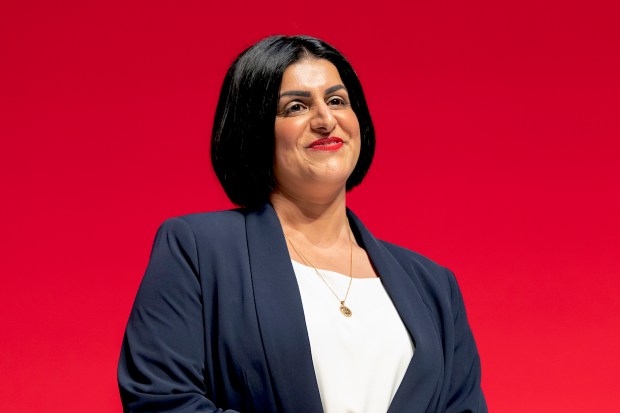
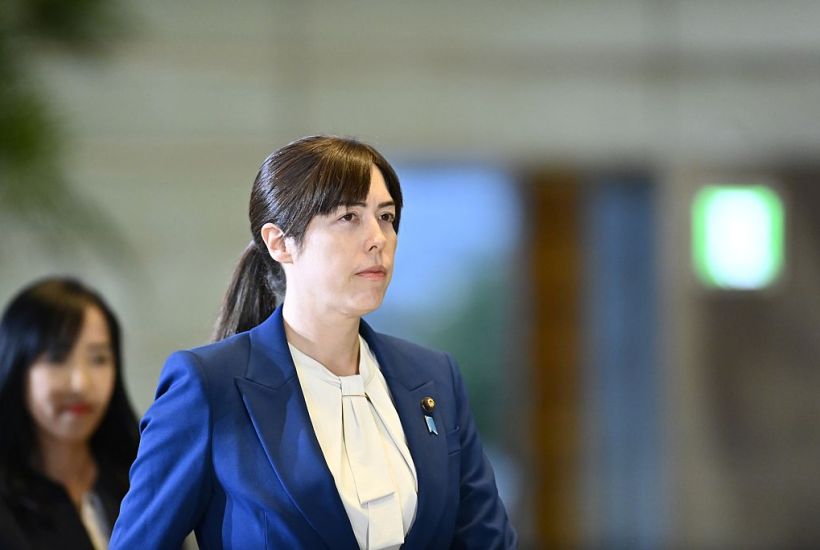
For those trying to understand Japan’s plummeting birthrate – which some fear could eventually lead to Japanese people ceasing to exist – evidence of where the problem might lie emerged this week. Old tweets from Japan’s new minister of state for economic security, Kimi Onoda, have surfaced in which the 43 year-old describes herself as ‘2D exclusive’. For the unenlightened, this means this very eligible young woman only forms romantic attachments with animated characters.
Onoda is far from alone is being smitten with 2D characters and untempted by the real thing
In the tweets Onoda explained that human romance is ‘uncomfortable’ and that her affection for ‘2D men’ leaves her no time anyway. She complains about having been pushed to get married (to an actual man) since her 20s, a form of discriminatory pressure she likens to gay people being urged to find a straight partner. Onoda seems to have presented herself as part of a distinct sexual subset. I was mildly appalled to discover terms actually exist for this (‘animesexual’ or ‘fictosexual’, if you’re interested – and I hope you’re not).
Could Onoda possibly have been joking? The tweets seem to be in earnest, are absent of any embarrassment, and full of justification and the apparent conviction that ‘relationships’ with what are effectively cartoons are not only perfectly normal but worthy of respect. Onoda is also on record as pushing back on criticisms that Japan’s often weird and creepy anime scene is ever responsible for crimes. She used to work for a video game company and is a member of the ‘Parliamentarians’ League for Japan’s Anime Manga and Games’. She is clearly a fan, an ‘otaku’ (geek) even, as they are known here. I believe her.
But Onoda is far from alone is being smitten with 2D characters and untempted by the real thing. According to research 17 per cent of young Japanese female students have reported romantic feelings towards a fictional character, as did 10 per cent of 16-29-year-olds overall. And those figures might well be an underestimate (would you admit this to a pollster?). There are even ‘marriage’ agencies that will arrange for a faux ceremony where you can tie the knot with a virtual husband like ‘Satoru Gojo’ (known for his ‘chaotic charm’) or a wife like ‘Rem’ (who has loyalty and domestic skills).
Apart from the pursuit of a genuine partner being uncomfortable and tedious, this decidedly odd phenomenon is often attributed to workplace stress. Office life is grindingly hard and unremittingly dull. And so after a hard day’s graft (12 hours or more) in a joyless, soulless office, with all banter proscribed and keigo (polite Japanese) mandatory, all many people can handle when they get home is something bright, artificial, pliant and dreamy. With an off-switch.
Money is a factor too. Japanese relationships have always been transactional, and until quite recently largely arranged. Due to Japan’s economic malaise, there is a lack of suitably wealthy real men to marry, which leaves lower order salarymen on the shelf unable to attract a partner, and a glossy, malleable fantasy an attractive option to both sexes.
Anime characters can be relied on to never age which plays into Japan’s obsession with childhood innocence and purity, manifested in the rather disturbing youth of the most popular ‘idols’ (sometimes washed up by their late teens) and the habit of high school girls, and even women in their twenties and beyond, to affix assorted soft toys to their bags as a sort of declaration of their refusal to embrace adulthood.
Japanese women in service roles even adopt a sort of squeaky high-pitched infant’s voice, in the belief that it makes them appear more youthful and charming. I hate it. The only complaint I had about the otherwise pretty decent Japanese health service when I was hospitalised was that the nurses would do an impression of Sue from Sooty and Sweep every time they addressed me: ‘Patrick-sama, lunch de gozaimasu’. I grumpily asked them to use their normal voices, which elicited looks of total incomprehension.
This cult of youth and beauty can be observed if you head down to the bypass between Shinjuku station and Isetan department store in central Tokyo for the weekly unveiling of glossy super high-resolution large-scale posters of real or imaginary (there’s not much difference) boy bands and anime characters. Many young women flock to have their picture taken alongside these images, which are no doubt added to virtual or perhaps actual shrines (think Rupert Pupkin in Martin Scorcese’s King of Comedy with his cardboard cut outs of Liza Menelli and Jerry Lewis). Security guards are often needed to manage the lines.
This would all be amusing (and sometimes it is amusing, I knew a woman who married a Japanese man who spent all his free time dressed head to toe as Darth Vader – though at least they were married) if it wasn’t also rather serious. Part of Onoda’s brief is revitalising the Japanese economy, which ought to include at least encouraging a higher birthrate and ensuring a healthy workforce will be available in the future. If she really does retain a preference for ‘2D men’ and sees no problem in that, it is not at all encouraging.