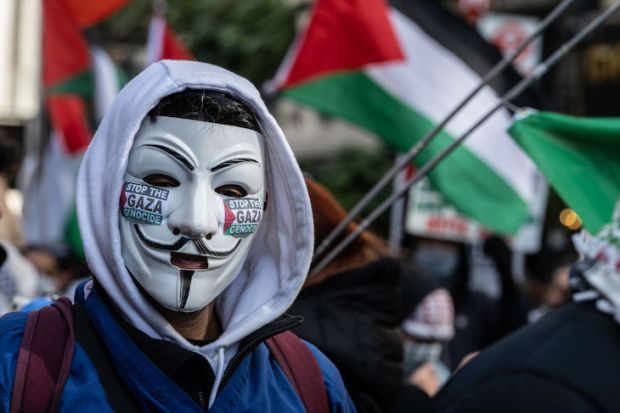

Protesters chanting ‘globalise the intifada’ will now be arrested, according to the heads of Greater Manchester Police and the Metropolitan Police. The announcement has been framed as a response to a ‘changed context’. But what it actually represents is an admission, belated and heavy, that the authorities spent years refusing to see what was directly in front of them.
The chant was never opaque. The intifadas were not metaphors or moods
The chant was never opaque. The intifadas were not metaphors or moods. They were campaigns of organised violence: shootings, stabbings, bombings, lynchings, buses torn apart, cafés turned into graves. And each individual terror attack, each ‘isolated’ act of violence with half a dozen or a dozen dead leads to the next, until one day a full scale atrocity unfolds with hundreds of people murdered in their homes, raped at a music festival, and kidnapped by savages. Suddenly, nobody knows how the signs were ignored. Suddenly, they see a ‘changed context’ requiring action.
That entire history travelled intact inside the phrase ‘globalise the intifada’. For many of us with even a few years of memory, it does not need decoding. Jewish communities said this clearly, again and again, in public, in meetings, in writing, in fear. They explained what those words had meant in Jerusalem, in Tel Aviv, in Haifa, and why hearing them shouted through London, Manchester and Sydney carried consequence rather than symbolism. These are words written in blood, carried across decades, still wet with memory.
They were waved away. Their warnings were treated as exaggeration or agenda. Police forces chose inaction. Media voices offered smug and patronising indulgence. Institutions preferred formulaic ambiguity to judgement. What followed was permission. A climate was allowed to thicken on British, Australian, and American streets, in the places where Jewish families walk, gather and pray.
This week, the same authorities declare that the meaning is now suddenly clearer. The line has now been crossed. Reality has now arrived. Language that was previously tolerated – entirely reasonable and gentle – has suddenly become actionable. That shift did not occur in the words themselves, of course. They have not changed, nor their meanings. It occurred in the difficulty to deny the truth brought about by the death of 15 more innocents slaughtered by Muslim terrorists. Did little ten-year-old Matilda really need to be sacrificed on the altar of tolerating hate chants?
The same refusal to recognise the dangerous truth has marked every stage of the past two years. In October 2023, clear footage from London showed demonstrators chanting ‘jihad’. The Metropolitan Police responded with the laughable, pathetic explanation that the word has ‘a number of meanings.’ Though they acknowledged that the public associates it with terrorism, they seemed wilfully blind to the fact that terrorists also associate it with terrorism. No offence was identified. Jewish alarm was noted, then set aside.
That posture has repeated itself in more grotesque form. In May 2021, a convoy drove deliberately through Jewish neighbourhoods in North London, waving Palestinian flags and shouting abuse. From a megaphone came the words ‘F*** the Jews’ and ‘rape their daughters’. It was shouted in English for all to hear. The incident was widely condemned. Arrests were made. Yet by November 2022, charges were dropped. No one was convicted. The message absorbed by both those targeted and the perpetrators was unmistakable.
The same indulgence has extended into places that ought to have triggered immediate alarm. In November 2023, Talk TV broadcast footage from inside British mosques showing sermons and prayers calling for harm, killing and destruction directed at Jews and Israel. Police assessed the material. Regulators reviewed it. In at least one case, police stated explicitly that no criminal offence had been committed. Review replaced enforcement. Concern replaced consequence. When calls for killing are recited as prayer, restraint becomes complicity.
Each episode has been treated as discrete. Together, they form a pattern. Language prepares the ground. It trains crowds. It lowers inhibitions. The first intifada did not erupt spontaneously. It was cultivated through chants, sermons and ritualised incitement. Stone throwing was celebrated. Stabbings were sanctified. Molotov cocktails were framed as duty. Hamas emerged from that environment and refined its methods with devastating effect.
That lineage is now being celebrated openly. Palestinian media mark the first intifada as a formative chapter leading directly to the October 7th massacre. They describe a progression ‘from stones to the flood’. They present violence as inheritance and instruction. This message circulates freely across borders, untranslated and largely unchallenged.
The same is happening even on the streets of Israel. In Jaffa, night marches now feature chants about redeeming the city ‘with spirit and blood’, celebrating death over coexistence and declaring Jewish presence illegitimate. These scenes echo earlier internal uprisings that escalated rapidly into synagogue burnings, lynchings and shootings. Israel learnt the hard way that tolerating violent chants and protests foments violent action and bloodshed. Impunity has a pedagogy. It teaches quickly. This is how it begins. It always begins this way.
Enough. Pretending that words float free of consequence has become an act of wilful blindness. When chants celebrate intifada, when crowds shout jihad, when men feel licensed to scream about raping Jewish daughters in the street, the meaning is plain. No contortions are required to see it. Only honesty.
This moment also demands clarity about sources. The Muslim Brotherhood and its offshoots have spent decades refining the language, structures and pedagogy that turn grievance into mobilisation and mobilisation into violence. Western states have treated this as an abstract concern, a foreign problem, or a matter of internal community debate. That indulgence has failed. The Muslim Brotherhood should be banned across the UK and the wider West, as it already is in multiple Arab states that understand its methods at close range. Radical Islamic teaching that sanctifies violence must be prohibited without apology. Hate preaching that incites harm against Jews, or against any non-Muslim, must be met with visible, decisive enforcement. There is nothing complex here and nothing shameful in drawing firm lines. A liberal society does not weaken itself by refusing to tolerate doctrines that glorify murder. It asserts itself.
Palestinian media mark the first intifada as a formative chapter leading directly to the October 7th massacre
Across the West, Jews are already paying the price. A Jewish scientist is shot dead in his home in the United States. A Jewish festival in Australia becomes the site of mass murder. Threats, harassment and violence intensify in British cities. Each incident is treated as isolated. The connective tissue is ignored.
What is demanded now is a real shift. Listening must replace dismissal. Recognition must replace procedural evasion. Jewish communities have shown restraint that borders on exhaustion. They have pointed to history. They have pointed to precedent. They have pointed to consequence. Each time, they were told the threshold had not yet been crossed.
This week’s decision concedes what was long denied. The threshold was always visible. It was simply ignored. The task ahead extends far beyond one chant. It requires treating declared threats as threats, applying the law with clarity, and abandoning the fiction that understanding arrives only after blood has been spilled.
The alternative is already familiar. Language hardens. Permission spreads. Violence follows. Allowing that sequence to continue is no longer an oversight. It is a choice.