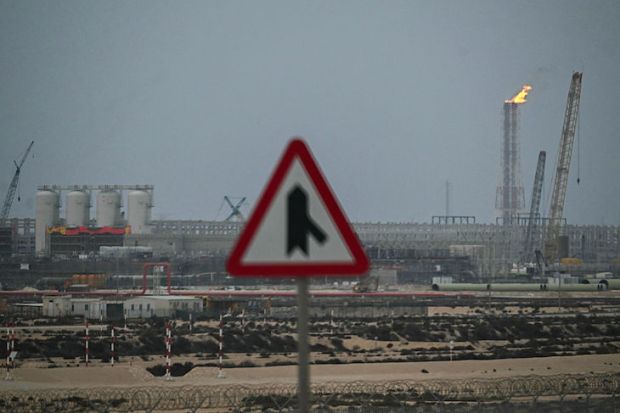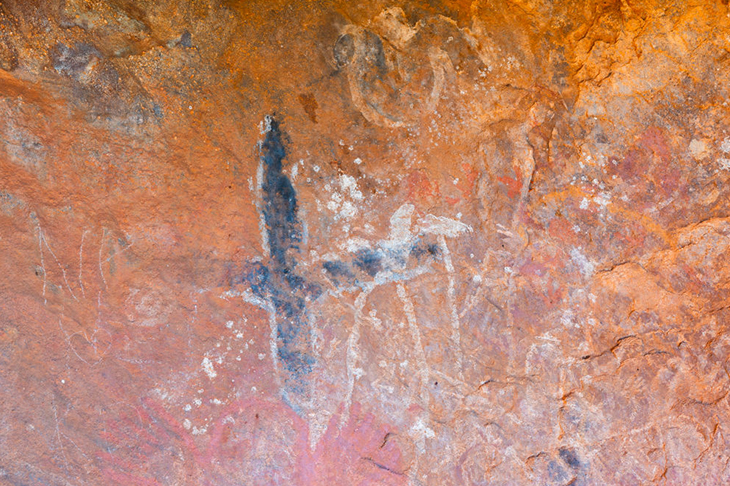
My wife and I enjoy watching Seven’s The Chase quiz show. I don’t know why, because many of the questions these days really put the trivial into trivia. But there you are. Every now and then a question comes up that piques my interest. Recently it was this: ‘Which mining giant, in 2020, destroyed the sacred Juukan rock shelters in Western Australia’s Pilbara region?’
That startled me because it shows just how far this modern myth has permeated our national awareness. It is no longer the province of Aboriginal activists, on one hand, and conservative commentators and Speccie readers, on the other. This impression was strengthened by the fact that the contestant got it right. It was of course – cue gnashing of teeth – Rio Tinto.
In 2019 I wrote Bitter Harvest, a demolition of Bruce Pascoe’s Dark Emu, which had, in the space of a few years, achieved the status of divine revelation about, previously unknown, Aboriginal agricultural tradition.
I believe the Juukan myth is set to rival Dark Emu in terms of its incurious acceptance by mainstream Australia. And it will overtake Dark Emu in its potential for damage. It promises to provide the emotional basis for increasingly outrageous demands for protection of Aboriginal heritage butt-ressed by the purported deeply spiritual attachment to country felt by Aboriginal people regardless of their mixed heritage.
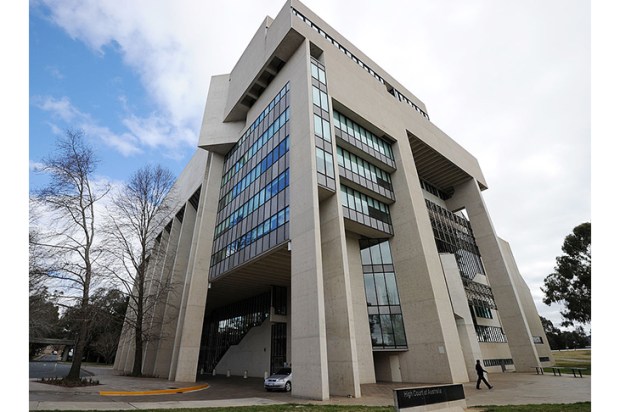
This doctrine gave us the absurd High Court decision that a part-Aboriginal New Zealand citizen convicted of a serious crime could not be deported from Australia to New Zealand because he had resided in Australia for many years and had a ‘spiritual attachment’ to the land.
This seemingly benign concept is particularly pernicious because it leads, inter alia, to the insatiable demand for the protection of Aboriginal heritage, something that plagues economic development, particularly in the resources sector. Mining companies have to tiptoe warily and expensively through the minefield of Aboriginal heritage.
Consider two simple propositions. First, mineral resources do not belong to mining companies, Aboriginal people, or the government, they belong to all Australians. Second, they should be exploited for the benefit of all Australians. They are not just critical to our prosperity, they are critical to our survival as a first-world nation.
In Western Australia, our largest source of mineral wealth, mining companies operate in tenements that cover large swathes of uninhabited and, in agricultural terms, unproductive land. The main challenge was the harsh, remote environment until, enter, stage left, Aboriginal heritage.
The Pilbara, for example, covers roughly half a million square kilometres with only a few small towns. The Aboriginal residents, around 8,000 people, live in some thirty communities.
Given that Aboriginal people have lived in the Pilbara for at least 46,000 years, there can hardly be a square inch where someone hasn’t camped at some time. Thousands of protected sites are registered, many uncovered by archaeological surveys commissioned by mining companies as part of their licence conditions under the West Australian Aboriginal Heritage Protection Act of 1974. In the Pilbara, the vast majority of these sites have been avoided by mining companies. Relatively few have been legally disturbed, but a few have been legally destroyed under the exemption provisions of Section 18 of the Act. Complying with these obligations is a costly business for miners.
The demolition in May 2020 of two rock shelters in the Pilbara, now known generically as Juukan, was carried out by Rio Tinto following the letter of the law in Western Australia despite last-minute pleas by the local Aboriginal community, the PKKP, that the shelters should be spared on the grounds that they were especially ethnographically significant to the Aboriginal people concerned. It was described as a national tragedy with international implications.
Juukan has become a byword for wanton destruction of priceless Aboriginal heritage as in, ‘We don’t want another Juukan.’ It caused such a stink that, less than a month later, the Morrison government established a parliamentary inquiry, under the aegis of the Joint Standing Committee on Northern Australia. That must be a record for government action.
I have studied the report, submissions and transcripts of public hearings of this inquiry and have come to the conclusion that it was a show trial.
Critical evidence was ignored, crucial witnesses were not called, and assertions as to the ethnological significance of the Juukan rock shelters were accepted as truth. The evidence of cultural significance presented to the inquiry was flimsy at best.
This is a complicated story but, in essence:
After decades of negotiation and billions of dollars of investment, Rio Tinto had been given agreement by the PKKP to affect the area concerned. The shelters, which contained no obvious ethnological significance such as rock paintings or extant cultural usage, were then marked for demolition, and this was approved by the WA government.
As part of the agreement, Rio Tinto commissioned an archaeological survey of the site. This survey uncovered significant artefacts that had been buried under two metres of earth, which were recovered and stored off site.
The PKKP then engaged the services of an activist anthropologist, who, at the very last minute, unearthed ethnological significance – previously unknown to the PKKP – that caused them to demand the demolition not proceed, but by this time the charges had been set and, despite some last-minute manoeuvering, the demolition went ahead.
These shelters had no geographical significance, they had no ‘Dreamtime’ myth associated with them, and they had no Aboriginal name. ‘Juukan’ was the name of an elder who had lived in the 1930s.
The inquiry, chaired by former Coalition MP Warren Entsch, did not ask for details of the newly discovered ethnological significance. They did not seek evidence from the members of the Aboriginal Cultural Management Committee which recommended to the Minister that he approve the demolition. The following will give you an idea of the objectivity brought to the inquiry by its Chairman.
At an early stage of the inquiry, and before he had heard evidence from Rio Tinto, Mr Entsch observed to the PKKP representatives: ‘All the evidence that you’ve given today suggests to me that you guys were well and truly stitched up right from the beginning of this.’
There was a stitch-up all right. Rio Tinto took the expedient way out and copped a plea, which cost the CEO his job. No doubt they considered this a small price to pay to keep the government happy. But it’s hardly conducive to protecting the interests of the mining industry and, more importantly, the interests of all Australians.
Make no mistake, ‘protection of Aboriginal heritage’ is a serious threat to our economy. Added to environmental and climate change lawfare, it acts, to put it in military terms, as a powerful force multiplier. And coupled with the grotesque Victorian treaty legislation, it threatens to stop, in its tracks, any meaningful development in that state for the foreseeable future.
The fact is that the mining industry pays billions of dollars in royalties and other benefits to Aborigines, partly in consideration of damage done to – often spurious – heritage sites. And the most spurious of them all is Juukan.
Got something to add? Join the discussion and comment below.
You might disagree with half of it, but you’ll enjoy reading all of it. Try your first month for free, then just $2 a week for the remainder of your first year.