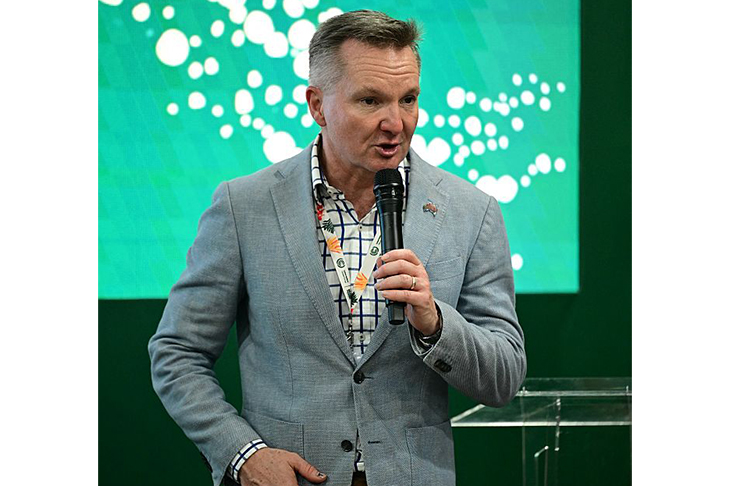
Australia’s retreat from hosting Cop31 has sparked disappointment and relief in equal measure, the relief being that the nation has narrowly sidestepped an invoice large enough to fund a moon landing. Yet even that paled beside the real shock: the appointment of Chris Bowen as the United Nations’ Cop31 President of the Negotiations.
In this new role, Bowen announced that the world must renounce fossil fuels and move to renewables. This includes, the world renouncing the purchase of Australia’s coal and gas exports which were worth $240 billion in 2023, and on which Australia’s tax revenue and prosperity rely.
For Australians who have endured two decades of Bowen’s relentless policy adventurism, the idea of him presiding over global climate talks is both grimly amusing and economically terrifying. It feels like watching the pilot who captained the Hindenburg being put in charge of international aviation safety.
Were it not for the damage which Australia is already suffering from, the prospect of Bowen unleashing upon the world the same carnage he has inflicted at home might almost qualify as a form of cosmic schadenfreude. Bowen is not a hapless minister stumbling into mishaps. Quite the opposite. He is ruthlessly efficient at getting things done. The difficulty is that what gets done is often catastrophically misaligned with the interests of Australia and Australians.
He approaches every portfolio with the zeal of a missionary convinced he is ushering in a better world. Unfortunately, the rubble left behind is always someone else’s long-term problem. His early career as minister for human services and assistant treasurer established the pattern that would follow him. Bowen arrived like an evangelist for expanded bureaucracy and sweeping structural tinkering. Then came immigration.
Australia was already grappling with asylum arrivals and mounting detention pressures yet, as immigration minister, Bowen’s decisions turned a difficult situation into a rolling crisis. Under his two-year tenure, 398 boats arrived carrying more than 24,000 illegal entrants; nearly half the total that arrived under the entire Rudd-Gillard-Rudd period. Detention centres overflowed like burst pipes and new facilities sprouted in panic-driven succession. Approximately 1,200 people drowned under Labor in their attempt to come to Australia.
Bowen himself was constantly active, constantly present, constantly earnest. The only thing he failed to deliver were the outcomes he broadcast with absolute confidence.
His brief but consequential stint as federal treasurer carried the theme forward. He proposed a new bank tax during a period of economic anxiety and somehow managed to worsen the jitters. Then came the crowning jewel of his political career before his current portfolio: his starring role in detonating Bill Shorten’s 2019 election campaign.
Bowen championed a tax agenda so misconceived, so interventionist and so oblivious to political reality that it made Gough Whitlam look like a patron saint of fiscal prudence. His proposal on franking credits alone vaporised entire blocs of potential swing voters.
His bold taunt that those who disliked the policy agenda were welcome to not vote for Labor was interpreted with far more enthusiasm than he anticipated. The resulting electoral defeat was so severe that strategists still whisper about it with the hushed reverence usually reserved for paranormal encounters.
Having secured a form of political redemption as Energy Minister in the Albanese government, Bowen has continued his lifelong devotion to large scale disruption in pursuit of sweeping visions. His policies have rattled electricity markets, spooked investors, driven up household bills and left regional communities bracing for vast uneconomic transmission projects linking numerous renewable energy sites marketed as though they were gifts from the future. His broken promise to cut energy bills by $275 has left the Australian public bamboozled.
The energy transition Bowen champions is undeniably ambitious, despite not having resulted in significant carbon dioxide emissions reductions so far. In lockstep with global failure, all of Bowen’s multi-billion-dollar green hydrogen projects have failed. In a worldwide pattern, investors are pulling out of offshore wind farms as quickly as they can. The infrastructure and technology required to deliver it are derived from China. The expanding gulf between the soaring rhetoric and the constrained reality has become the defining characteristic of Bowen’s stewardship.
Households feel the cost pressures. Businesses feel the instability while industry closes or moves offshore. Bowen feels the warm glow of ideological certainty. And despite the mounting evidence, he marches on undermining any alternative that cannot be squeezed into his renewables-centric worldview.
Bowen has spent virtually his entire adult life inside the sheltered tent of taxpayer-funded politics. From local councillor, to mayor, to political adviser, to MP, to minister. He has never needed to withstand the real-world consequences of the systems he remodels. Now this career-long architect of bold but frequently chaotic policy frameworks is preparing to preside over global climate negotiations where a key goal is the elimination of Australia’s fossil fuel exports.
One day Bowen will retire into the cocoon of a generous inflation-indexed parliamentary pension insulated from the market realities he often disregards. The symbolism is difficult to ignore.
The Cop31 role he now assumes demands diplomacy, patience and the capacity to listen deeply to competing national priorities. These qualities do not appear prominently in his career portfolio. Bowen is not a champion of careful incrementalism. He prefers grand transformations and prophetic declarations delivered with the fervour of a revivalist preacher.
Australians know this man well. They have watched him move mountains of paperwork, push through enormous programs and repeatedly fail to ensure that those programs deliver the benefits conjured in the ministerial suite.
Whether the world ultimately applauds Bowen or rues his elevation is still uncertain. But if the past two decades offers any indication, the international community might want to tighten its seat belt.
Because when Chris Bowen strides onto the global stage with a vision in one hand and a megaphone in the other, the turbulence does not simply rattle the cabin. It tears open the overhead lockers, throws the snacks across the aisle and leaves the passengers wondering how on earth was this guy allowed anywhere near the cockpit in the first place.
Got something to add? Join the discussion and comment below.
Dimitri Burshtein is a Senior Director at Eminence Advisory. Peter Swan AO is professor of finance at the UNSW-Sydney Business School.
You might disagree with half of it, but you’ll enjoy reading all of it. Try your first month for free, then just $2 a week for the remainder of your first year.