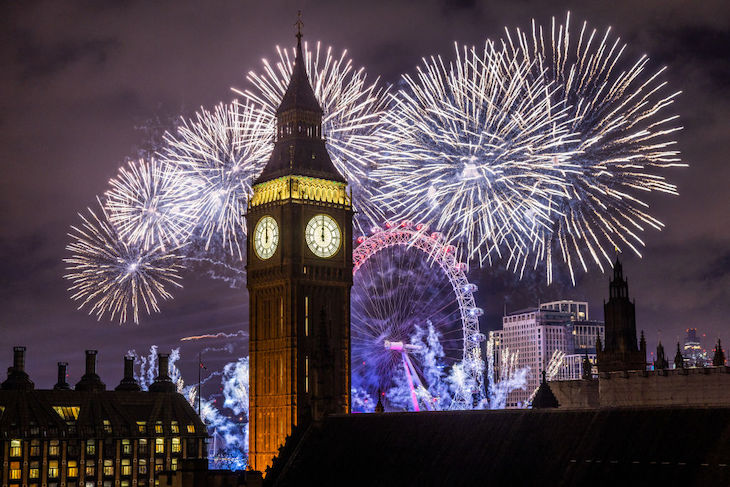
New Year’s Eve is the party we don’t need but can’t get rid of. The location varies according to geography. City-dwellers gather in public squares and cheer at midnight as the skyrockets explode overhead and add more fumes to the blanket of urban smog. In the countryside, revellers meet in freezing farmhouse kitchens and drink bathtub gin while grumbling mutinously about soaring taxes and declining freedoms.
Compared with Christmas Day, the procedure is maddeningly vague. There are no special dishes or designated drinks
In Britain, the festivities have a distinctly Caledonian flavour. Hogmanay is a Scots word of uncertain origin. The theme tune, ‘Auld Lang Syne’, means something like ‘past time’ or ‘time long since.’ Robbie Burns wrote the lyrics and everyone promptly forgot them – apart from the opening line. For obscure reasons, the anthem is sung by revellers holding their arms across their chests and grasping the hands of both their neighbours to create a circle of unbroken contact. This eccentric rite is never taught, discussed or explained to anyone. And yet everyone knows how to do it.
We have nothing specific to celebrate on 31 December. It’s a funeral that becomes a birthday at the stroke of midnight. One year ends and another begins. And everyone is 12 months closer to being dead – which is hardly good news. The inventive Chinese name each year after a cuddly creature or a mythological beast but we westerners use four digits, 2026, like a PIN number. Why are we getting excited about a pass code?
Compared with Christmas Day, the procedure is maddeningly vague. There are no special dishes or designated drinks. Gifts may or may not be exchanged. Party games are optional. Buffet nibbles are good enough and a sit-down meal looks a bit needy. Timing is important. If you write ’10 pm till late’ on your invitation you may have an empty house until 11.30pm when a gang of thirsty drunks will arrive on your doorstep. An earlier starting point, ‘7.30pm for 8pm’ creates a four-hour void with nothing for the guests to do but get smashed and talk rot. Large quantities of booze are essential, the cheaper the better. And that means punch. The basic ingredients are sugar, rum, ginger and a lot more sugar. The recipe for napalm is not dissimilar. Some hosts treat the punchbowl as a recycling basin for the disposal of leftover beverages like ruby port, crème de Menthe, cooking sherry, home-made pear wine and even cough mixture. If the punch is pre-heated it’s less likely to poison you than the chilled variety. As your host ladles the concoction into your goblet, prepare for the experience in a spirit of adventurous forgiveness. If it tastes like tractor fuel and causes hallucinations, you’ve got off lightly.
Your challenge at the party is to converse politely with your host’s misshapen neighbours and inbred relatives. There’s nothing to say, of course, apart from the seasonal inanities like ‘did you eat turkey or goose?’ and ‘what are your new year resolutions?’ Be imaginative here. Don’t bore people by explaining your new seaweed diet or your ambition to take up gymnastics and do the splits by Easter. The Dry January pledge is so out of date that it’s almost due for a revival – but not quite yet. Declaring that you plan to cancel your TV licence is as normal as changing your energy supplier. Not worth mentioning. Resist the temptation to use your resolutions as a chance to boast. ‘I’m making do with a smaller yacht this year,’ or ‘I’m giving all our gardeners a six per cent pay rise.’ Everyone will see through these self-aggrandising ploys. If you want to create a real stir, you could announce a new habit that will improve your character and add to the sum of human happiness. As follows.
‘Tomorrow morning, I’m throwing away my phone to encourage my children to do the same.’
‘I’m taking a litter-picker with me each time I walk the dog.’
‘I’m volunteering to teach literacy at a young offenders’ institute.’
‘I vow to stop typing “Keir Starmer affair with” into Google.’
‘When a vagrant starts begging on a train, I’m going to leap up and organise a whip-round.’
These are fantasies of course. No one wants to start 2026 by helping anyone else. Let’s continue as we were.
Attending a New Year’s Eve party is optional but even the hermits and the refuseniks like to mark the stroke of midnight in some way. You’ll understand this urge if you’ve ever arrived at a failing New Year’s Eve party and tried to escape but found your exit route blocked by your smiling host. He doesn’t want you to leave. And he has a trump card to flourish. ‘Stay for the bongs,’ he says. And that’s it. The bongs are your inescapable duty. You have to stick around and join in the countdown and shout ‘hurray’ when the first chime rings out.
The same rite is being observed all around the world. A simultaneous display of reverence for a ticking clock. That’s the essence of New Year’s Eve. Time itself becomes our idol. This brings us satisfaction because the stroke of midnight may not be delayed or cancelled by any earthly power. No president or oligarch can prevent the universal stopwatch from grinding onwards, adding years to our age and wrinkles to our skin, and driving us towards the grave. And the process offers us a kind of comfort. Good timekeeping binds us together. Punctuality creates order and certainty. We arrive at work at 9am and we feel that our job is secure, our income is guaranteed and our home is safe. And on New Year’s Eve, we come together to celebrate our willing enslavement to this implacable deity. Every single member of the human race genuflects in honour of the same benign despot. And we recite the numbers in reverse, from ten to one, as a kind of plainchant. For a tiny moment, we turn into monks in an abbey that spans the globe.