To most modern Britons the words ‘Yule Log’ probably bring to mind that masterstroke of marketing that has enabled supermarkets to sell an ordinary chocolate roulade (with the addition of a plastic sprig of holly) as a speciality item for the Christmas table.
But the edible Yule Log of our own day – to an even greater extent than the meat-free mince pies of modern Christmas – is a mere shadow of what it once was. The original Yule Log was an actual log – in theory, an enormous one that was large enough to burn between Christmas Eve and Twelfth Night (5 January). Its evocative name preserved the pre-Christian Old English word for the midwinter festival, Geol.
The wide diffusion of Yule Log traditions across the Germanic, Baltic, Finnic and Slavic worlds – and even as far afield as Spain and Italy – suggests we may be dealing here with a shared Indo-European tradition
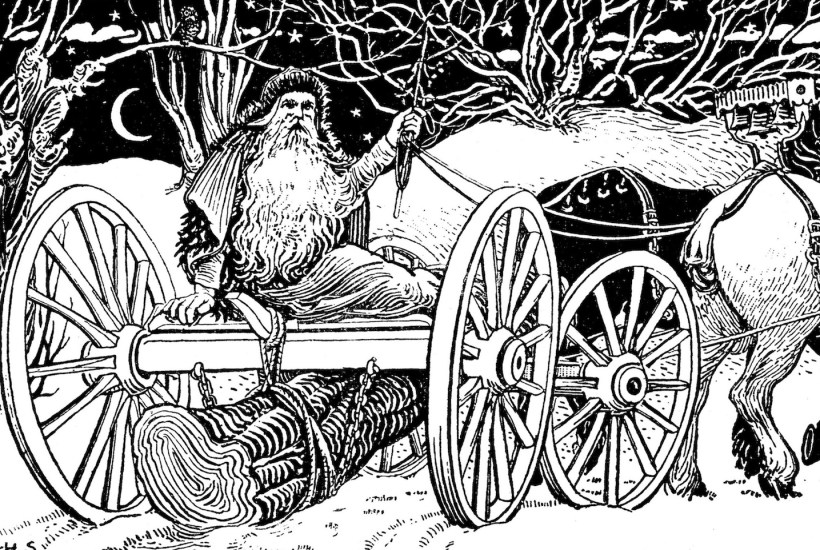
The arrival of the Yule Log (on Christmas Eve) was at one time a moment of great festivity accompanied with singing and dancing – the early modern equivalent, perhaps, of the arrival of the Christmas tree in a 20th-century household. Some Yule Logs were so large that they left a permanent mark. In one Shropshire farmhouse horses had to pull the log to the kitchen hearth, leaving a path of broken flagstones that were shown to the folklorist Charlotte Burne in 1845. However, in most households the Yule Log was probably more modest. Only a few households could afford to cut down a whole tree (or obtain permission from a landowner to do so). The Somerset tradition of burning the ‘ashen faggot’ (a bundle of ash saplings), which until recently was maintained every 5 January at the King William IV pub in Curry Rivel, may be more reflective of the customs of ordinary people.
According to one story, the ashen faggot is burnt because Mary used ash to light the first fire after Christ’s birth to warm her newborn child. It was crucial to the British Yule Log tradition that it be lighted from a small piece of the previous year’s Yule Log. This aspect of the custom suggests it had pre-Christian origins, perhaps linked with traditions of perpetual fire. Pieces of the Yule Log (or ashen faggot) that survived the fire were considered lucky, and provided a protection against witchcraft throughout the following year. Curiously, a bundle of ash twigs was found inside the tomb of Richard II in Westminster Abbey when it was opened in 1871 – as if the notoriously superstitious Plantagenet king was seeking protection even in death.
The oldest uncontested mentions of Yule Logs in Britain date from the 17th century. But the wide diffusion of Yule Log traditions across the Germanic, Baltic, Finnic and Slavic worlds – and even as far afield as Spain and Italy – suggests that we may be dealing here with a shared Indo-European tradition.
Latvians were reportedly worshipping the Yule Log as a god (called Bluķķu) in the early 18th century. On 24 December they would drag the god around the village. Libations of beer would be poured into a hole in the log, which was sometimes carved with a human face. Later, when the log had been brought indoors, four fires would be lit in each corner of the room and hay, bread and fire were offered to Bluķķu. It is possible that the Latvians, who were among the last pagans in Europe, preserved older traditions in which the Yule Log was a god. On the other hand, the Latvian word bluķis came from the German Block (‘block’), which could mean the Latvians borrowed the Yule Log custom from Germans rather than preserving their own pagan tradition. Curiously, in parts of Yorkshire the Yule Log is still the ‘Yule Block’.
Writing in 1725, the antiquary Henry Bourne (who collected folklore in the northeast of England) thought the Yule Log was a pagan Saxon custom, and that its burning represented the returning sun hailed at the midwinter festival – but this was nothing more than speculation on his part. While the Yule Log may have pagan origins, it is perhaps better understood as the wooden equivalent of a goose or turkey – a special treat for the Christmas season, relieving the misery of midwinter. After all, in times past it was no small thing to have sufficient firewood to last the Twelve Days of Christmas, and nothing symbolised conspicuous plenty like an enormous log.
Except in a few locations such as the far north of England and the southwest, the Yule Log does not seem to have survived the rise of coal in the mid-19th century. Perhaps because it requires a large hearth, it is not the Yule Log but the German tradition of bringing trees into houses that has endured at Christmas.