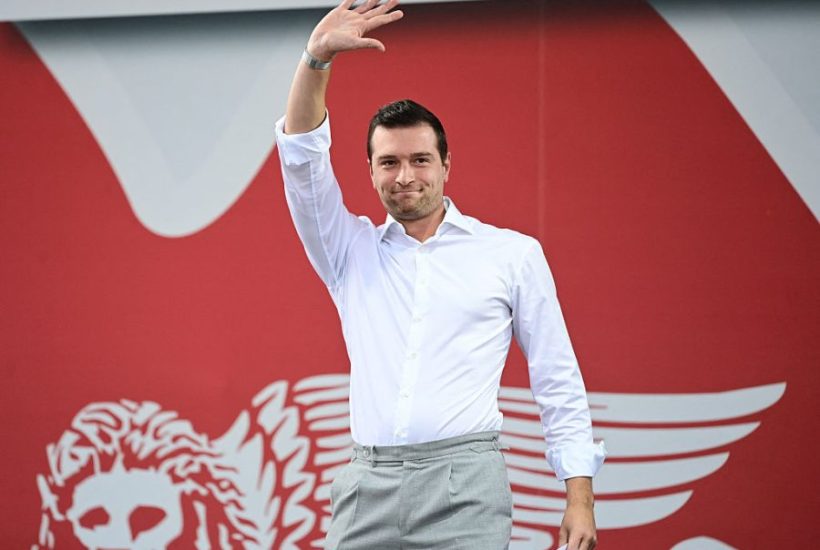
France’s Jordan Bardella has promised to stop the boats. Now where have we heard that before? The president of Marine Le Pen’s National Rally made his boast on a day trip to London on Tuesday. After lunching with Reform UK’s Nigel Farage, the 30-year-old outlined his strategy for curtailing the passage of illegal immigrants between France and England.
‘My ambition is to make France the least attractive country for mass immigration in Europe,’ explained Bardella. ‘From there, if it is no longer possible to cross, then there will be no one left in Calais.’
Bardella said he will make France unattractive for migrants by abolishing the right of asylum, expelling foreign criminals and giving French citizens priority to social housing and welfare. He also vowed to hold a referendum on immigration, saying that ‘I’m in favour of a total overhaul’.
Retailleau was thwarted at every turn by the blob
These are bullish words from Bardella – but he knows this overhaul is impossible without first defeating ‘Le Blob’. It is the unelected blob that runs France, a blob composed almost exclusively of bourgeois Socialists who are the ideological children of the student protestors of 1968. The president of the Constitutional Council, for example, is Richard Ferrand, a former member of Socialist party and a Macron loyalist. He was appointed by the President earlier this year for the fixed nine-year term, replacing Laurent Fabius, the Socialist former prime minister of France in the 1980s.
The Council of State and the National Audit Office are also run by Socialists, and the political leanings of the judiciary are well known. ‘Red Judges’ was how Bruno Retailleau described one magistrates’ union earlier in the year when he was the exasperated minister of the interior. This was the same union who, on the eve of last year’s parliamentary election, issued a statement calling the country to mobilise to prevent a National Rally victory.
When Retailleau was appointed the minister of the interior in September last year it was to much fanfare from conservatives. Finally, they said, we have one of our own in a position of influence.
Retailleau was considered to be a new, right-wing rival to Marine Le Pen. This was on account of his support for a referendum on immigration, his promise to deport people in the country illegally and his desire to ban the Muslim Brotherhood. Le Pen’s party were rattled by his appointment. One of her inner circle admitted that ‘if he starts getting results… we’ll really have to start worrying.’
But Retailleau didn’t get any results. He tried, but he was thwarted at every turn by the blob. One example was the bill he championed in parliament that extended the maximum length of detention for foreigners considered a risk to the public. The Constitutional Council was, however, aghast at the idea of increasing the detention from 90 to 210 days and struck down the bill. Retailleau expressed his ‘extreme concern’ at their ruling.
Bardella frequently accused Retailleau in public of failing to live up to his promises but in private he must have known that he tried his best. He was beaten back by the blob. It is a taste of what lies in store for the National Rally in the event they win presidential and parliamentary power in the 2027 elections, as the polls suggest they will.
In 2024, Fabius warned the National Rally in an interview that his institution is ‘the bulwark of the rule of law’. He claimed that Le Pen’s party ‘want to threaten the rule of law’ but he would not permit them. Le Pen retorted that it was Fabius who was ‘violating the rule of law’ because the Constitutional Council should always be impartial and neutral.
But the blob is neither of these things. It doesn’t care if 72 per cent of French people want a referendum on immigration because they believe it is out of control; nor does it take much notice of the 86 per cent of the people who believe foreign criminals should be incarcerated while they await deportation.
These views are incompatible with their own and so they are dismissed. The same goes for the Council of State. Bardella says he is in favour of ‘pushbacks’ – European vessels pushing back migrant boats – whether it is in the Channel or the Mediterranean. At the moment France is incapable of deporting radical Islamists considered a threat to national security by their intelligence services. When the government tried to deport an Uzbek national in 2023, the Council of State ordered his return because his life was in danger in his homeland. In a speech in London earlier this year, Retailleau described this case as an example of how ‘the law is turning against the law’.
Winning power at the ballot box will only be half the battle for the National Rally; in fact, that may be the easy part. Implementing their programme will be the greater challenge. There will almost certainly be resistance on the streets from the extreme left and resistance in the institutions from the blob. Bardella is likely to discover, as others have before him, that stopping the boats is not as simple as it sounds.