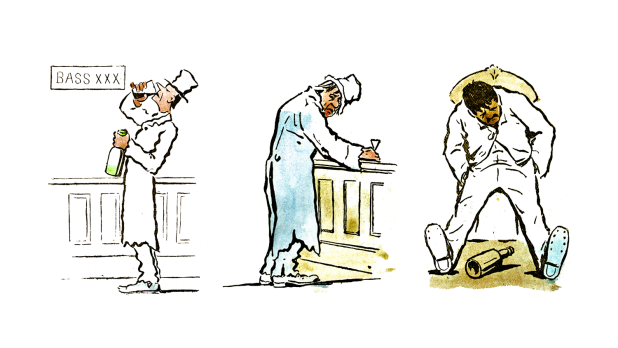
The first time I got drunk was at a wedding. I was 12 or thereabouts and sick in the taxi on the way home. I’d like to say that set the pattern for my behaviour at weddings thereafter, but it goes way beyond that. (My Uber rating is not good.) I acquired a taste for alcohol that’s stayed with me ever since. Other intoxicants have come and gone, but I’ve always returned to my first love.
Which, to be clear, is wine. That first illicit tipple was Babycham – which is basically wine, right? – so perhaps my lifelong passion has been an attempt to recreate that childhood pleasure. As madeleines were to Proust, Babycham is to me. Not that I drink the revolting muck now. These days my taste runs to the pricier stuff. Caroline says it’s a toss-up which outcome my love of wine will bring about first – death or bankruptcy. My money’s on bankruptcy, although my alcohol-befuddled brain can’t work out whether it’s possible to bet on bankruptcy, because if you win the bet…
I used to be perfectly happy with a £10 bottle of plonk, but I was ruined by a rich friend who started inviting me shooting at his grouse moor in Northumberland and served eye-wateringly expensive wine. It was there that I was first introduced to good mature Bourdeaux – 1982 Lafite, for instance. At pudding time, out came the 2001 Yquem; the next morning, at elevenses, unlimited Rousseau, still my favourite red Burgundy. I had occasionally turned left on a plane before, and that made turning right difficult, but this was more like hopping on a private jet. After that, the Wine Society claret lost some of its lustre.
At the beginning of last year I gave myself permission to splurge on some good Bordeaux by vowing to limit my drinking to 100 bottles a year. If I was going to be so abstemious, I reasoned, I might as well confine myself to the good stuff. (Amazing how easy it is to convince yourself to buy expensive wine.) Needless to say, I drank the lot in three months.
These days my taste runs to the pricier stuff. Caroline says it’s a toss-up which outcome my love of wine will bring about first – death or bankruptcy
I really can’t go back to turning right, but I try not to spend more than £50 on a bottle. My everyday wine is usually a good second: a 2016 Lacoste Borie or a 2015 Segla, both of which can be bought for less than £40. I also have a supply of ‘special occasion’ wine, like 2010 Grand-Puy Lacoste and 2009 Domaine de Chevalier – both in the £80 range. But I only allow myself to drink that when QPR win, so 12 bottles can easily last a year. Actually, that’s a little unfair on my beloved Rs, who have already chalked up seven victories this season. But getting through 12 bottles is vanishingly unlikely.
My latest wheeze for cutting the wine intake is to go ‘on the jabs’. I’ve been taking Mounjaro since the beginning of the summer and, for the first few months, it had the ancillary benefit of reducing my appetite for alcohol as well as food. Even good Bordeaux tasted a little bland, and after a few glasses I began to feel dizzy rather than elated. But the trouble with GLP-1 weight-loss drugs is that you build up an immunity, meaning you have to increase the dosage if you want to keep shedding the pounds. Having lost a stone, I don’t want to lose any more so have stayed on a low dose. The result is my desire for wine has come roaring back.
The one saving grace is that another side effect of Mounjaro is insomnia, which I can treat by drinking exactly half a bottle of red. Anything less and I struggle to get to sleep; anything more and I wake up after a few hours feeling dehydrated. You might not think of half a bottle a day as particularly moderate, but I maintain that it’s actually better for you than drinking nothing, something I learned from a book called The Good News About Booze by Tony Edwards. The jokey title belies the fact that his upbeat conclusions are based on a forensic examination of all the medical studies purporting to show alcohol is bad for you, discovering lots of health benefits buried in the appendices.
With Christmas approaching, I’m planning to come off the jabs so I can enjoy the feasting in full. Last year a generous friend gave me a half-bottle of 2009 Yquem and I shared it with Caroline and the children on Christmas Day, dividing it up six ways. Charlie was then 16 and, having seen his father drunk on too many occasions, had avoided alcohol entirely until then. I persuaded him to try some of the honeyed ambrosia, thinking it would be a far better introduction to lifelong oenophilia than Babycham. But he was unimpressed. ‘It’s like liquid sugar,’ he said, pushing the glass aside. I was disappointed, but also pleased because it meant I could drink the rest. This must be how heroin addicts think.
I was tempted to give myself the same present this year, but when I saw the price – £299 – I balked. Not that I was worried about the kids’ university tuition fund. ‘That’s the same price as a half-case of 2016 Chateau Gloria,’ I thought, another of my everyday tipples. So instead I ordered some 2010 Suduiraut, a less ruinous Sauternes. According to Wine-Searcher, my favourite app, that vintage gets an average of 94 points from the critics.
For the main course – roast beef, not turkey – I’m going to dust off my last magnum of 2009 Grand-Puy Lacoste, an even better vintage than the 2010 in my view, although both are 94 pointers. The magnum should be enough, given that Caroline and her mother prefer white with Christmas lunch (a bottle of 2020 Olivier Leflaive Puligny-Montrachet for them) and Charlie won’t be drinking. The challenge will be to stop my two other sons, who take after their father, from guzzling it. ‘It costs £5 a gulp,’ I’ll cry. ‘For god’s sake, savour it.’
I’ve written this as if my addiction to wine is a curse, when the truth is I feel more ambivalent about it. The expense, even with these second-tier bottles as opposed to premier league, is crippling. I’ve just done my 2024-25 tax return and I spend more on wine than I do on my mortgage. More seriously, I cannot pretend I always limit myself to half a bottle. I often think of Christopher Hitchens, with whom I spent many an evening drinking, who died of oesophageal cancer aged 62 – my age now. All that fire-water he poured down his throat must have been a contributory factor.
But then, nothing else in life has given me so much pleasure. Like Rudolph, my nose may turn red this Christmas, but my taste buds will be enveloped in silky tannins, dark fruit and wisps of smoky caramel. Would life be worth living without any wine in it? I suspect not.
Got something to add? Join the discussion and comment below.
You might disagree with half of it, but you’ll enjoy reading all of it. Try your first month for free, then just $2 a week for the remainder of your first year.