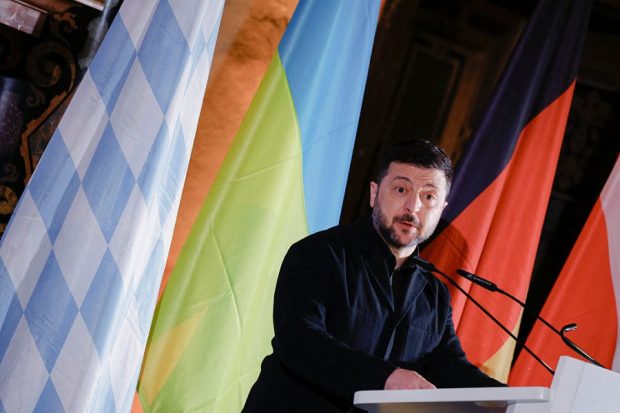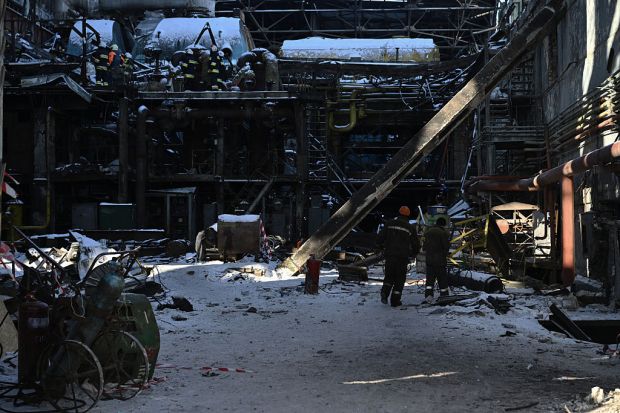
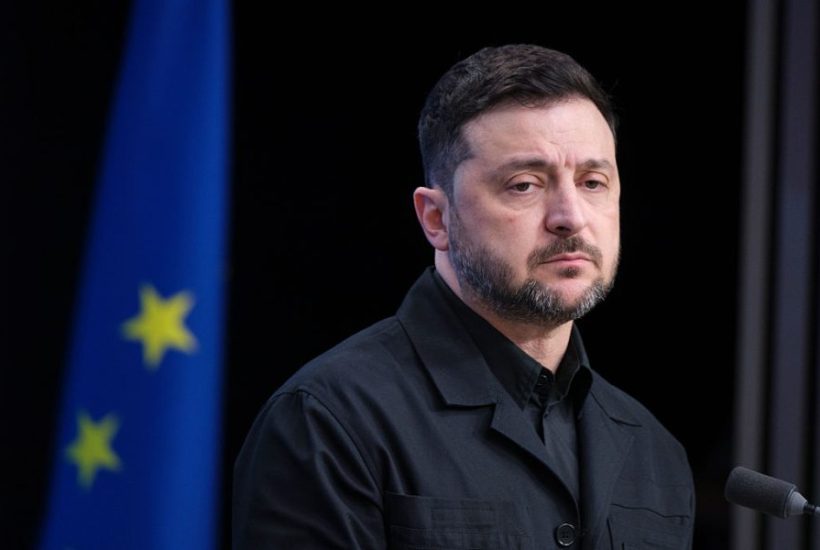
Russia started the war on Ukraine, so Russia should pay for the damage it has wrought. Such was Volodymyr Zelensky’s forceful message to European leaders last night as he pleaded for a ‘reparations loan’ backed by the €190 billion (£167 billion) of Russian Central Bank capital frozen in a Belgian clearing bank since Putin’s full-scale invasion. ‘Just as authorities confiscate money from drug traffickers and seize weapons from terrorists, Russian assets must be used to defend against Russian aggression and rebuild what was destroyed by Russian attacks,’ Zelensky told his European allies. ‘It’s moral. It’s fair. It’s legal.’ But after negotiations that went late into the night, Europe ultimately shied away from grabbing Russia’s money. Instead, the continent’s leaders have agreed to collectively raise a smaller loan of €90 billion (£79 billion) to keep Ukraine’s war effort afloat.
The Kremlin has its own ways to retaliate if Europe seizes its sovereign capital
Talks failed after several key allies disagreed about the ‘legal’ part of Zelensky’s plea. Russia is not in a state of war with Europe or any other country other than Ukraine. There is no international court, nor any clear legal mechanism, for confiscating the €290 billion (£250 billion) in sovereign assets that the Kremlin has deposited worldwide (including some £24 billion in the UK, €17 billion (£15 billion) in France and $5 billion (£3.7 billion) in the US). The prospect of forcing Russia to pay war reparations is non-existent until the Kremlin is actually defeated – which at the moment appears unlikely. So when the war eventually ends, Moscow will sue to have its money returned – and under Belgian law, it would win. That, argued Belgium’s Prime Minister Bart De Wever, would leave his country liable for the whole sum unless European leaders agreed to mutualise the debt – in other words, to guarantee the reparations loan with their own money. They declined to do so, instead compromising on a smaller collective loan drawn only on countries that opted in and left Russian money untouched.
The heated talks in Brussels pitted Ukraine’s most passionate supporters from Scandinavia, the Baltics, Poland and Germany against the less belligerent and more cautious Italy, plus the usual Ukraine-sceptical Hungary and Slovakia, as well as Bulgaria, Malta, and Czechia and Belgium itself. ‘Italy obviously considers sacrosanct the principle that Russia should primarily pay for the reconstruction of the nation it attacked,’ said Italian prime minister Georgia Meloni, who has been a passionate supporter of Kyiv but who unexpectedly emerged as a leading opponent of the reparations loan. ‘But this result must be achieved on a solid legal basis.’ Simply confiscating the assets of enemies is not something a civilisation that claims to uphold the rule of law can do without undermining the very principles it claims to be defending.
German Chancellor Friedrich Merz had insisted that the reparations loan was Europe’s ‘only option’ to support Ukraine and that using the Russian assets would be ‘a sign of strength and determination’. But Merz overlooked another, rather more obvious option – that Europe could actually find the money to support Ukraine itself out of its collective €17.9 trillion (£15.6 trillion) annual GDP.
‘Now we have a simple choice: either money today, or blood tomorrow,’ was Polish Prime Minister Donald Tusk’s stark warning. ‘I’m not talking about Ukraine only, I’m talking about Europe.’ But if Tusk is right and Europe indeed faces an existential security threat from a resurgent Kremlin, how come EU members cannot reach into their own budgets to support Ukraine’s plucky defence of their continent?
Yet debate there was. Usually the European Council makes all its decisions by unanimous vote. But European Commission President Ursula von der Leyen – who earlier this week controversially invoked emergency EU legislation to freeze the Russian funds indefinitely – made the reparations loan a matter for the rarely-used Qualified Majority Voting (QMV) which requires 55 per cent of member states representing 65 per cent of the EU population to pass a motion. In the end, even this procedural manoeuvring failed to get the reparations loan across the line.
There has also been intensive lobbying from the US, where the latest round of ongoing top-level talks between the Kremlin, White House representatives and the Ukrainians are scheduled for this weekend in Miami. All week, Donald Trump’s team have reportedly applied behind-the-scenes pressure on European partners to drop talk of a reparations loan and leave the negotiators around the table in Miami free to use the Kremlin’s frozen assets as a pawn in their diplomatic horse-trading. The Daily Telegraph reported yesterday that Germany’s Merz had persuaded the Trump team to remove the return of Russia’s billions from its latest peace proposal. But that will not stop the Russians from asking for their money back, either as part of a peace deal or in court.
Moscow, for its part, this week launched an early legal salvo against Euroclear, the Belgian clearing bank that currently holds the lion’s share of the Russian Central Bank’s euro reserves. As a result, the international risk agency Fitch announced it was putting Euroclear on ‘ratings watch with negative outlook’. Since Euroclear also holds Chinese, Qatari and Saudi sovereign deposits, some key European leaders, including Emmanuel Macron, have warned that a raid on Russian money could trigger a major exodus of other international capital to safer havens such as the dollar. That in turn could herald a crisis in confidence in the euro itself, driving up borrowing costs and triggering a fiscal panic that the massively indebted continent can ill afford.
The Kremlin also has its own ways to retaliate if Europe seizes its sovereign capital. By various estimates there are between $127 and $288 billion (£95 and £215 billion) worth of Western assets still trapped in Russia. According to the Kyiv School of Economics (KSE) some 2,315 Western companies that are still actively operating in Russia, including Austria’s Raiffeisen and Italy’s UniCredit banks. BP still owns a 19.75 per cent stake in the oil giant Rosneft, while the Financial Times reports that the US investment giant JP Morgan has around $2.5 billion (£1.9 billion) still invested in Russia. Foreign companies earned a tidy $19.5 billion (£14.6 billion) in profits in Russia last year, KSE reported – but under wartime legislation, they are unable to take those profits out of the country. The Kremlin could easily confiscate those assets in a tit-for-tat – paradoxically leaving Putin cash-richer than before, since the funds in Europe are frozen but the capital of Western businesses in Russia is within his reach.
The bottom line for Ukraine is that its economy and war effort rely entirely on Western aid – and with funding from the US cut off by Trump since February, in practice that means that Europe must find a way to foot the bill. Just to maintain current levels of spending, Ukraine requires some €137 billion (£120 billion) in 2026 and 2027. But even the €140 billion (£123 billion) reparations loan that failed this week would not have been a silver bullet to fix Kyiv’s financial black hole. Europeans insisted that €45 billion (£39 billion) of the money be used to pay back a loan made in November 2024, knocking the net payout down to €95 billion (£83 billion). Another chunk would also have gone on expensive armaments from Germany, France and Sweden, all of whom have signed massive arms deals with Zelensky that would have ensured that a large slice of the reparations loan would have ended up in the pockets of European arms manufacturers.
With the reparations loan dead, or at least stalled, Kyiv’s financial life support has become more precarious than ever. The Americans continue to attempt thrashing out peace, while Europe has plumped for continuing to fund the war. That leaves Ukraine living, quite literally, on borrowed time.