Did you follow that story about the Deputy Vice-Chancellor (Human Resources) of the newly created Adelaide University (a combination of two universities) who suggested to staff that they might want to put in a full week’s work?
There was a town hall meeting. She made the perfectly reasonable plea that staff should not make it a habit of regularly working from home on Mondays and Fridays because this arrangement smacks of a four-day weekend.
The pampered tribe down at the varsity were not having a bar of it. Didn’t she realise the pressures these downtrodden workers are under? Didn’t she realise that these wage slaves have carer duties that need to be undertaken on those precious days of the week? Who does she think she is?
The end result was she quickly resigned from her position although we are not sure she has left the university. If she is smart, she will have a substantive, funded position to take up.
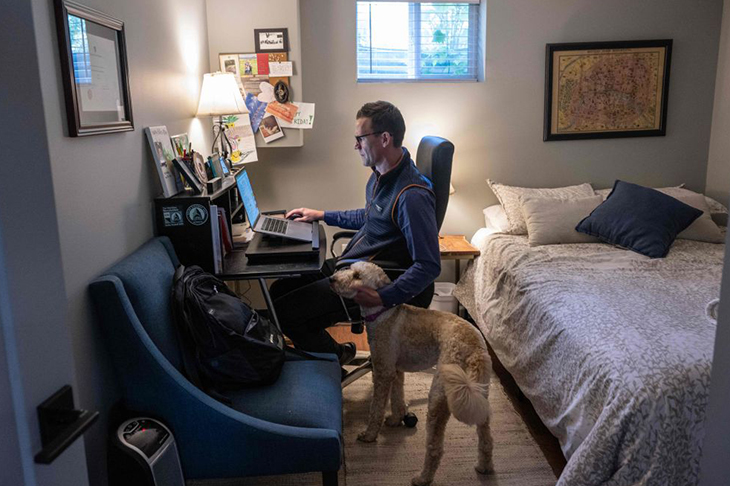
But this incident got me thinking about the extent to which we have lost the plot when it comes to working from home – or WFH, the abbreviation commonly used.
It wasn’t that long ago when WFH among employees was virtually non-existent. The 2016 Census showed that only two per cent of employees reported working from home. But according to the Household Incomes and Labour Dynamics in Australia survey – that old gal, Hilda – by 2023, one in four employees was regularly working from home at least one day per week. The term hybrid work is now commonly used.
And here’s something that won’t surprise Speccie readers – the incidence of hybrid work is much higher in the public sector compared with the private sector. The percentage of public sector workers who work from home is closer to one-third.
In fact, a recent survey of Commonwealth public servants indicated that only one-third of them work exclusively from the office. You might think that stronghold of free market thinking – OK, only joking – Treasury would have disproportionately more workers at the office. But, no; slightly less than one third work exclusively from the office while 55 per cent of Treasury staff report working some of the time at home on a regular basis.
The impact of WFH on productivity is not entirely clear. It works better for some classes of workers than others. Where work output is easily measurable, WFH may be a positive because workers don’t have as many commutes. But there are plenty of cases where productivity is likely to be adversely affected, in part because of the loss of teamwork, mentoring, supervision and training – and the scope to slack off.
That productivity growth in Australia has effectively stalled over the period during which WFH has taken off is an awkward correlation for supporters of these flexible work arrangements.
Of course, working from home only works if the staff don’t have to be physically at work – laying bricks, cutting hair, taking out an appendix. What this means is the privilege of being a hybrid worker is not evenly spread across the workforce. This can generate resentment as the stuck-at-the-workplace staff observe their mates fitting in a Pilates class or coffee date on their WFH days.
But here’s the thing: it is very clear that working from home is extremely popular among eligible employees and their families. It is for this reason that the WFH phenomenon represents something of a political dilemma for conservative parties, particularly in an Australian context with its overregulated industrial relations arrangements.
Recall it was the Coalition’s policy proposal at the last election that Commonwealth public servants would be required to return to work to the office full-time. Working on the assumption that most people think that public servants are overpaid freeloaders, the expectation was that the plan would be well received by voters.
There were various problems with the proposal, however. For starters, industrial agreements covering Commonwealth public servants containing the right to WFH had been signed and would run until 2027. Under these agreements, supervisors are expected to agree to WFH requests unless there are very cogent reasons for refusing.
There was also the point that voters didn’t pick up on the specificity of the proposal to Commonwealth public servants. Rather, the view emerged that a Coalition government would seek to ban WFH across the board. This view was strongly kicked along by Labor. In the end, the Coalition effectively dumped the proposal midstream, leaving voters completely uncertain of where the alternative government stood on the issue. It was a disaster.
An important development in the WFH saga in Australia relates to the Westpac case. A long-standing staff member of the bank had an arrangement that allowed her to work some days of the week at home and others at a designated office.
Her family then moved house to accommodate the schooling needs of the children. The new house was a great distance from the office, and she requested to work entirely from home. Her request was denied by the bank. Miffed by the decision, she took the case to the Fair Work Commission which decided in her favour. The FWC found that there was insufficient justification for the bank’s decision and the bank had failed to engage in a proper and timely fashion with the worker. The decision has not been appealed by Westpac.
The real import of this development is that employers will think very carefully about insisting that employees work from the office or refusing requests for WFH. In other words, the ability of managers to manage is limited by this decision.
It is a far cry from what is happening in corporate America. It is commonplace for managers to insist on full-time attendance at the office, with dismissal being the ultimate remedy. In some cases, workers who insist on WFH are hit with substantial cuts to their pay, something that would be unimaginable in an Australian setting. An interesting case in the US involved IT workers and the decrement in pay that they would accept to work from home, at least part of the week. The highest figure was close to a 25-per-cent cut – individual bargaining is the norm in the US for these situations – which was much higher than many expected.
Returning to the Australian situation – or quagmire, more accurately – we now see the Victorian Labor government is proposing to legislate the right to WFH. Under this proposed law, eligible workers will be entitled to hybrid working arrangements of at least two days per week. This will apply to both the public and private sectors, including not-for-profits. There are some technical problems because Victoria ceded its industrial relations powers to the Commonwealth many years ago. The proposal is to use the state’s discrimination law to enact the entitlement. It’s hard to see how this will work, but it will require a legal challenge if the new bill passes the state parliament.
It also creates a dilemma for the opposition in Victoria, under newly elected leader Jess Wilson. Does she oppose the new law because it is bad for business in the state or does she keep quiet knowing that this entitlement plays well with folk in the outer suburbs? She can add this to her long list of challenges.
Got something to add? Join the discussion and comment below.
You might disagree with half of it, but you’ll enjoy reading all of it. Try your first month for free, then just $2 a week for the remainder of your first year.