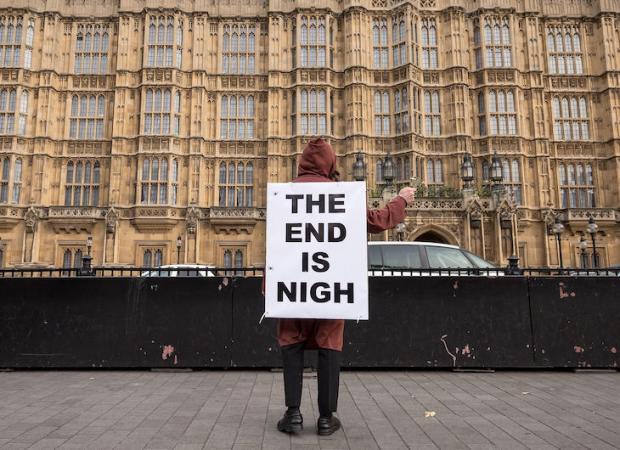
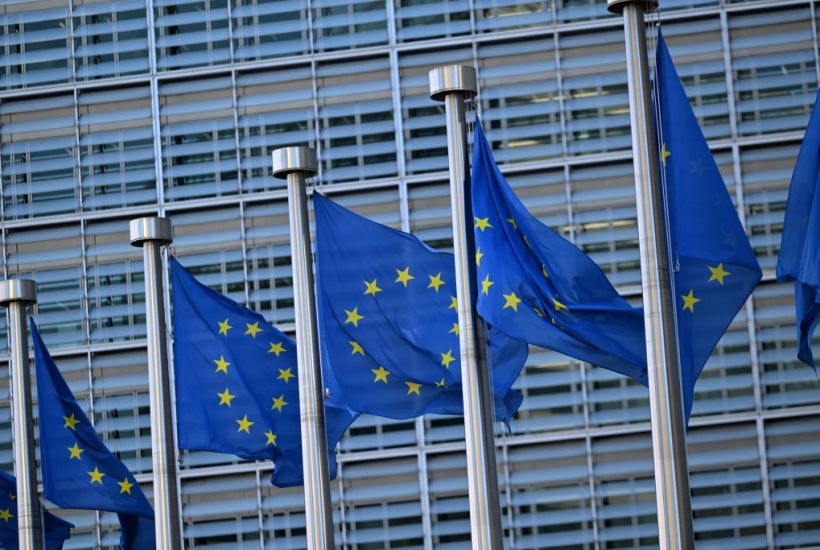
If I were a bookie, I would be making odds now about when the European Union will finally unravel and die. Unless there is an imminent and drastic course correction, the blessed event cannot be far off. I might need a Doomsday Clock akin to the one publicized by the Bulletin of the Atomic Scientists. Their clock hovers near midnight, which signifies nuclear Armageddon, the minute hand pushed closer or farther away from the blast depending on minatory world events. My clock would measure the EU’s proximity to implosion. Its recent decision to fine Elon Musk and his company X €120 million for “non-compliance with transparency obligations” has me nudging the minute hand closer to midnight.
“Non-compliance with transparency obligations.” What do you reckon that means? It means Musk’s commitment to free speech has horned in on the EU’s chief domestic product, which is censorship and its attendant regulatory impositions. In announcing its punitive action against Musk, an EU spokesman was careful to say the decision “has nothing to do with content moderation,” which is bureaucratese for “censorship.”
The commentator Michael Shellenberger got it exactly right. “The EU wants X to give its data to government-selected ‘researchers’ so they can identify which posts and advertisements should be censored. This is a censorship-by-proxy strategy.”
The US pursued a similar strategy thanks to President Autopen when the government leaned on Twitter (as it then was) and other media outlets to throttle unsanctioned opinions about Covid, Donald Trump, the contents of Hunter Biden’s laptop, climate change, immigration and a host of other issues. Often the pressure came not from the government directly, but from NGOs which were wholly owned (that is, wholly funded) proxies of the government.
The EU’s allergy to free speech, which is a symptom of its allergy to democratic rule, seems terminal. In the US, thanks to people such as Musk and Trump, we have seen a rebirth of free speech. Much of Europe is stuck in the slough of despond, struggling to transform Orwell’s Nineteen Eighty-Four from a warning about totalitarianism into a user manual for the elite. Why is that? Because the EU is a profoundly undemocratic regime, run by a bureaucratic elite that is appointed, not elected, and that is accountable only to itself, not to the voters.
Are you interested in voting for the AfD in Germany? Marine Le Pen in France? Sorry: those candidates have not been cleared by the EU’s star chamber. In Romania recently, the high court, with the blessing of the European Commission (the executive council of the EU), actually invalidated national election results because the wrong party won. This is not news. Unclubbable reactionaries – that would be people like me – have been warning about the rise of bureaucratic totalitarianism for the past couple of decades. We like to quote Alexis de Tocqueville on the nature of that “democratic despotism” which prefers to infantilize rather than directly tyrannize its subjects.
What is new is the union of universal surveillance, the regulatory state and the shifting ideology of woke intolerance. They all came together when Covid swept across the world and set the hearts of budding despots pit-a-pat as they eyed the compliant ovine populace cowering under the draconian stipulations of the health police.
There are certainly plenty of enemies of free speech in the United States. Still, this country has taken important steps to escape from that sinkhole of conformity. Europe has embraced it. As several commentators have pointed out, the attack on X may simply be the opening salvo in the EU’s effort to enforce the Digital Services Act, the blandly named blueprint for enforcing political correctness online. As the commentator Jonathan Turley pointed out, EU officials have acknowledged that the fine imposed upon X “will lay the foundation for additional penalties to come to force companies to comply with EU ‘values’ on free speech.” This includes, Turley notes, “investigations for failing to carry out demands for censorship, including of American citizens.”
The ironies abound. Even as the EU sought to penalize X, the platform surged to become the number one news source in all 27 countries of the EU. Moreover, the EU announced its attack on X by logging on to a dormant ad account and posting a link that deceives users into thinking they are accessing a video. In other words, the EU engaged in the same deceptive practices of which they accuse X. Result: the EU’s ad account has been terminated. Who says that schadenfreude isn’t sweet?
I think Musk is correct: “The EU should be abolished and sovereignty returned to individual countries, so that governments can better represent their people.”
The EU is desperately attempting to preserve its undemocratic prerogatives by clamping down on free speech and extending its regime of censorship. Meanwhile, the White House just released its 2025 National Security Strategy report. Europe’s economic performance and military posture are dismal. But that is the tip of the proverbial iceberg. Economic decline, the report says, is
eclipsed by the real and more stark prospect of civilizational erasure. The larger issues facing Europe include activities of the European Union and other transnational bodies that undermine political liberty and sovereignty, migration policies that are transforming the continent and creating strife, censorship of free speech and suppression of political opposition, cratering birthrates, and loss of national identities and self-confidence. Should present trends continue, the continent will be unrecognizable in 20 years or less.
All of which means that the odds favor Elon Musk. The question is not whether the EU will collapse but when. My book has good odds that it happens before the end of Trump’s second term.
This article was originally published in The Spectator’s December 22, 2025 World edition.