Across much of the developed world, the climate policy orthodoxy is shifting. Countries that once boasted of their leadership in decarbonisation are now recalibrating in the light of engineering constraints, affordability crises, voter pushback and concerns about grid stability. The rhetoric of the inevitable transition –once delivered with the certainty of a moral crusade – is giving way to practical concerns like reliability, social licence and distributional fairness.
Meanwhile, Australia continues its grand narrative of becoming a renewable energy and climate superpower – now rendering us a global outlier. Despite having some of the world’s best agricultural and resource endowments, we have constructed a decarbonisation regime that is extraordinarily land-intensive, structurally punitive to farmers, and utterly indifferent to the social and ecological consequences imposed on rural communities. No other country has imposed such a heavy share of its climate burden on private rural land, or been so unwilling even to acknowledge that this is what has occurred.
The result is not simply discontent. It is now approaching uproar. Many farming communities are now at breaking point – not only because of the economic, environmental and agronomic consequences of the policy mix, but because they have endured three decades of technocratic sleight-of-hand and regulatory tides which have only ever moved in one direction.
What has been marketed to the city as ‘biodiversity protection’ or ‘the energy future’ has, on the ground, been a one-way ratchet of over-regulation.
The pattern was set in New South Wales in 1995 when an environmental planning policy, SEPP 46, dropped without consultation. Overnight, clearing native vegetation became development that required bureaucratic sanction from Macquarie Street. Only later did the carbon-accounting logic become clear: with the January 1990 baseline locking in retrospectivity, the state vegetation controls delivered massive carbon-accounting benefits to the Commonwealth under Kyoto. Australia’s national emissions numbers show that between 1990 and 2004, a 59-per-cent fall in land-use change emissions kept total national emissions growth to barely two per cent. About 70 per cent of that decline came from reduced clearing in Queensland – and a non-trivial share from NSW.
In plain English: most of our apparent emissions ‘progress’ did not come from decarbonising electricity or industry or transport – but from stopping farmers managing vegetation in ways that had previously been lawful, practical and often ecologically sound.
Over time, the land use, land-use change and forestry sector was transformed on paper from a major source of emissions to a large net carbon sink. That sink largely sits on private land. And the increased environmental and financial burden has been borne almost entirely by farmers in the more remote areas of NSW and Queensland.
This was not done inadvertently. A sequence of official inquiries – Productivity Commission 2004, ABARES 2006, and others – made clear that the regulatory model was inequitable and that blanket prohibition on clearing was an inferior design compared to proportionate, economically rational alternatives which would have better ecological outcomes. ABARES acknowledged that many of the benefits accrued to the public at large, while the costs were borne privately. That should have triggered a compensatory model or a market-based framework. Instead, NSW opted for the lockdown option – and it has only tightened since then.
The consequences are now plain to see. Land that has been over-regulated is now under-managed and, in many places, unmanageable because the costs of complying with mandated management are prohibitive. It is obvious that in many regions the ‘environment’ has been destroyed in order to save it. In some places the damage is irreversible.
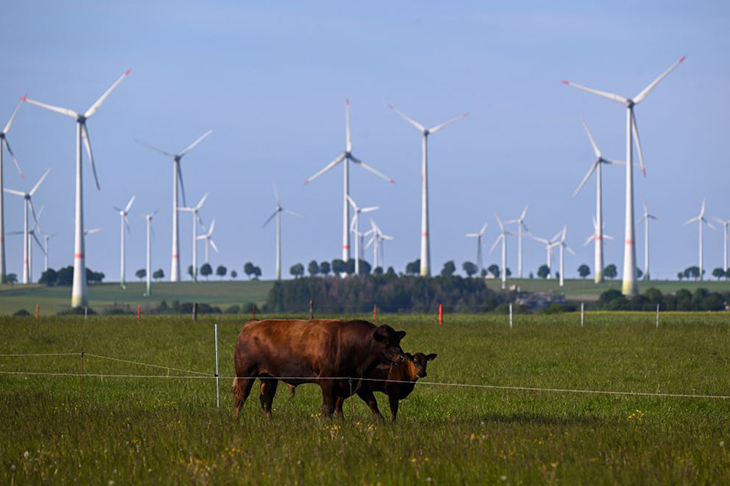
Layered on top of this history we now shoulder the so-called energy transition – the sprint to an 82-per-cent renewable share delivered via a sprawling network of industrial energy facilities, solar and wind factories and transmission lines laid almost entirely across regional Australia. The cities get the virtue of the decarbonisation narrative; the regions get the industrialisation of their landscapes and sense of place.
The most revealing feature of this phase is the refusal by governments to impose rehabilitation or decommissioning bond obligations on developers of large-scale renewable projects. The only rational explanation for ignoring this most basic environmental safeguard is fear that it will slow – or stall – the renewables rollout. The existence of remediation bonds for offshore wind under federal rules is one of the reasons investment in them has dried up. Yet for onshore projects, we see the same pattern as the native vegetation controls: state government blindness to long-term costs and consequences, with governments desperate to harvest the interim political benefit, and rural communities understandably furious knowing they will bear the monumental future costs.
There will be a third phase in coming years: new climate-aligned financing rules, compulsory livestock methane accounting, and carbon border adjustment mechanisms that will operate as tariffs by another name. For export-driven agriculture – especially grains and meat – these pose existential threats. Australian farmers rightly fear a descent into more economic populism: witness the devastating impacts of Trump’s tariffs on US farmers.
All of this has produced a collapse in trust – not just in bureaucrats and politicians generally – but in those who were supposed to be advocates for the farming sector itself.
And so we come to the farming representatives. Against this long-simmering cauldron, the way farming has been presented to the wider public has become a crucial part of the problem. For too long the NFF and its state bodies have been captured – softened by the very policy frameworks doing the damage. Once fighting forces, they are now too broad a church with too many competing agendas, too many voices, and too timid to challenge metropolitan narratives.
The result is that the city has not been hearing from actual farmers – the ones living with weeds they are forbidden to control, firebreaks they can not clear, fences they cannot move, and land they must now manage as if they are a park ranger. They’re not hearing from the dozens of badly impacted neighbours to solar and wind factories, and hundreds of people who bear the brunt of mammoth transmission lines marching through their properties. Metropolitan audiences have instead been given a narrative through the filter of minority green-activist farmers, or soothing commentary tailored to ABC sensibilities, with smoothed edges and softened grievance. There has been a political conformity – a complete aversion to any confrontation – which has left rural communities without authentic representation.
The pushback now emerging is not cultural hysteria or reactionary stubbornness. It is a rational response to decades of accumulating impositions, having to wear nonsensical and costly regulations, shaking our heads at vast environmental damage, and recognising that polite acquiescence has gained us nothing.
Rural Australia is done with carrying the can.
Got something to add? Join the discussion and comment below.
You might disagree with half of it, but you’ll enjoy reading all of it. Try your first month for free, then just $2 a week for the remainder of your first year.