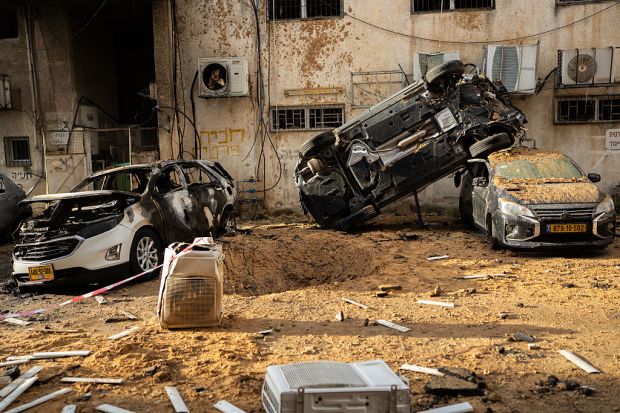
A crisis of authority now festers at the heart of Israel. A shrill, violent fringe of extremist settlers in the West Bank is not only terrorising Palestinians, but undermining the authority of the Israeli state, its security and diplomatic relations. This week, there have been reported attacks by settlers near Deir Istiya, near Nablus, and in Jaba, southwest of Bethlehem. These settlers’ growing impunity, and the government’s failure to rein them in, is no longer a side issue. Settler violence is emerging as a national security crisis.
This is not hyperbole. These hilltop radicals act with a confidence that is backed by far-right politicians and suggests de facto immunity: arson, intimidation, physical violence, price‑tag attacks, and organised harassment – including against Israeli soldiers. Israeli authorities dismantle one illegal outpost, only for it to be quickly replaced by another. Despite this blatant, violent, lawbreaking, which most Israelis object to, meaningful prosecutions are rare. The result is a growing sense that these dangerously out-of-control criminals are above the law.
For many Israelis living in mainstream settler communities, this feels like betrayal. These men and women built homes and businesses under the assumption that the state would uphold order. Now they are watching a radical minority hijack that very project. Their reputation – and Israel’s – is being dragged through the mud by extremists who operate outside accountability. The radicals’ violence reflects poorly on them; worse, it provokes international blowback that hits their communities directly.
Indeed, that blowback is coming. The UK has imposed sanctions on extremist settlers and on outposts linked to violence, calling ‘for immediate action against extremist settlers’, alongside sanctions on two Israeli far-right ministers Itamar Ben Gvil and Bezalel Smotrich for inciting violence against Palestinians. Both also oppose a heavy-handed approach to tackling the rioters. Foreign Secretary David Lammy explicitly cited ‘the impunity’ of settler violence, warning that the two-state solution is ‘endangered […] by the spread of illegal Israeli settlements and outposts across the Occupied West Bank, with the explicit support of this Israeli government.’
The EU’s Global Human Rights Sanctions Regime now covers multiple extremist settlers and groups accused of promoting violence. The European Commission stated in August that it ‘strongly condemns the ongoing extremist settler violence in the West Bank, including East Jerusalem, and recalls that Israel is bound by international humanitarian law and applicable norms of international human rights law, including, as an occupying power, the obligation to protect the population under occupation.’
In Washington, concerns are deepening. The American ambassador to Israel, Mike Huckabee, condemned the violence this week, calling it ‘terrorism.’ To Israel’s allies, this is not merely a moral issue, it is a strategic one. Unchecked settler extremism threatens stability in the West Bank, undermines President Trump’s peace plan, and complicates Israel’s diplomatic agenda.
Israel’s broader geopolitical ambitions hang in the balance. The Abraham Accords may get increasingly fragile and become more difficult to expand if Israel as seen unable – or unwilling – to control its own extremists. For Gulf states weighing further integration, Israel’s failure to hold ideologically motivated settlers to account is not a technical nuance. It’s a litmus test of whether it can be a stable, responsible partner committed to peace building.
The state must reassert its monopoly on force
The stakes are not just diplomatic but endanger Israel’s security. If the hilltop radicals continue unchecked, they may well ignite a new flashpoint in the West Bank – one that could spiral into wider conflict. Israel’s security is under pressure from multiple fronts, and overstretching the army risks undermining its own defences. With troops already deployed across Gaza, Lebanon, and the West Bank, the IDF is thinly spread, making sustained counter‑insurgency operations more difficult. When extremist settlers continue to ignite violence, they force the army to divert resources to contain both Palestinian militants and radical Jewish actors.
Just two days ago, a Palestinian Islamic Jihad cell carried out a combined ramming and stabbing attack at Gush Etzion Junction, killing a civilian and wounding others, underscoring the precarious balance the IDF must maintain.
Following domestic pressure from settlers, Shin Beit, the IDF and the general public – and despite concerns about angering his far-right coalition partners – Prime Minister Benjamin Netanyahu has pledged a crackdown. But symbolic gestures won’t suffice. What is needed is structural: independent, depoliticised policing; fearless prosecutions; restoring administrative detentions; willingness to enforce the law even when it confronts ideological, powerful groups. Only by reasserting its monopoly on force can Israel repair both its internal legitimacy and its standing on the world stage.