Over the last two years of the conflict in Gaza, the phrase ‘international humanitarian law’ has been heard almost daily in the media, usually in the context of the commentator claiming a breach of this code on the part of Israel. The reality is, however, that in one sense there is no such thing as international law and, in any event, it has never played a significant role in a wartime situation.
It is, of course, open to any individual nation to sign an international convention and insert its obligations into that nation’s domestic law and Australia has implemented many treaties in this way. But, if those obligations are not observed, there is no means by which they can be enforced except in the unlikely event of invasion by another nation state.
The conduct of great powers is largely immune from any notion of international law because other nations are not strong enough to resist their actions. This reality is reflected in, for example, the annexation of Tibet by China in 1951, the US invasion of Grenada in 1983 and the Russian seizure of the Crimea in 2014.
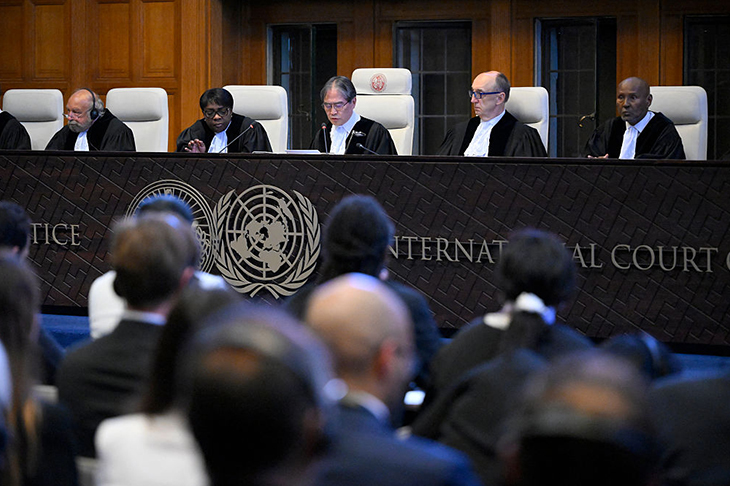
How does the International Court of Justice fit in to this seemingly abstract legal world? One of the current cases before this Hague-based body is a claim by South Africa seeking a declaration that Israel is carrying out genocide in Gaza. As a matter of theory, any orders made by the court can be enforced by military action on the part of the UN Security Council but, not surprisingly perhaps, this has never occurred. One reason for this is that such an exercise could be vetoed by any one of the five permanent members of the council – the US, Russia, China, Britain and France. It might be expected that in any given situation the subject of the court’s orders would be an ally of one of these members and so protected by their veto.
This was why in 1999 the bombing of Serbia – in order to force the withdrawal of the Serbian army from Kosovo – was undertaken by Nato as Russia would have vetoed any action by the United Nations. Because the bombing was not authorised by the UN Security Council, it was itself a breach of international law but this question was never raised by the US or any other Nato members. It was also a breach of Serbia’s sovereignty because Kosovo was at that time one of its provinces and not another country.
In a final exercise of military and political power over any idea of international law, Kosovo was declared to be an independent nation in 2008 and this status was recognised by many countries, although not, of course, by Serbia.
The academic quality of many of the decisions of the International Court of Justice was illustrated by its declaration in July of this year that failure by a nation to take appropriate action to protect the climate system may constitute an internationally wrongful act and that nations harmed by climate change could be entitled to reparations. The case was initiated by Vanuatu and supported by more than 130 countries, although no one has suggested how these declarations of the court could be practically implemented. It is hard to see how any nation could agree to pay damages to other states on the basis that its domestic policies have failed to adequately address the global impact of climate change. Even by the other-worldly standards of many of the court’s judgments, this decision would seem to have reached a new level of unreality.
The problem of anyone observing international law, whatever its content, in a war situation is particularly acute, given that one side has breached this notion at the outset by invading the other side or launching air attacks on it.
No doubt proponents of international law would say that it was contravened by the Allied bombing of German cities in the second world war and even more certainly by the use of atomic weapons against two Japanese cities at the very end of the war. But these events raise the question of how to deal with an aggressor, here both Germany and Japan, that observes no rules of any kind and is determined on the total annihilation of its enemies. These were opponents who, in the case of Germany, set up a network of extermination camps in Europe and, in the case of Japan, worked prisoners of war to death on the Burma railway.
Israel’s bombing of Qatar’s capital Doha, in an effort to kill some of the leaders of Hamas, has been widely condemned as a breach of international law on the basis that this was an attack on the territory of a sovereign state. But Hamas has been designated by many nations, including Australia, as a terrorist organisation. Why should any country that harbours terrorists be immune from an attack that is designed to eliminate the leaders or members of such an organisation? If the harbouring state suffers some collateral damage, that is a risk it has assumed by knowingly taking in the terrorists.
There are those in all Western countries, including Australia, who would prefer the notion of international law, as promulgated by the UN and the International Court of Justice, to override domestic law where there is a conflict between them. This view, however, is essentially inconsistent with the concept of the nation state. One of the traditional attributes of such an entity has always been the ability to control actions and events within its own borders. This was really the point of Brexit – whether Britain was to have the ultimate say as to what happened within its own territory or whether that control would be conceded to the administrators of the European Union in Brussels.
It is something of a puzzle that the concept of international law, given its rather ineffectual history, is treated with such a degree of reverence by some politicians and officials in the West. It certainly plays no part in the conduct of nations in most parts of the world.
Got something to add? Join the discussion and comment below.
You might disagree with half of it, but you’ll enjoy reading all of it. Try your first month for free, then just $2 a week for the remainder of your first year.