It takes a certain kind of genius to hold power for a decade and still look bored by it. The Tasmanian Liberals have mastered that art. They govern as though politics were a family inheritance rather than a public trust – proof that they’ve kept the name but squandered the estate.
Jeremy Rockliff’s government – ten years in power, nothing left to say – has perfected the art of looking comfortable while governing as theatre. Beneath Rockliff, the Four Amigos: Abetz, Archer, Barnett and Pearce – voters questioned their fitness for Canberra, now reborn in Hobart’s toy parliament.
Nowhere is their moral exhaustion clearer than in their courtship of the AFL. The Rockliff government talks fiscal discipline but behaves like a cheer squad with a Treasury credit card: a billion-dollar stadium in Hobart, built on public land, funded by public debt, to serve a private code that could buy the site twice over with one year’s broadcast rights. The argument isn’t against football – Tasmanians love football – but against vassalage. If the game is so profitable, let the AFL build its own temple. Instead, the government waves pom-poms while handing over the bucket of cash. Populism rents the room; taxpayers pick up the minibar tab.
The contrast isn’t subtle. With the worst health system of any state, the government discovers limitless funds for a stadium that will host barely ten AFL games a year. Premier Rockliff, whose fortune came from farming potatoes, seems unbothered that Tasmania’s students rank among the worst in the nation for educational outcomes. More workers for the harvest? Surely not.
A billion-dollar stadium is hardly the answer. Over ten years, once you account for the construction overruns that plague every major stadium project, the operating subsidies the government’s own business case admits are needed, and the maintenance bills that compound faster than spreadsheets assume, Tasmania will likely commit around $750 million of public money to this one building. To translate that for mainland readers: New South Wales collects about $100 billion annually. For Sydney, Tasmania’s stadium is the fiscal equivalent of the NSW government dropping $8 billion on a single football ground. Eight billion dollars! It’s madness incarnate.
The Liberals thought they were starring in a feel-good story about bringing big-league football to Tasmania. They didn’t realise they were extras in an expensive hostage video. The AFL played them perfectly – threatened to walk, dangled glamour, made them compete with Labor for the privilege of being fleeced. And Rockliff’s government, drunk on Grand Final selfies, signed the keys away without checking the locks.
This is what political capture looks like when conviction yields to collusion. And what’s happened in Tasmania isn’t local – it’s national in miniature.
Across the country, Liberal MPs tie themselves in knots trying to finesse positions that satisfy no one. They’re paralysed not by complexity but by cowardice – listening to people who aren’t their friends, taking cues from the Age and the ABC, craving approval from the very class that loathes them. The party that once championed enterprise now worships bureaucracy. Risk aversion has become its only conviction.
The rot shows clearest wherever speech is concerned. When Labor tested media controls, most Liberals had no language for why freedom mattered – only procedural quibbles. When the party lost its nerve reforming 18C of the Marxist-inspired Racial Discrimination Act, a law with noble intentions and abysmal outcomes, the infamous line about ‘the right to be a bigot’ turned a first-principles defence of liberty into a public confession of moral embarrassment. Now, as ‘misinformation’ proposals creep toward legislating truth by regulation, the party that once defended open contest manages a frown and a footnote. Most of them can quote Hayek on prices; nearly all go mute on Mill. The economics they remember; the philosophy they’ve forgotten.
In Tasmania, Rockliff – a man who hasn’t found a woke cause he won’t champion – backed the Voice referendum, pushed DEI frameworks with gusto, supported land-rights claims for populations ninety-per-cent Anglo-Saxon and truth-telling commissions, and came down hard on parents who dare circumcise their infant sons.
Among the conservative establishment who have lost power across the country, ‘populist’ has become the not-so-polite slur for voters who won’t clap along with these types of foolhardy policies. When tradies suggest mass migration might depress wages or make housing unaffordable, and when small business faces cost hikes from soaring power prices, both are told they don’t understand the complexities of the situation. A consensus this fragile cannot survive contact with the country it presumes to govern.
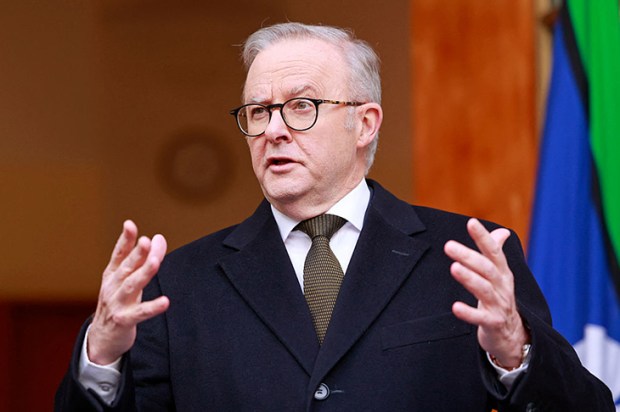
Labor, for all its chaos, at least knows it’s in a fight. Albanese governs with swagger, the misplaced conviction of the gleeful redistributor and the occasional flamethrower. His ministers fear him the way primary school children fear a teacher with a loud voice and a lisp – half comedy, half terror.
Sussan Ley, a latter-day Nero, fiddling while Australia burns, holds press conferences about ‘learning opportunities’. Her deputy, Ted O’Brien – looking suspiciously like Tim Walz – has recast defeat as an audit, not a reckoning: another round of reviews, road trips and talking points. They mistake procedure for purpose and noise for renewal. Ask the shadow cabinet what they believe and they’ll say ‘the process of listening’. Ask who they represent and they’ll cite ‘all Australians’. Ask what they’ll do – and the silence returns.
We’ve been here before. In the 1940s, the United Australia party died the same death – elite, clubby, allergic to conflict. Its leaders mistook decorum for direction and waited for Labor to fail rather than offering an alternative. When Menzies returned from exile, he saw what had to be done. He didn’t modernise the UAP; he buried it. Renewal required ruin first. He built something from scratch that believed in work, family and freedom, and called its supporters the forgotten people.
Eighty years later, the forgotten are forgotten again. The Liberals have succumbed to the same disease that killed the UAP: comfort mistaken for competence, process mistaken for principle. The old reassurance – that the party must be both liberal and conservative – now works like a lullaby. Balance is treated as wisdom. But Menzies’ genius wasn’t balance; it was decisiveness.
The right’s problem today isn’t division. It’s sleepwalking.
If the mainstream right vacates moral ground, others move in. Call them populists, call them national conservatives – whatever the label, they’re speaking to voters the Liberals have abandoned: people who still believe in Australia, and the right not to be constantly scolded by their self-appointed betters. The same forces that have reshaped politics abroad are at work here too. They will find their outlet – through a new party, a revolt, or simply voters walking away. In the end, belief always outlasts branding.
Tasmania, the last self-declared conservative government, is the last square on an empty chessboard – nice, simple chaps playing for a draw until a new Menzies arrives to start the next game.
Got something to add? Join the discussion and comment below.
You might disagree with half of it, but you’ll enjoy reading all of it. Try your first month for free, then just $2 a week for the remainder of your first year.