Every November, a dwindling noisy priesthood gathers for the annual Festival of Whitlam Whingers, marking the anniversary of We Wuz Robbed Day – that fateful moment in 1975 when the Governor-General committed the unforgivable sin of doing his job. In this leftist liturgical rite, the worshippers chant the sacred refrain: ‘Maintain the raaaaage.’ This commemorative wailing comforts the faithful, certain that their secular saint’s martyrdom is proof of his (and their) superior intelligence, integrity and morality.
The dark deception of this charade is nowhere more apparent than in foreign policy, where the Great Gough was such a ruthless practitioner of realpolitik that he would have made Bismarck blush.
This was the statesman who gave a nod-and-a-wink to Indonesia’s bloody annexation of East Timor, disparaged desperate refugees fleeing communist brutality as ‘Vietnamese Balts’, and waved away Mao’s mass starvation in the Great Leap Forward and mass murders in the Cultural Revolution to embrace China as a geopolitical opportunity.
When it came to great historical forces crushing others, Whitlam was a model of steely-eyed realism. But when asked to swallow the tiniest teaspoon of domestic realpolitik – a constitutional crisis, blocked supply, and the Governor-General dusting off his very real reserve powers – the great man all but collapsed on the steps of Parliament in operatic indignation with the ululating of the faithful persisting up to the present day.
Unfortunately, Whitlam’s worldview continues to shape Labor’s foreign policy, particularly the core belief that because China’s rise was inevitable and legitimate, Australia should not even comment on its militarisation, ‘provoke’ it by criticising its values or ideology, and acknowledging the threat it posed was a dangerous delusion of right-wing security agencies. It inevitably led to downplaying CCP brutality or militarisation, the threat to Taiwan, the Indo-Pacific strategic imbalance, and the importance of the US in countering this threat.
The purest exposition of this view comes from Paul Keating, who repeatedly claims that China is not a threat, Taiwan is not a core Australian interest, defence concerns about China are ‘deranged’, ‘maniacal’, ‘lunatic’, and acceptance of the Aukus submarine strategy was ‘the worst decision by a Labor government since Federation’. His attack on former RSL president Greg Melick, calling him a warmongering ‘dope’ for daring to address the nation’s lack of military preparedness in his Remembrance Day address, is a case in point.
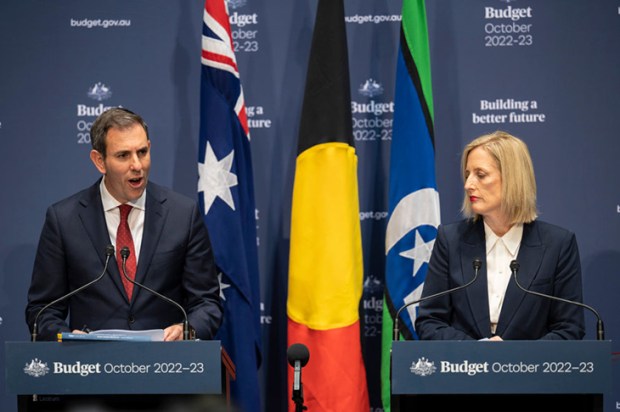
Prime Minister Albanese and Penny Wong cautiously acknowledge China’s military build-up, stating support for the status quo in the Taiwan Strait, and saying conflict would be ‘disastrous’. Yet, they emphasise an illusory ‘stabilisation’ of relations and a strategic minimisation of the threat China poses as a militaristic, expansionist, totalitarian power, not least because it would explode the myth of Whitlam’s farsighted vision, and the ALP’s claim to superior Asia literacy and China management prowess.
Inevitably, Labor’s foreign policy myths are being mugged by reality. This week, a Chinese state-linked media outlet called for nuclear strikes on Japan for the outrageous provocation of deploying defensive missiles on its own islands, the Indo-Pacific equivalent of shouting, ‘Nice little archipelago you’ve got there – shame if anything happened to it.’
At the same time, China’s CRINKy (China-Russia-Iran-North Korea) ally, Vladimir Putin, edges ever closer to being rewarded for invading Ukraine, with Trump seemingly prepared to appease Russian aggression in the hope of being hailed a Nobel peacemaker, while European leaders engage in peace-plan yoga.
Unfortunately, what Trump is negotiating risks being, as Tony Abbott memorably put it this week, not peace but a pause, while Russia insists on hamstringing Ukraine’s re-armament while engaging in its own. Whatever happens in Ukraine, it is clear that the post-Cold War holiday from history is over; the world has returned to realpolitik and might is once again insisting it is right.
In this environment, the Australian government’s first duty is to provide effective deterrence. The obvious place to start for a country that is woefully unprepared for war is with collective strength. The logical way to keep Australia safe is not to hide under the doona, refusing to acknowledge the danger, but to raise the cost of Chinese aggression against Taiwan or Japan to a level that dissuades Beijing from acting after careful consideration of the calculus.
This means Japan, the US, Australia, South Korea, the Philippines, and Vietnam must expand military cooperation, missile defence, field drones by the tens of thousands (Ukraine has written the manual), and tighten every link in the regional chain so that aggression anywhere becomes a problem everywhere.
It means hardening our northern bases and rebuilding our fuel and ammunition stores, so a first salvo doesn’t cripple us on day one. Instead of focusing on building capability in 2045, we need to buy off-the-shelf long-range ground and air-launched missiles, swarm drones, uncrewed surface craft and cheap autonomous systems in the thousands, not boutique numbers.
That brings us to Israel, the gold standard in existential resilience. Albanese’s policy on Palestine is not only outrageously immoral but strategically suicidal. If Australia is serious about deterrence, it needs to learn from the only state to not only survive but thrive despite facing an existential threat since the moment of its modern inception.
Israel’s survival is based on two principles. First, it prioritises defence and military innovation. Second, it backs its soldiers, even beyond the grave, champions truth, and fights morally defensible wars despite the additional cost and the relentless propaganda of its enemies.
Deterrence begins with the ADF, but recruitment is collapsing because our forces are under-strength, under-prepared, and under-valued, with veterans of Afghanistan abandoned to a legal and moral no man’s land, subjected to years of inquiries and judged by civilian standards in circumstances that no civilian has ever had to face.
The military must behave honourably and be seen to behave honourably, but that starts with timely, transparent military justice, not endless purgatory. It requires senior commanders to accept responsibility for their soldiers; a chain of command without a chain of accountability is nothing but a cheap necklace strung with fake medals. Combine this with the relentless demonisation of Australian history, and it’s no wonder young Australians aren’t rushing to enlist. Who volunteers to defend a nation that loathes itself? If we want to deter aggression, we need to abandon Whitlam’s fantasy of a benign China and return to the oldest truth in strategy: if you want peace, prepare for war.
Got something to add? Join the discussion and comment below.
You might disagree with half of it, but you’ll enjoy reading all of it. Try your first month for free, then just $2 a week for the remainder of your first year.