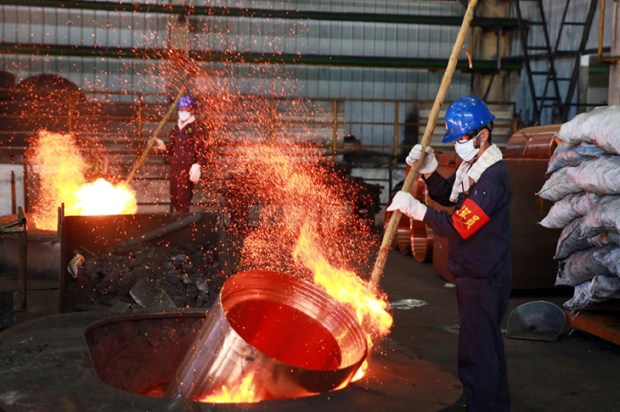
Join the dots. They show the significant threat to Australia’s economic prosperity (and strategic security) that has resulted already from the crisis that has culminated this year in a succession of announcements of huge governmental (federal and state) rescue packages and subsidies needed to keep Australia’s struggling multi-billion-dollar minerals and metals processing industry on life support – but with no assurance of longer-term survival. They also show how the rest of the Western world shares our problem: a combination of the impact on energy prices of the self-destructive pursuit of climate targets along with a free-trade mantra that helped China achieve world domination in processed metals and minerals.
The wide product range and geographic spread of governmental support for what Australia’s ailing smelting and refining industry describes as being ‘on the brink of collapse’ is testament to the underlying and worsening nature of the crisis. It demonstrates the lack of a long-term solution for the troubled aluminium of Tomago and Bell Bay, the lead and zinc in Hobart and Port Pirie and copper in Mount Isa and Townsville. Nor is there a ready solution to the issues resulting in the closure of BHP’s West Australia nickel and Kwinana aluminium, although there are hopes for a resolution of the hiccups in steelmaking in South Australia (helped considerably by a $2.4 billion governmental hand-out) and manganese in Tasmania as well as the lithium hydroxide plant near Perth that suffered during last year’s Chinese disruption of the market for what should be a boom mineral for Australia.
There is also governmental support for new strategic but otherwise uneconomic projects, like antimony in South Australia. And there are continuing pleas for further taxpayer handouts to avoid even more units of this economically – and strategically – vital industry from joining the list of those that have already been forced to shut up shop.
So how did this largely export-oriented smelting and refining industry, which contributes hugely to Australia’s wealth by converting Australia’s wide range of mined materials into major earners of export income, come to be in such steadily worsening state of financial distress? As an energy-intensive industry, it clearly has been damaged by the massive rise in power bills due to the rush out of the cheap coal-fired power on which their viability depended, into renewables. But, and with much more serious implications, it also has been crippled by the predatory actions of Australia’s biggest trading partner – China.
In a strategic investment master stroke, China has, over the last couple of decades, become the world’s dominant metal and mineral processor, effectively controlling the markets for the materials on which the industrialised world relies.
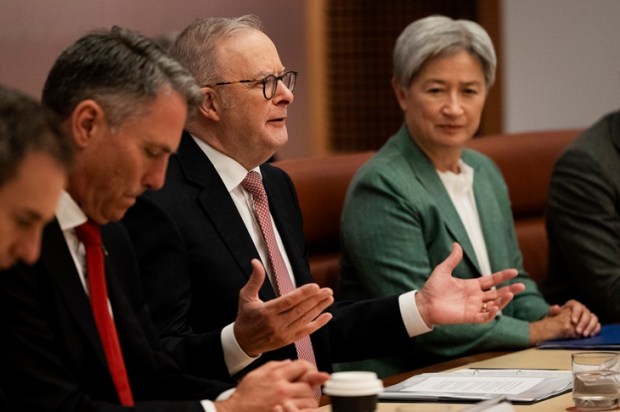
So where does this leave the Albanese government’s great ‘Future Made in Australia’ unrealistic ambition to upgrade with local processing (as energy costs soar!) of the raw minerals and metals on which our prosperity depends? As long as China continues with its strategic design to dominate the world’s materials processing, any serious attempt to make Australia more of a manufacturing nation along these lines, let alone to maintain its existing largely unviable processing status, would require unprecedented governmental intervention – along with a return to the days when Australia was a cheap (coal-powered) energy nation.
This is not just Australia’s problem. The rapid expansion of China’s refining and smelting capacity across the metallic spectrum, is, according to Reuters, leaving Western metal smelters in crisis as margins are crushed, gifting market and pricing power – and supply chain control – to China. The West’s belated recognition (particularly by Trump’s America) that China’s processing dominance presents a potential economic and security threat, has prompted a rush to try to broaden supply chains.
The media favourite, rare earths (vital to the West’s commitment to energy transition) that China overwhelmingly controls and whose Australian reserves provided Prime Minister Albanese with at least a playable hand when meeting an evidently concerned rare-earths-dependent President Trump last month, make up only a fraction (but a strategically significant one) of the overall problem.
As the Australian Strategic Policy Institute recently pointed out, China currently controls production of 29 commodities, made up of 22 metals and seven industrial minerals, delivering it power on both sides of the demand and supply equation. So miners of many of these minerals have almost no option but to send their raw material to China for processing, while its stranglehold over the supply of refined material gives it serious pricing power.
The International Energy Agency recently observed that China’s strategic focus on controlling the middle of the supply chain – processing rather than mining – provides maximum leverage with minimum resource investment. ‘China doesn’t dominate global mining but rather the intermediate stage where value is added by converting ore into metal’, giving China control of metals flows without being home to the mines that produce them.
The West’s years of outsourcing its smelly, polluting, environmentally troublesome processing industries to China were not only due to the siren song of climate purity (and the expense and delays of environmental approvals), but also to the even more attractive lower costs that were largely due to the cheap coal-fired power generation that China still continues to expand. So the financial benefits of free trade hid the vulnerability of their global supply chains to China’s control arising from its processing dominance.
As the Diplomat magazine recently noted, ‘Since the last quarter of the 20th century and until very recently, the neoliberal globalisation paradigm in the West left to market forces the task of fulfilling critical mineral security objectives. This led to decades of internationalisation, financialisation, and global supply chain reconfiguration to align with profit motive and maximising shareholder value and creating incentives to delocalise mining and refining.’
The United States’ eventual recognition of the national security risk of China’s dominance of critical minerals processing and the lack of domestic US refining and advanced processing capabilities did prompt the Trump administration into encouraging private sector investment, reducing environmental barriers and adding to the list of ‘critical minerals’ to receive support; aluminium is the latest addition. But industry commentators say that China is too far ahead of the US for meaningful catch-up.
For Australia, however, will the solution to China’s destructive dominance lie, as the Australian Financial Review has canvassed, in the government using its $15 billion National Reconstruction Fund to take ‘major equity stakes or even controlling interests in troubled metal smelters as part of Labor’s bid to tackle the crises that threaten to shut processing across the country’?
Nationalisation, anyone?
Got something to add? Join the discussion and comment below.
You might disagree with half of it, but you’ll enjoy reading all of it. Try your first month for free, then just $2 a week for the remainder of your first year.