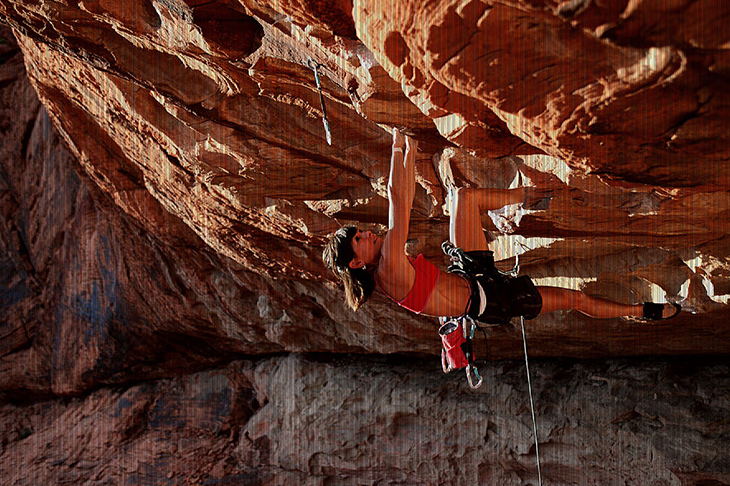
‘Celebrate Spring in Nature’, is the call to action on the Parks Victoria website, which urges us to visit the state’s ‘Beaches and Coasts’, ‘Rivers and Lakes’, ‘Tall Forests’ and ‘Mountain Peaks’ to ‘revitalise and rejuvenate’, whatever that means. But at least one of those menu options is itself in need of urgent rejuvenation: ‘Mountain Peaks’ should be updated to ‘Views of Mountain Peaks’. Because not content with being a gateway to the state’s natural treasures, in the last few years Parks Victoria has also become a taxpayer-funded Climb It Denier. And the latest climb it wants to deny us is Mt Arapiles, an undistinguished and not even very high sandstone escarpment halfway between Melbourne and Adelaide. Until very recently, Mt Arapiles’ only intrinsic worth was as a challenging free-climbing venue, and the rock art on it was accorded so little cultural significance that even First Nations leaders seemed unaware of its existence. But if Parks Victoria gets its way, access to 60 per cent of Mt Arapiles will soon be denied in perpetuity to climbers – some of whom have been prepared to fly halfway around the planet for the privilege. The opposition of such a niche group is unlikely to daunt Parks Victoria, whose success in ring-fencing much larger areas of the Grampians range five years ago was resisted by the state’s urban population about as fiercely as the people of Vienna resisted the Anschluss. But public apathy about the annexing of Mt Arapiles may prove a false summit. Not because the banning of recreational activities may be found to be at odds with Parks Victoria’s charter obligations. But because its latest opponents are the very demographic whose interests its climbing bans purport to serve. If there’s one thing First Nations leaders care more about than their spiritual and cultural past, it is their economic and political future. And if Parks Victoria’s plan to give Mt Arapiles sacred site status threatens to obstruct or delay the long march to Treaty – as is asserted by certain high-profile First Nations spokespeople – we can be confident it will be mothballed. In the meantime, this conflict of interest at least puts Parks Victoria in a position which allows them to empathise with those whose fun they want to spoil: they are between a rock and a hard place.
The prototype of all Australian climbing bans was, of course, the one which put Uluru off limits to tourists in 2019. The first time I stood on top of it, in the days when you could still call it Ayers Rock without raising eyebrows, the signage below had only warned me about the possibility of heart failure and heat stroke.
Even ten years later, when I went there several times to shoot commercials for the nearby Sails in the Desert resort, the additional signage only said the decision to climb was a matter of conscience. I am racked with colonial guilt now, of course, but at the time I had no idea that the three or four ascents I made on those trips were causing such offence to what we now call traditional owners. I certainly didn’t seem to offend either of the cheerful guides who went up and down it with me, both of them proud Anangu locals.
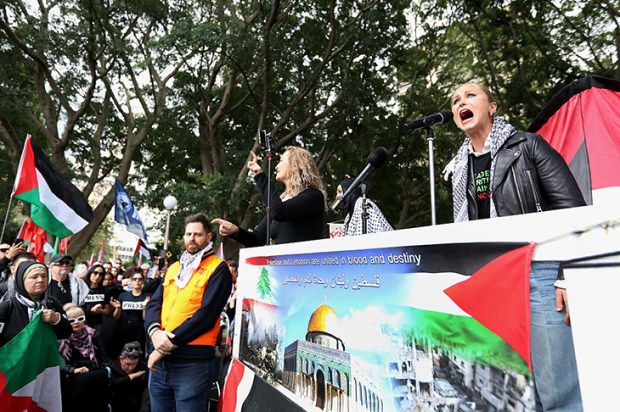
Although climbing in NSW has not yet become a casualty of the culture wars, it may only be a matter of time before our equivalent of Parks Victoria calls for the repeal of legislation which made it possible, 25 years ago, for one of this state’s great cultural landmarks to be turned into a tourist thoroughfare, notwithstanding the opposition of a local minority. But since that minority was white of collar and complexion, it is hardly surprising that Bob Carr’s Labor government ignored it. And as BridgeClimb has proved to be as popular with Sydneysiders as it is with tourists, you’d have to be an off-the-scale wowser to want to see it shut down now. But the Harbour Bridge is a cultural icon which all Australians should be proud of, so it’s harder to justify allowing it to be used for divisive political purposes. The anti-Israel demonstration it hosted two months ago is an obvious recent example, but the precedent was set by the so-called ‘Sorry’ march of 2000. While failing to have any discernible effect on the gap it hoped to close, this gigantic exercise in disingenuflexion did make it easier twenty years later for Aboriginal rights activists to have the NSW flag which then adorned the western arch replaced with an Aboriginal flag. It continues to fly there today, challenging rather than complementing the Australian flag atop the eastern arch. And tourists don’t need any signs to tell them that the side with the Aboriginal flag is the one they’re not allowed to climb.
Got something to add? Join the discussion and comment below.
You might disagree with half of it, but you’ll enjoy reading all of it. Try your first month for free, then just $2 a week for the remainder of your first year.