Charlie Kirk’s assassination was shocking, but it should not have been a surprise. According to data scientist Peter Turchin’s US Political Violence Database, the five years from 2020 to 2024 saw seven political assassinations in the US – a rate higher than the turbulence of the 1960s and approaching the carnage of the late- 1860s after the Civil War. That earlier peak claimed Abraham Lincoln and saw bloody reprisals after a period of profound disruption. In the civil rights era of the 1960s it included President John F. Kennedy and Martin Luther King. According to Turchin, the body count is climbing again. Terrorism events are also on the rise.
Turchin is no partisan firebrand. A Russian-born ‘complexity scientist’ with a background in ecology and mathematics, he models centuries-long cycles of instability. Through his structural-demographic theory he attempts to establish that when the number of ambitious elites outruns the opportunities to satisfy them, competition intensifies, norms erode and violence follows. ‘Elite overproduction,’ he writes in End Times (2023), ‘leads to intra-elite conflict, political instability, and, ultimately, the breakdown of order’.
The left blame Donald Trump, but he is a symptom, not the cause. The deeper drivers are structural and – if Turchin is right –they lie squarely with the elites themselves: too many of them (yes folks, that’s us). In an age of mass higher education and credential inflation, the supply of would-be rulers now vastly exceeds the number of positions of power. As Samuel Huntington once put it in Political Order in Changing Societies, decay sets in ‘when political institutions cannot keep up with the mobilization of new social forces’. This tends to support Turchin’s thesis.
These disappointed ‘aspirants’ are not the working poor. They are knowledge economy professionals. They are the children of a new global meritocracy: many, credentialled to the hilt, now face shrinking prospects of power and reward.
Of course, elites in and of themselves are not the problem. Any functioning system of democratic government depends on a serious core of competent professionals who quietly do the expert and (supposedly) neutral work in the upper reaches of the administrative state; the courts, the professions, in universities and in business.
However, according to Turchin there are already too many ‘credentialed aspirants’ for the positions of serious responsibility. Some still thrive, many continue to do just fine in a job that underwhelms them – but some of them radicalise. These are the ones who now marinate online – liking, tweeting and guffawing at the supposed ignorance of ordinary citizens, and rejoicing in the murder of a political opponent. They have all the moral certitude of the expert class without the benefit of real work and experience. They thought they would end up running institutions but, now in oversupply, they pour scorn on each other and the general public from behind a screen.
British writer David Goodhart captured the mentality in The Road to Somewhere (2017), describing how the ‘Anywheres’ – highly educated, geographically mobile, mostly socially liberal professionals – are increasingly detached from the rooted ‘Somewheres’ who prize stability and belonging. When the Anywheres multiply faster than the high-status roles that sustain their sense of superiority, frustration is inevitable.
American political economist Michael Lind calls this the ‘new class war’. He argues that managerial professionals have used cultural and economic leverage to dominate politics while off-loading the costs of globalisation onto the working and lower-middle classes. Lind too warns that when the professional overclass feels threatened or blocked, it ‘defaults to coercion and exclusion rather than compromise’. Turchin would say this is the point that they turn from policy to punishment.
The polling is grim. The 2024 FIRE/College Pulse survey of US campuses found that 63 per cent of students thought it was at least ‘rarely’ acceptable to shout down a speaker, and 27 per cent approved of using violence to stop a campus speech. The 2025 iteration recorded even higher numbers: 69 per cent for shouting down and 32 per cent for violence. Earlier surveys suggested very liberal students were most willing to endorse violence; however by 2025 ‘strong Republicans’ were catching up. The appetite for coercion is spreading across the political divide, but it appears especially strong amongst holders of degrees. According a poll recently cited by Turchin, in December of 2024, 10 per cent of responders in the USA viewed Luigi Mangione – who murdered United Healthcare CEO Brian Thompson – as a ‘hero’. However support for the assassination was especially high among holders of higher degrees: among voters with a postgraduate degree, 15 per cent consider the killer a hero, almost double the percentage of those without a college degree.
The problem is global. In Britain, a 2023 YouGov poll found that 24 per cent of 18-to-24-year-olds agreed that ‘violence can be acceptable to achieve political goals’. After Charlie Kirk’s murder our own Zali Steggall MP liked an Instagram post that stated ‘violence is sometimes necessary’. Under public scrutiny, she later unliked the post. It was a small gesture, but it suggested that casual, unthinking approval of violence now circulates amongst our polite, professional classes, who often pose as moral guardians.
The cultural signals remain disturbing. In 2016 Hillary Clinton dismissed millions of US voters as a ‘basket of deplorables’, crystallising the contempt voters sensed from the credentialled class that claimed moral authority. The dynamic repeated in 2022 when President Joe Biden warned that ‘Maga Republicans’ were ‘semi-fascist’, a phrase instantly read as a new ‘basket of deplorables’ and seized on by conservatives as proof that the so-called liberal ruling class still holds them in contempt. However, the response by President Trump and some Maga office-bearers to Kirk’s murder and the lawfare perpetrated against Trump prior to his election – i.e. tit-for-tat revenge and old fashioned retribution – sadly suggests that for the moment the cycle will continue.
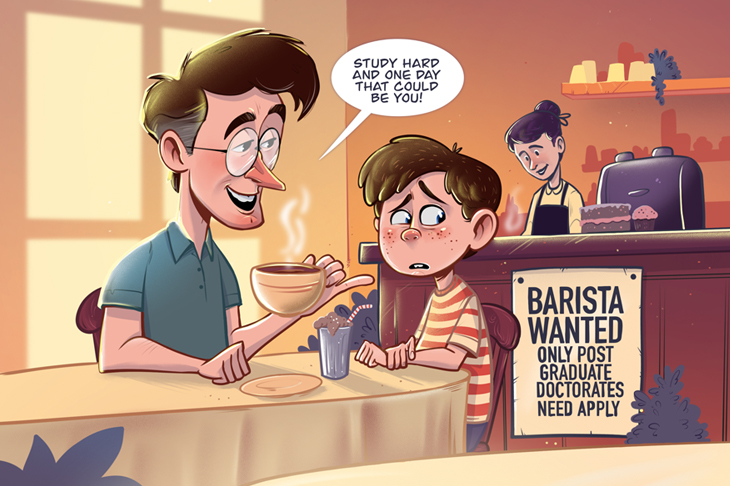
Artificial intelligence is almost certain to turbocharge the problem. If AI fulfils even moderate predictions regarding automating white-collar tasks and hollowing out the graduate labour market it could strand millions of highly educated young people in low-status jobs, or worse still, with no job. A society that already produces more law graduates than legal jobs and too many baristas with masters degrees will get uglier still.
Turchin says that history shows this leads to political violence. If we churn out ambitious elites faster than they can be absorbed, we should expect more assassinations. It might be time to tell the kids to go get an apprenticeship, or start a small business.
Got something to add? Join the discussion and comment below.
You might disagree with half of it, but you’ll enjoy reading all of it. Try your first month for free, then just $2 a week for the remainder of your first year.