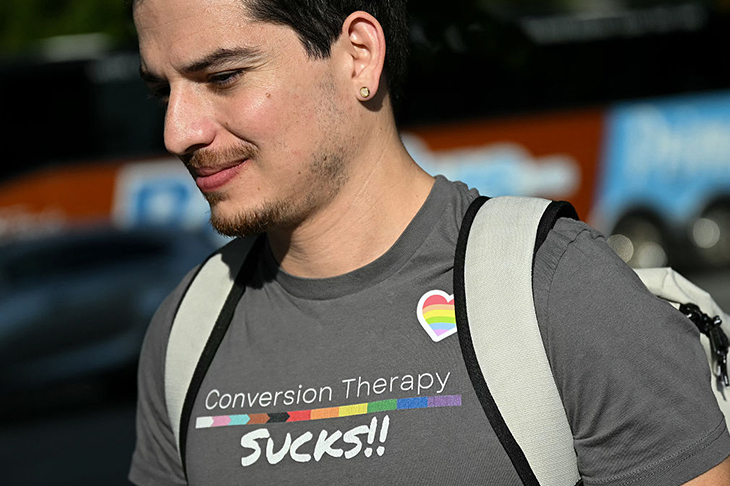
Chief Justice Roberts leaned forward. ‘Just because they are engaged in conduct,’ he said, ‘doesn’t mean their words aren’t protected.’ Now before the US Supreme Court, Chiles v. Salazar tests Colorado’s ban on so-called ‘conversion therapy’. Colorado insisted it wasn’t censoring belief – it was regulating medical practice. Roberts wasn’t buying it. The therapy, after all, consists entirely of words. Justice Alito pressed harder. If a counsellor can urge a child to affirm one identity but not another, isn’t that viewpoint discrimination – the precise sin the First Amendment forbids?
Colorado’s Solicitor General didn’t duck the question. She admitted the asymmetry and defended it: different conversations get different treatment because one aligns with professional consensus and the other doesn’t. Translation: yes, it’s viewpoint discrimination – but the state claims medical opinion gives it cover.
That exchange should echo far beyond Washington. It isn’t really about sexuality or science. It’s about who gets to speak moral hope – and whether states can criminalise certain kinds of compassion simply because professional guilds disapprove. Every age invents a new blasphemy law – ours punishes dissent from therapeutic orthodoxy.
The danger isn’t that professionals reach agreement; it’s when that agreement becomes law. A recent sitcom set in Palm Springs, California, Mid-Century Modern, shows three gay men working things out capably and powerfully without state intervention. That’s how it should be. Consensus is useful in science, but dangerous in politics. When governments turn sterile professional guidance into legal compulsion, conversation becomes contraband. What began as ‘best practice’ ends as ‘only practice’.
For decades the Supreme Court has made itself the nation’s moral weather bureau. Roe v. Wade declared abortion a constitutional right; Dobbs v. Jackson removed it. It wasn’t an assault on women – it was an admission that judges aren’t soothsayers. By returning abortion law to elected legislatures, Dobbs restored the question to voters.
This month, Roberts and Alito asked the simplest civic question: may free people still speak uncomfortable truths aloud?
Medical consensus has been catastrophically wrong before. Eugenics was consensus, forced sterilisation standard practice. Lobotomies won Nobel Prizes. The psychiatric establishment pathologised homosexuality until 1973 – evidence didn’t prompt change, culture did the heavy lifting.
If states can ban speech based on ‘current professional standards’, they can silence dissent from reigning orthodoxy – including the dissent that proves right a generation later. Therapists who told gay patients in the 1970s ‘you’re not sick’ were violating professional consensus. Under Colorado’s theory, states could have criminalised those conversations. Justice Gorsuch made this explicit during oral argument. If Colorado’s logic holds, he asked, could states in the 1970s have banned therapists from contradicting the psychiatric establishment’s view that homosexuality was pathological? Colorado’s answer: yes, if that was the prevailing standard of care.
That answer is terrifying. It means courts should only protect the speech that power already permits –and history shows how often power has been catastrophically wrong.
The Court will likely rule 6-3 for the counsellor, with Sotomayor, Kagan, and Jackson arguing that states do have broad authority to regulate medical practice and defer to professional expertise. Two more appointments – one presidential term – and free speech sceptics are in the majority.
In Australia, they already are. Justices arrive fully formed like homunculi, through whispered consultation between the Attorney-General and the legal profession.
If the Chiles question had arisen in Australia, it wouldn’t reach a courtroom at all. Several states have already outlawed such counselling – no First Amendment hurdle, no constitutional test, no public argument about free speech whatsoever. Legislators and health boards declare the science settled, and dissenting practitioners are brought into line through professional discipline. What the US treats as a contest of principles, Australia resolves by administrative consensus.
If a challenge miraculously made it to the High Court, the court would defer to professional standards, note parliament’s authority over healthcare, and decline to second-guess consensus. The judgment would be technically flawless and unnoticed. The result is government by credentialled elites. Parents who want their children to have time and alternatives before committing to lifelong medical transition or non-heterosexual lifestyles are told their preferred therapy violates ‘professional standards’. No constitutional confrontation here, we’re British! No public debate. Just quiet compliance with expert consensus. The Australian approach seems civilised compared with American chaos. But civilisation purchased through eliminating dissent is just authoritarianism with better manners.
The American Supreme Court, as we have seen lately, is opinion-rich, divided on ideological lines and increasingly partisan. Every major case becomes a culture war. But that noise, that ideological contestation protects something essential we lack here: the capacity to resist consensus. When Colorado tells the court professional opinion settles the constitutional question, six justices say no – not because they actually oppose the science, but because they understand that consensus isn’t truth, and yesterday’s consensus is often tomorrow’s scandal. Three justices will dissent, arguing that states should defer to professional expertise. Their opinions will be thoughtful, well reasoned and unequivocally wrong – wrong because they treat current consensus as eternal truth and professional opinion as neutral.
That’s what American judicial chaos protects: six justices who can tell the entire medical establishment, twenty or more state legislatures, and three Supreme Court colleagues that professional consensus doesn’t trump constitutional protection.
Australia has no equivalent judicial capacity to resist this type of erroneous reasoning. The ballot box and a capable media might – but not the High Court. Should it be asked to protect us from such egregious legislation, it won’t resist professional consensus. It embodies it.
Chiles v. Salazar asks whether a state can criminalise certain conversations with willing clients – not coercive or harmful exchanges, but those simply exploring whether a gender-dysphoric teenager might, with patience and support, become comfortable in their biological sex. A parent who says, ‘I want my child to have time before we commit to this path’ isn’t asking for electroshock or coercion. They’re asking for an alternative to the reigning protocol. Colorado says no – because professional consensus condemns them outright.
A ruling for the counsellor wouldn’t just protect the possibilities in America for therapy and for dialogue. It would stop states using professional consensus to ban any licensed professional’s dissenting speech – from doctors to teachers to counsellors. When Roberts asked whether words might still be protected even when spoken by licensed professionals, he was asking whether law still trusts citizens to manage moral disagreement. The answer from six American justices will, thankfully, likely be yes. The answer from Australia to a similar human rights issue would be stone-cold silence from the people entrusted to safeguard our most basic liberties.
Dobbs trusted voters to resolve abortion. Chiles asks whether families can navigate identity without state permission. When courts stop trusting people to work things out, freedom dies quietly.
Got something to add? Join the discussion and comment below.
You might disagree with half of it, but you’ll enjoy reading all of it. Try your first month for free, then just $2 a week for the remainder of your first year.