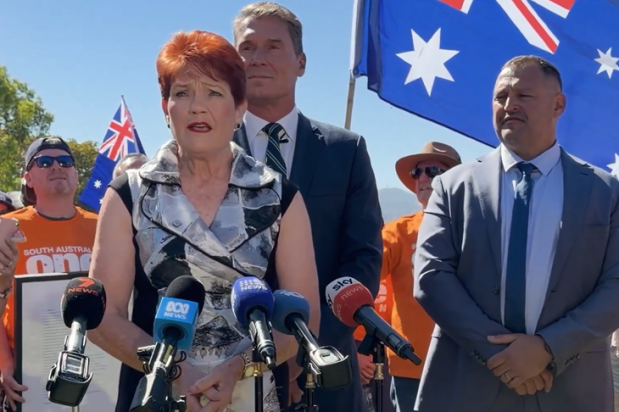
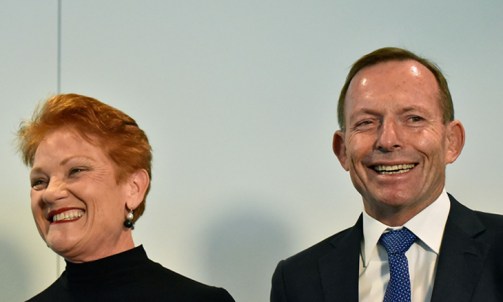
One Nation Leader Pauline Hanson said the ‘quiet part’ out loud last week when she accused supermarkets of ‘overcharging for paper bags’.
Paper bags, which usually cost around 25c, are notorious for being inferior to their free plastic predecessors.
Plenty of customers resent being made to pay for a service that was previously free while the cost of their weekly shopping skyrockets. I don’t know about you, but I can easily hold $100-worth in my hands before I need the 25c paper bag. That used to fill two trolleys.
This eyebrow-raise over the cost is especially true if you are packing the bags at a self-checkout, saving the supermarket a wage.
As one person joked, ‘Considering I’m doing all the work, do I get access to the staff tearoom?’
It’s this bizarre modern trend where we are told things are getting more automated and convenient yet customers are being inconvenienced and paying more for the privilege. Sometimes we’re given a pat on the back and congratulated for being green, but that’s starting to wear thin as a sales pitch.
When it comes to paper bags, not only do they break and give customers the shopping equivalent of ‘range anxiety’, they cannot be re-used as rubbish bags which forces people to fork out another few bucks for bin liners.
Saving the environment? Laughable.
To get her point across, Senator Hanson filmed a short video featuring holding a broken paper bag, something most of us have experienced.
I'm with Pauline.
Bring back plastic bags! pic.twitter.com/MCtuUt45a8
— Kobie Thatcher (@KobieThatcher) October 7, 2025
‘I’m over it. I’m so angry about this … for the cost of living, I’m telling Woolies and Coles, get your act together with the bags.’
As many have said, there’s is no point ‘saving the dolphins’ by ditching plastic bags if you turn around and litter the water with thousands of wind turbines.
Worse, amongst the thousands of comments left on Senator Hanson’s social media platforms are those who admit to being old enough to remember when paper bags were phased out to ‘save the trees’ and replaced by the virtuous environmentally friendly plastic bags. In truth, American supermarket chains wanted to save money.
Plastic bags started creeping into the Australian shopping experience in the late 1970s. By 1980, the removal of paper bags from major supermarkets was almost complete.
To be fair, there was originally an environmental component of bringing in plastic.
As reported by the Independent, ‘Plastic bags were invented to save the planet, according to the son of Swedish engineer Sten Gustaf Thulin who created them in 1959.’
This refers to the argument that many Australians remember about paper bags being linked to deforestation.
Some say we exchanged our forests for our seas with the switch.
However, historical discussions now show that the main reason for the change was cost. Plastic was lighter and cheaper to transport. That remained true for many decades, but with increasing government scrutiny on plastic, costs started rising. Political parties of all colours got it into their electoral campaigns that forcing plastic packaging (especially straws, for some reason) out of the market made them look green.
The freebie bag was no longer looking quite so free.
Convincing customers to start paying for something that used to be free is tricky, but taking away a plastic bag and saying, well, you have to pay a small premium to be eco-friendly with this new paper bag is a much easier argument even if customers remain miffed. There are unofficial green taxes everywhere. Customers are conditioned to accept a green tariff for moral reasons without questioning their legitimacy.
If you look back over the yo-yo bag diet of supermarkets, particularly in the US where these trends start, there is a pattern when it comes to using environmental sympathy to justify economic decisions.
Supermarkets are caught in a bit of a pickle if they stick with the purely environmental line. While paper bags are ‘biodegradable’, they are carbon-intensive to produce. If you believe that climate apocalypse is more important than the landfill apocalypse, you better stick to plastic.
And yes, trees are still being cut down for environmentally-friendly paper bags even if a percentage of production comes from recycled sources. They are still a wood-based product.
Carbon Positive Australia has pointed out that you have to be careful with assumptions about paper bags breaking down.
Biodegradable materials do not properly break down in landfill. Biodegradable materials need an environment rich in oxygen to break down properly, which they do not have in landfill. Without this, they break down into methane which is one of the most harmful greenhouse gases in our atmosphere.
The unreliability of paper bags has also led to a massive increase in heavy-duty, multiuse bags which sit around in people’s cupboards before working their way to landfill. These are said to have ‘twice the environmental impact’ and must be used ‘an estimated 10 to 20 times compared to one single use plastic bag’ while cotton bags need to be ‘used 50 to 150 times to have less impact on the climate compared with one single-use plastic bag’.
Cotton bags (those totes favoured by super green clothing stores) have a large environmental footprint because of the water and land requirements involved in cotton farming.
The degradability of our waste has been a major gripe of plastic bag marketing. If you put stuff in landfill that doesn’t degrade, you’re basically ground zero for climate evil. That’s the message. And yet no one is filling our landfill up with more permanent waste than the Net Zero renewable energy industry.
While plastic bags take 1,000 years to biodegrade, they do degrade. Fibreglass wind turbine blades, which are discarded in landfill, persist indefinitely. In other words, they never biodegrade. Global projects estimate that by 2050, 43 million metric tons of these blades will be sitting in landfill.
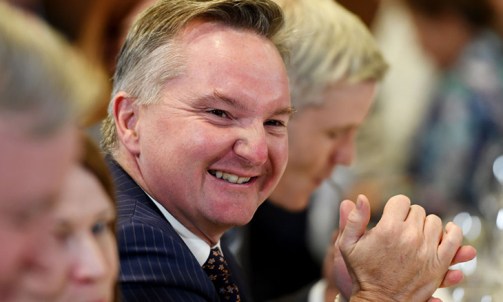
You don’t hear Chris Bowen talk about that very often…
Even nuclear waste has a shorter lifespan than a wind turbine blade.
It is not only hypocrisy that bothers consumers about this eco narrative, it is the obvious frivolity of some decisions.
Even if we follow the environmental advice to ‘only use re-useable bags we bring from home’ and everyone dutifully gives up all their single-use carry bags, we still have to throw our rubbish away in a plastic bag. What do we do? We buy plastic rubbish bags for a single-use when previously we re-used our carry bags as rubbish bags. Make it make sense…
Personally, I now have twice the rubbish in a paper bag I don’t want and a plastic bag I had to buy separately from the supermarket which is far larger than I need. It’s idiotic, really. This idiocy is made even more apparent when half the fresh fruit and vegetables come in plastic bags (they never used to) and packaging requirements for imported technology and goods have gotten so bad you’re throwing out half a forest. What caused this? Government regulation, that’s what. It certainly wasn’t a market choice.
And while we skimp on our plastic bags, Chinese companies ship us cheap goods wrapped in plastic without the slightest bit of real oversight from our busy-body overlords in government. When was the last time they inspected the environmental credentials of Chinese imports which have successfully undercut the domestic market? Our environmentally-compliant Australian companies have gone out of business and now Australia’s environmental credentials are being outsourced. It is doubtful Labor will ask any questions about this. The last thing they want to do is upset Xi Jinping with a conversation about conservation.
The truth is, Australians keep swallowing environmental narratives while opening their wallets for products they don’t really want.
So yes, Pauline Hanson is right.