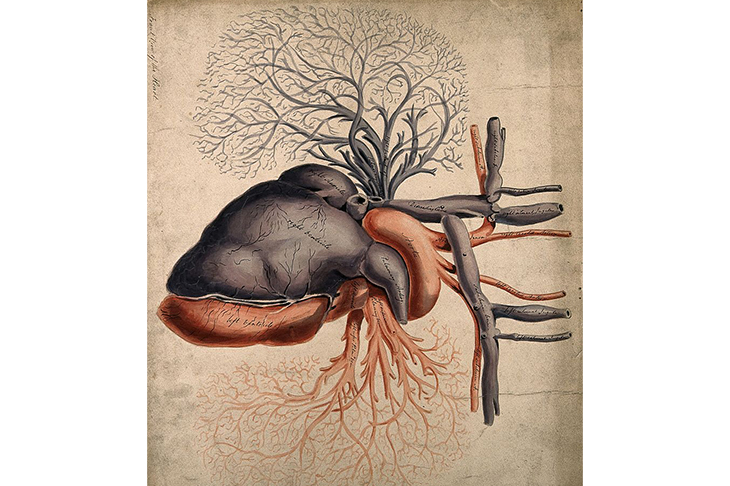
Do you know Banjo Paterson’s ‘Clancy of the Overflow’ I asked? Yes, was the answer, I have it off by heart. Why is rote learning called ‘learning it off by heart’? Why not ‘by mind’? Or ‘by brain’? We know it’s not your heart that does the learning, since a heart is ‘a hollow muscular organ of vertebrate animals that by its rhythmic contraction acts as a force pump maintaining the circulation of the blood’ (Merriam-Webster). We know that now, but people didn’t always understand that. In ancient times the heart was thought to be the centre of many things, except the circulation of the blood (discovered by William Harvery in 1628). Before then the ancient Egyptians, Greeks, Chinese, and Germanic tribes (including the early Anglo-Saxons) had weird ideas of what the heart did. From around 1387 learning something ‘by heart’ meant: ‘from memory; so as to be able to repeat or write out correctly and without assistance what has been learnt; by rote’. The Oxford goes on to say that in early Germanic languages (such as Old English) the word ‘heart’ was used to mean: ‘courage; the seat of life, of feeling, of thought, or of the will’. The Egyptians believed the heart recorded one’s good and bad deeds, and that the gods weighed one’s heart after death to determine whether the soul would enter the afterlife or be destroyed. In ancient Chinese, a pictograph originally referred solely to the anatomical organ, but by the late-4th century BC it meant the mind as well, and is often translated by sinologists as ‘heart-mind’. Aristotle described the heart as the organ of sensation. I assume when ancient anatomists opened up corpses they found the heart more or less central to the chest, so they concluded it must the ‘central’ organ that measured, remembered, and sent out all the orders. At the same time they had no idea what the grey stuff inside the skull was or what it did. And as their heirs, to this day we still we learn stuff ‘off by heart’.
Got something to add? Join the discussion and comment below.
Contact Kel at ozwords.com.au
You might disagree with half of it, but you’ll enjoy reading all of it. Try your first month for free, then just $2 a week for the remainder of your first year.