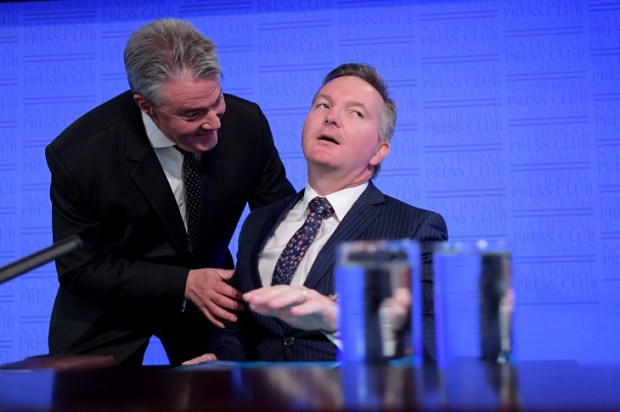
Anthony Albanese came to Washington seeking to strengthen his relationship with the US President based on mutual interests in trade and defence. He clinched the deal with an agreement that the Australian Ambassador is a joke.
The Rudd-the-Dud alliance started as a collective of Rudd’s cabinet and caucus colleagues but quickly expanded to be broad, bipartisan, and, as Trump demonstrated, international.
The agreement was precipitated when Trump was asked why the bilateral meeting had taken so long to materialise and whether it had been delayed by Albanese’s policies on Palestine, climate change, or the badmouthing of the President by the Ambassador.
Trump feigned ignorance of the insults and initially asked the Prime Minister what the undiplomatic emissary had said, but thought better of it, asking instead where he had gone.
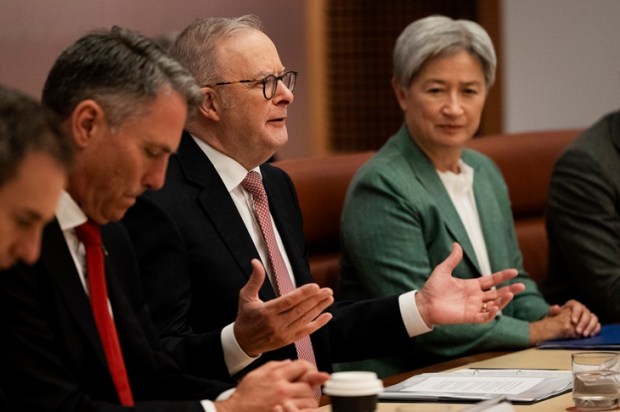
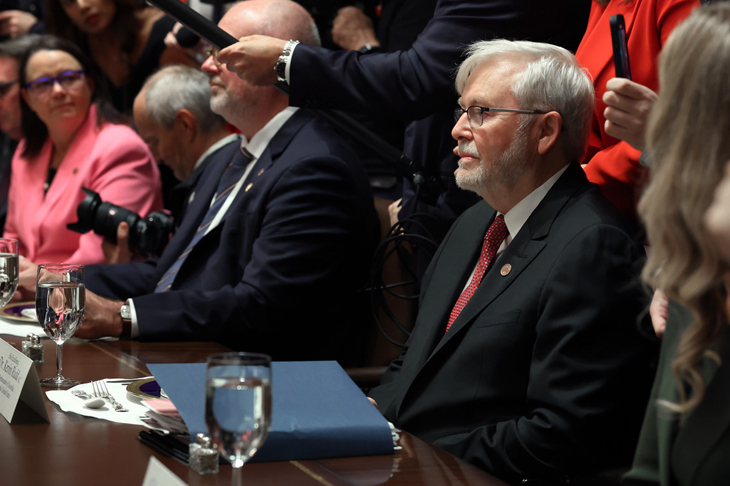
The press pack cracked up as the smirking Prime Minister pointed to his ‘great mate’ squirming across the table, as well Rudd might, after calling Trump the most destructive president in US history, a traitor to the West and a village idiot.
Trump magnanimously asked Rudd if he had ‘said bad’. It was the moment for the former PM to lavish praise on the President and disavow his intemperate invective. Even if Rudd is fool enough not to believe it, a diplomat is sent abroad to lie for his country and meant to be so skilled at flattery that when he tells you to go to hell, you look forward to the journey.
Yet all the egotistical envoy awkwardly spluttered was that he had made the comments before his ambassadorial appointment. Before he could finish his sentence, Trump cut him off saying mildly, ‘I don’t like you either, and I probably never will.’
It made Rudd look like… a village idiot and proved that Trump was indeed the most destructive president in US history when it came to Rudd’s credibility. How could he take credit for the visit when his role was so insignificant that the President wasn’t even aware he was still working in Washington, let alone sitting opposite him?
After demonising the opposition for resembling Trump in the May election, Albanese gave a new meaning to chutzpah by claiming he would use Trump’s compliments for his 2028 re-election campaign. Yet instead of bathing in the glory of his belated success, the headlines read: ‘Kevin Rude’, ‘Trump’s Ruddbath’, and ‘Rudd-faced’.
If Albanese has anyone to thank for his diplomatic triumph, it isn’t the Ambassador but Xi Jinping. Xi’s announcement, ten days earlier, of crippling export controls on critical minerals galvanised Washington into securing the US supply chain by making a deal with an ally.
Albanese claimed the agreement represented ‘a significant new chapter in the over 70 years of our formal Alliance’, but it’s a chapter that began in 2017 when Trump called for the United States Geological Survey to identify the minerals critical to America’s economy.
Senator Matt Canavan, the then minister for Resources and Northern Australia, seized the moment, realising Australia could supply most of the 35 minerals. He struck a deal with his US counterpart to explore reserves and followed up with Letters of Intent formalising the collaboration, a Critical Minerals Strategy, a report on the Critical Minerals Supply Chain in the United States, agreements signed by prime minister Morrison and Trump and a US-Australia Critical Minerals Dialogue. Presumably, Albanese missed these developments while hiding under his doona because, as he said in 2017, Trump ‘scares the sh-t’ out of him.
Yet, as Canavan said this week, for the deal to work, Albanese needs to do more than promise to slash red tape; he must slash power prices, which have soared 40 per cent under Labor, gutting mineral processing, the advanced manufacturing, where Australia had a competitive advantage until net zero policies destroyed it.
Last month, Alcoa announced the closure of its Kwinana aluminium refinery after gas prices in Western Australia had more than doubled since 2019. Meanwhile, an Australian nickel refiner that moved to Indonesia benefits from cheap, coal-fired energy, cheap labour, generous tax breaks and technological advances that make Indonesia’s lower-grade ore commercially viable, funded by a Chinese EV manufacturer.
Australia’s remaining aluminium smelters are on life support, funded by taxpayers who also compensate iron, steel and other metals manufacturers for the exorbitant cost of green energy. Meanwhile, China repeatedly floods international markets with cheap products to drive Western competitors out of business and monopolise global supply.
Xi cemented the success of the bilateral meeting when a Chinese fighter jet fired flares at a Royal Australian Air Force plane in international airspace over the South China Sea, where freedom of navigation is vital to Australia since 90 per cent of our refined fuel imports and 60 per cent of our seaborne exports transit these waters.
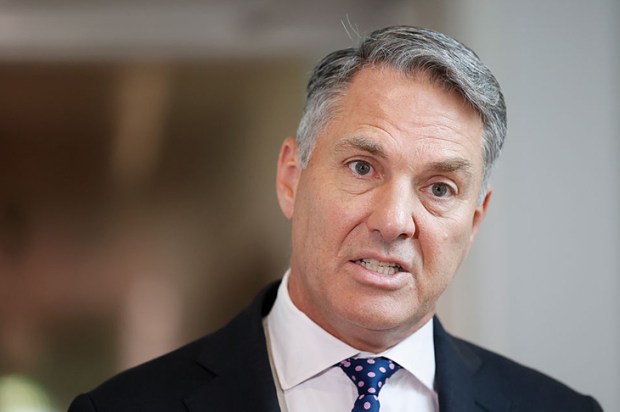
When Deputy Prime Minister and Defence Minister Richard Marles meekly lodged a formal protest, China snapped that the RAAF plane had ‘illegally intruded into China’s territorial airspace’ while the former editor of the Global Times and wolf warrior-in-chief snarled that Australia ‘needed to be taught a lesson’.
He’s right. The lesson is that panda diplomacy has not reset the relationship with China, which is not our friend.
Happily, after months of reviewing Aukus, Trump backed it. This is progress, as it is doubtful his predecessor had a clue what he was signing and couldn’t even remember Morrison’s name, referring to him vaguely as ‘that fella down under’.
Albanese would have fuelled US uncertainty about Australia’s commitment to Aukus by refusing to increase defence spending, which we should do in the national interest, instead cosying up to China and the Palestinian proxy of China’s ally, Iran.
Ultimately, however, what Australia offers the US – airfields, logistics hubs, intelligence facilities, and a new base to host US nuclear-powered Virginia-class submarines – is invaluable and Trump recognised it. This is good news for the US, Australia, the region and the West, and will hopefully help deter China from invading Taiwan.
The significance of the twin deals is evident in China’s hostility to them; their interrelated nature is highlighted by the fact that a Virginia-class submarine contains more than four tonnes of rare earths.
This was noted not by Trump or Albanese but by Canavan in a speech to the Atlantic Council in 2019, which explains why, until he returns to the frontbench of the Coalition, it will tear itself apart in the political wilderness.
Got something to add? Join the discussion and comment below.
You might disagree with half of it, but you’ll enjoy reading all of it. Try your first month for free, then just $2 a week for the remainder of your first year.