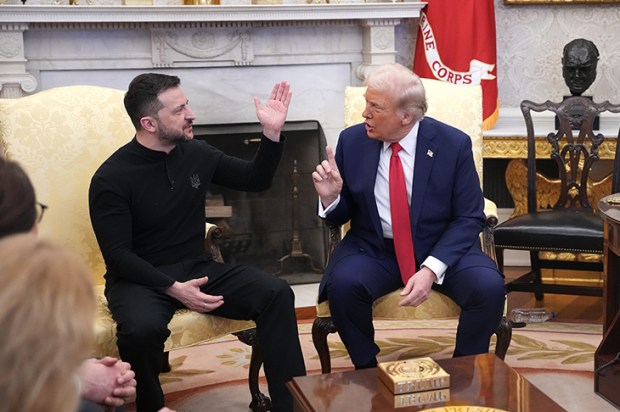
President Trump has been widely mocked for his claim that he could end Russia’s war against Ukraine in 24 hours. Indeed, believing his personal persuasion of Putin and Zelensky would allow a deal that eluded others, he underestimated the challenges.
In fairness, Trump’s optimism that Putin after three years of war would be open to a peace deal reflected the view of many Kremlin observers – including this columnist. The conflict Putin’s military told him would be over in three days has been a disastrous failure, with only 19 per cent of Ukraine occupied, a million Russian military casualties – plus 1,000 more each day – and the nation reduced to an economically struggling, sanctioned pariah. And, far from stopping Nato’s enlargement, Putin expanded it by terrifying Finland and Sweden into joining.
Putin will never face a leader of the free world as prepared as Trump to be accommodating about a peace deal that would allow him to keep the spoils of his aggression. Yet he thinks he’s winning and seems uninterested in ending the conflict short of Ukraine’s defeat.
The war has also, of course, been horrendous for Ukraine, with over half a million military and civilian casualties and up to 11 million internally displaced or refugees. Yet heroically it’s resisted significant recent military advances while launching audacious attacks into Russian territory. Still, Zelensky, unlike Putin, is prepared to compromise to achieve peace: with his people exhausted and pressure on manpower, supported by public opinion, he’d probably accept the de facto loss of Crimea and other Russian-occupied territory in return for cast-iron Western security guarantees.
The basics of the war are straightforward. Ukraine wants independence and the EU and Nato membership granted to most of Moscow’s other European former vassals. Putin rejects those ambitions because he claims Ukrainians are really Russians and anyway Moscow should have the right to dominate the neighbourhood. His regime calls Zelensky an ‘illegitimate leader’. While Vice President Vance says Putin would accept a sovereign Ukraine, that looks doubtful. Compromise seems impossible.
Trump, driven by a genuine horror of war, deserves praise for making a concerted effort to end this one. There briefly seemed hope of momentum toward a deal after the Anchorage summit where it appeared Putin would settle for less than the whole of Ukraine and the Kremlin would agree to Western states giving it Nato Article 5-style security commitments – a concession described by Trump’s team as ‘a game-changer’.
But Putin demands the whole of the Donbas, which would require the Ukrainians to surrender unconquered territory thousands have fought and died to defend, with trivial compensating land in return. As for Western security guarantees, Trump’s special envoy, Steve Witkoff – who appears to have little understanding of Kremlin politics and unwisely met Putin, ahead of the Alaska summit, alone – appears to have been mistaken in his ‘game-changer’ claim. Moscow insists it would agree to international security ‘guarantees’ to Ukraine only on the absurd condition that it (and China) have a veto over them. Putin opposes any stationing of Nato member-state forces in Ukraine, so a Europe-led ‘coalition of the willing’ peacekeeping force won’t happen, unless it takes the inconceivable step of ignoring Russian objections. Moscow also insists Ukraine’s armed forces be radically reduced. In other words, the Kremlin proposes that any ‘peace’ deal leave Ukraine at its mercy. Given Ukraine’s bitter experience of previous betrayals, it has every right to reject a deal that lacks cast-iron security guarantees. The 1994 Budapest Memorandum saw Ukraine surrender its nuclear arsenal in return for solemn pledges from the US, Britain and Russia to respect its sovereignty and borders. It proved worthless.
Putin probably fantasised that Trump would be a reincarnation of Roosevelt, who in 1945 acquiesced to Stalin’s dominance over Eastern Europe. But, while Putin clearly relished the Anchorage red carpet treatment and is publicly friendly towards Trump, his actions suggest contempt. He seems never to have had any intention of acting on Trump’s announcement after the two Anchorage and Washington meetings that the next stage in a peace process would be a Putin-Zelensky summit. Instead, he’s raising a middle finger to the West with increasingly ferocious air attacks on Ukraine, supplemented with multiple provocative intrusions into Nato territory. Trump, with his repeated failure to follow through on new sanctions, is partly to blame for emboldening Putin. Additional signs of weakness, such as dropping his earlier insistence on a ceasefire and Zelensky’s participation in the Anchorage summit, haven’t helped.
Trump is clearly exasperated with Putin and has signalled his preparedness finally to give Congress the green light for the Graham-Blumenthal Act, which would allow him to punish Russia with ‘secondary sanctions’ – starting at 500-per-cent US tariffs – on countries which import its energy products. Trump finally seems to mean business, having already punished India – Russia’s second-biggest energy export market – with tariffs in line with the Act. He appears confident that hitting China, Russia’s biggest energy export market, would elicit Chinese pressure on Russia to end the war.
However, Trump has made it clear he’s not prepared to do this unless Nato acts together, collectively imposing 50-to-100-per-cent tariffs on China. He’s also insisted Nato members must stop their ‘shocking’ practice of importing Russian oil. There are three miscreants: Hungary, Slovakia and Turkey, Moscow’s third-largest customer.
America’s Nato allies will balk at Trump’s demands, especially as he’s given exemptions on oil imports to Maga-friendly Hungary and Slovakia. Some commentators see his pressure for joint sanctions pressure as a stalling tactic. But, just as he’s stopped Europe’s long history of defence freeloading in Nato, it’s reasonable for him to insist that the US shouldn’t be expected to risk a trade showdown with China to end a war in Europe’s backyard without Europe’s full support.
Trump has accepted that his peace efforts might fail. At least while Putin remains in power, that seems to be the likelihood. Trump’s criticism of Biden for allowing Afghanistan to fall to the Taleban and his signature commitment to a Ukraine peace deal mean he wouldn’t similarly let it go under. But, for the foreseeable future the war seems likely to continue, a grim near-stalemate with neither side able to achieve victory.
Got something to add? Join the discussion and comment below.
You might disagree with half of it, but you’ll enjoy reading all of it. Try your first month for free, then just $2 a week for the remainder of your first year.