The decline of religion is disappointing, and not only because of the immortality or not of the soul.
That disappointment can also be explained in a saying attributed to Chesterton, at least in my preferred version: ‘When a man stops believing in God, it’s not that he then believes in nothing; it’s that he’ll believe in anything.’
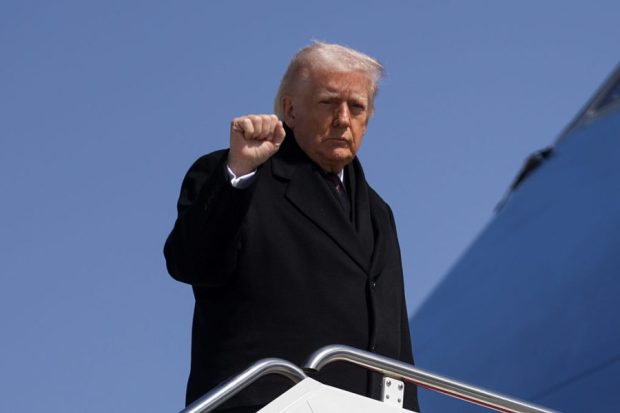
This has been exacerbated by the replacement of education with left-wing indoctrination and the failure of most conservatives to reverse this, with Donald Trump being the leading exception.
As a result, too many young people leave school indoctrinated, and with diminished numeracy and literacy, both textually and with respect to science.
Consequently, they find it difficult to resist the left’s most destructive mantras.
Two presently dominate: ‘The science is settled on global warming’ and ‘From the river to the sea’.
The meaning of the latter is that by recognising a non-existent state, controlled partly by terrorists and partly by a corrupt despot, the only democracy in the Middle East, the one on ancient Jewish land, is to be liquidated.
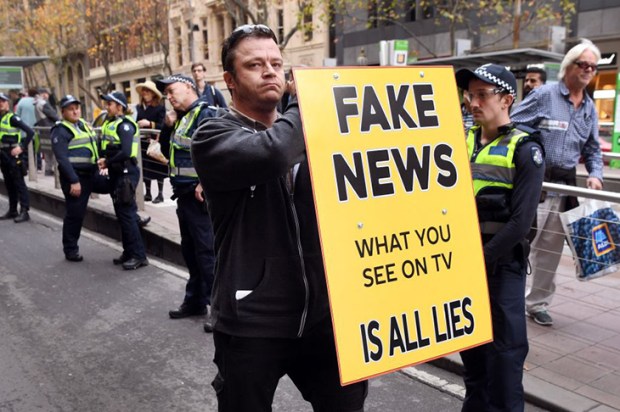
Both mantras are supported by the exclusion of any alternative as a legitimate argument by the majority of the world’s leading English-speaking media who have chosen, on this, to be the left’s propaganda arm.
While the Murdoch media and commercial talkback radio remain notable exceptions, most people receive little or no information challenging either mantra.
But when the US Department of Energy (DoE) released a major report in July on the very question of climate catastrophism, you would have thought it would have received attention from the media at least as full as, say, their coverage of Taylor Swift’s engagement .
Instead, much of the mainstream media either ignored it or reported it minimally, concentrating on critiques of it.
Commissioned by the US Energy Secretary, Christopher Wright, an engineer and a successful businessman, the report was written by some very distinguished climate scientists together with a noted environmental economist. Known to the well-informed on climate catastrophism, they are John Christy, Judith Curry, Steven E. Koonin , Ross Mc-Kitrick and Roy W. Spencer.
Anyone challenging climate catastrophism must be courageous, just like Australia’s best-known geologist, the prolific author Professor Ian Plimer.
Nevertheless, politicians frequently refer to ‘the’ science’, falsely claiming scientific unanimity on catastrophism.
As to the US report, the authors cannot be attacked as ‘deniers’.
But they conclude that even if the United States motor vehicle industry were closed down, with all those trucks, cars and buses, the effect on the climate would be so small, it could not be measured.
The corollaries are obvious.
All those measures taken against CO2 emissions, for example, those favouring electric cars, are pointless.
And given that this US industry is around 15 to 20 times Australia’s, the Albanese government’s policy of making electricity so expensive that small businesses are closing, farmers are damaged, families are struggling and investors are avoiding Australia, spending billions on so-called renewable power, enriching Beijing, is untenable.
Meanwhile, the Prime Minister has just revealed his secret wish: four-year fixed terms. The Coalition is also in favour.
Australians should vote ‘No’ unless there is a deal to make politicians constitutionally accountable 24/7. To achieve this, the people must be able to recall the government. Also, the monopoly that politicians currently enjoy to introduce a constitutional referendum should be shared with the people.
Only then should people agree to give governments four-year terms.
Returning to the content of the DoE report, it is worth noting some of its carefully considered conclusions.
Apart from arguing that US policy actions alone will have an undetectably small direct impact on the global climate, the report concludes that CO2-induced warming is likely to be less damaging to the economy than commonly believed.
Indeed, excessively aggressive emissions mitigation policies could be more detrimental than any beneficial effects, which, in any event, would emerge only after a long delay and at great economic cost.
In addition, it was pointed out that while CO2 does have a warming influence, it also has a ‘fertilising effect’ that contributes to increased plant growth, global greening and agricultural productivity, benefits often overlooked in climate assessments.
Despite what Prime Minister Albanese claims about extreme weather events, the report’s authors find no clear, long-term trends in the frequency or intensity of hurricanes, tornadoes, floods and droughts.
While CO2 absorption in seawater makes the oceans less alkaline, the report notes that the Australian Great Barrier Reef has shown considerable growth in recent years.
They find no obvious acceleration beyond the historical average rate of sea-level rise, while the projections in climate models generally ‘run hot’, i.e. they show warming biases.
Due to these discrepancies, long-term projections of future warming are likely to be exaggerated.
While the IPCC downplays the role of the sun in climate change, there are ‘plausible solar irradiance reconstructions’ that imply it contributed to recent warming.
The report is surely correct on this point and also in drawing attention to evidence that urbanisation biases in the land-warming record have not been completely removed from climate data sets.
Economic damage from warming, they find, is thus often overstated, while a single-minded focus on reducing emissions, they say, is a flawed strategy because it fails to consider the broader context of human welfare and energy poverty.
The report concludes that policies based on fear, rather than facts, could endanger human wellbeing and that a more pragmatic approach, focused on innovation and adaptation, is needed.
This report demonstrates how Australians should not tolerate billions being delivered through various toadies to end up in Beijing, all in what is here exposed as the entirely fictional cause of climate catastrophism.
At some point, the question must be asked whether ministers are committing the actionable wrong of misfeasance in public office, even to the extent of engaging their personal financial responsibility.
Got something to add? Join the discussion and comment below.
You might disagree with half of it, but you’ll enjoy reading all of it. Try your first month for free, then just $2 a week for the remainder of your first year.