The news for Australia concerning President Trump’s UK state visit is not so much about the King’s reference to Aukus. It is about the remarkable breakthrough in affordable CO2-free baseload energy. This has no doubt alarmed the Albanese government.
As part of the $200 billion in US investment, with added British investment, the UK will become a major player in the international market for low-cost, prefabricated, and very safe nuclear small modular reactors.
Along with already planned larger ones, they will provide the UK with a significant amount of emission-free baseload power.
What this breakthrough demonstrates is that the Albanese-Bowen plan to impose massive costs on Australian households and businesses, while enriching Beijing, is entirely unnecessary.
Is it any surprise that this is being ignored in Australia?
Meanwhile, the state visit has also proved an overwhelming success for the continuation and strengthening of the ‘special relationship’. To appreciate this, we should go back to Winston Churchill, who long ago argued that the Declaration of Independence is, after Magna Carta and the Bill of Rights, the third great title-deed on which the liberties of the people of the English-speaking world are founded.
Central to that are those self-evident truths that all men are created equal, that they are endowed by their Creator (and not by government) with certain ‘unalienable rights’, and that among these are ‘life, liberty, and the pursuit of happiness’.
And yet, these truths are being challenged by the rise of beliefs totally alien to them, dark and evil beliefs which, if applied universally as intended, will seriously damage mankind and destroy our civilisation.
It is important, then, that from time to time we hear rallying calls reminding us of the essence of our civilisation.
Within living memory, and with the benefit of Western technology, the world has identified the voices and heard the messages of great world leaders, giants like Churchill and Kennedy, Reagan and Thatcher.
We sometimes forget that, as befits the very notion of democracy, they have been criticised and opposed.
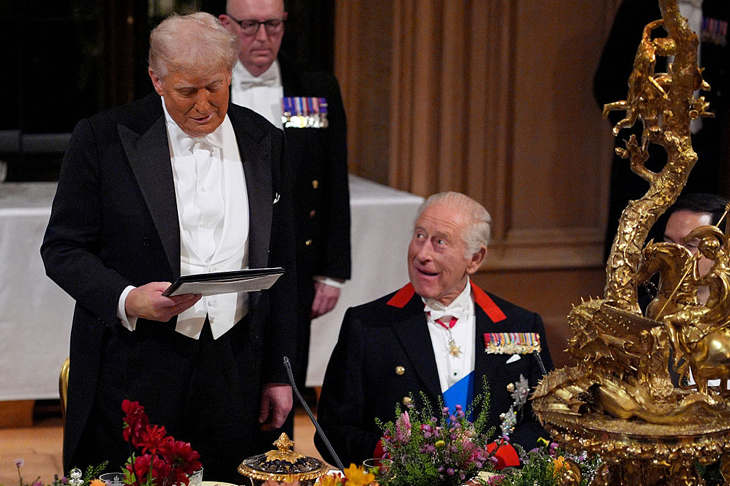
We have just heard at Windsor Castle messages from two much-criticised leaders recalling the centrality of the English-speaking world in mankind’s most-advanced civilisation.
What they have said demands consideration in schools and universities, the media, and across the broad citizenry.
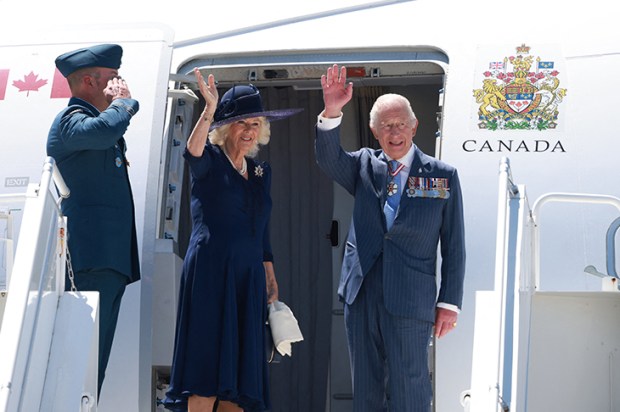
One was by Charles III, king of a worldwide collection of realms and territories and head of a vast commonwealth of nations.
It was a long-held belief of Australia’s republican movement that his accession would deliver their politicians’ republic almost by acclamation.
Instead, the accession was followed by increased support for our crowned republic, signalling that, as Graham Richardson long ago declared, if the republican movement is not dead and buried, it is comatose.
Charles is a monarch whose byword, like that of the Windsor dynasty, is service.
The other message was from the president of the imperial republic at the very heart of an increasingly vibrant Pax Americana leading the Western world, who, despite his achievements (including markedly advancing on this visit the cause of CO2 emission-free energy), is still both unfairly reported and the subject of an abusive and even lethal campaign.
This will never deny him the likely objective historical assessment of being one of the handful of truly great American presidents.
His second state visit to the United Kingdom, a rare and beautifully choreographed honour extended by the monarch on the advice of government, centred on a clear desire to maintain the two countries’ ‘special relationship’.
Recalling that it was Winston Churchill who coined the term ‘special relationship’ and that his bust graces the Oval Office, the President said at the state banquet that, ‘seen from American eyes’, the word ‘special’ does not begin to do the relationship justice.
Pointing out that the two nations are joined by history and fate, by love and language, and by the ‘transcendent ties’ of culture, tradition, ancestry and destiny, he drew an analogy between ‘two notes in one chord’, each beautiful on its own, but really ‘meant to be played together’.
The bond of kinship and identity between the United States and the United Kingdom is, he affirmed, ‘priceless and eternal, irreplaceable and unbreakable’.
The centrepiece of this state visit was a long carriage procession accompanied by the Household Cavalry Mounted Regiment, followed by a ceremonial welcome in the Quadrangle.
Unlike the intimidating and unnatural Stechschritt or goose step, and parading tanks and rockets, a parading cavalry is a magnificent sight combining fluid motion and disciplined precision, thus creating a single, coordinated entity which moves with grace and power, and, with the gleam of polished brass, silver and steel on bridles and uniforms, adding to the visual spectacle.
It is unfortunate that terrorists have ensured, far more than spoilers, what is the firm assessment of the security services: it is no longer possible for an American president to take part in a public ceremonial procession.
But through modern technology they cannot stop the world from seeing it.
It is likely that over one billion people saw at least core parts of the event.
While there is an enormous interest in our royal family, one of the curious decisions of certain media during the Australian republic referendum campaign was to boycott royal reporting.
However, as the London newspaper, the Independent, found with its original royal boycott, such reporting can become unavoidable.
As to the state banquet, recalling that the nations are united by a common language and shared heritage, the King identified the extraordinary advances in every field of endeavour made in the English-speaking world.
The President praised the ‘lion-hearted people of this kingdom’ who defeated Napoleon, unleashed the Industrial Revolution, destroyed slavery and defended civilisation in the darkest stages of fascism and communism. The British, he recalled, gave the world the Magna Carta, the modern parliament, and Francis Bacon’s scientific method.
The ‘special relationship’ is not only alive, it has been strengthened.
Got something to add? Join the discussion and comment below.
You might disagree with half of it, but you’ll enjoy reading all of it. Try your first month for free, then just $2 a week for the remainder of your first year.