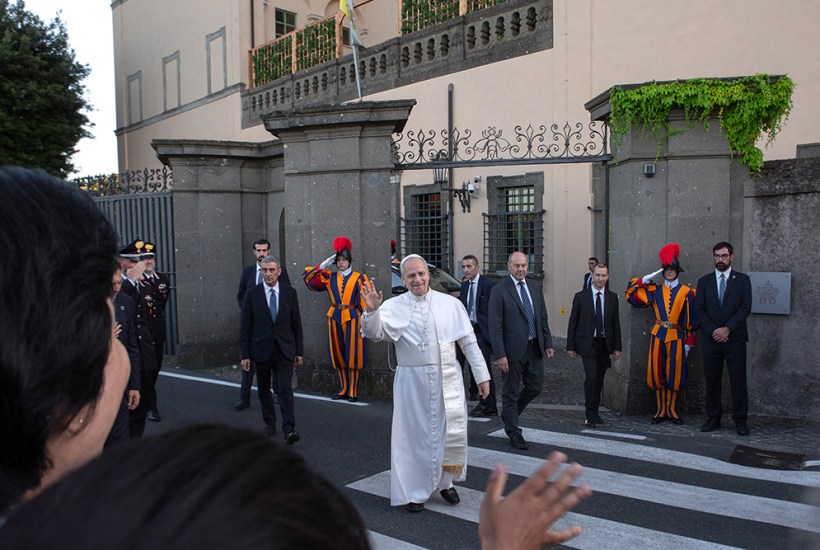
Over the last few weeks, Pope Leo XIV resumed the tradition of popes spending some part of the summer at the papal residence in Castel Gandolfo, located in the lakeside town about thirty kilometres south of Rome. He will be the first pope to use the summer residence since 2013, when it was eschewed by Pope Francis in favour of supposedly more frugal accommodations. This ‘frugality’ also included Francis’ decision to reject the papal apartments in the Apostolic Palace in favour of the Casa Santa Marta guesthouse (mainly used as a guest-house for visiting clergy or dignitaries).
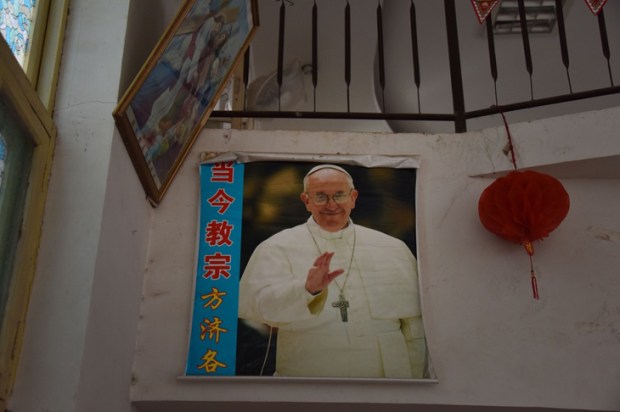
This, along with the decision not to go to Castel Gandolfo, was constantly parroted by the secular media as evidence of Jorge Bergoglio’s humility. However, as with nearly everything about Francis’ pontificate, it was performative piety – and anything but frugal.
Recent investigations by Italian newspaper Il Tempo revealed that Francis’ decision to live in the Santa Marta guesthouse cost the Vatican almost €200,000 per month, totalling around €29 million over the 12-year pontificate, equivalent to around $AU55 million, thus contributing to the already dire state of the Vatican’s finances.
Is it any wonder Pope Leo wanted to get away for a while?
As reported by the Catholic News Agency, papal ties to Castel Gandolfo date back to 1596; it became an official papal residence 30 years later. The Baroque architect Gian Lorenzo Bernini – the same Bernini who designed the colonnade of St Peter’s Basilica – made additions to the property’s historic villa, initially built by the Roman Emperor Domitian in the first century AD.
Since the Lateran Pact of 1929 with the Italian government, when it became part of Church territory, Popes Pius XII, John XXIII, Paul VI, John Paul II and Benedict XVI all spent at least part of the summer at Castel Gandolfo, not just to escape Rome’s oppressive heat, but also where they would pray the Sunday Angelus and mingle with the townspeople and visitors. Indeed, Papa Prevost has held the usual Sunday Angelus from Castel Gandolfo during the last two weeks.
However, there has been much speculation that the pope would be using this time, in addition to rest, to think about senior appointments in the Church and possibly prepare a new encyclical.
Normally, popes use their first encyclical as a way of highlighting certain key priorities they wish to focus on during their reign.
There have been suggestions the new pope would start to gently re-emphasise Catholic teaching, however, as yet his young pontificate has many unanswered questions.
In a recent assessment, Kazakhstan Bishop Athanasius Schneider summed up this urgent need to answer some of the more pressing of these questions, declaring: ‘[I]t would be a most urgent act of the new Pope to issue a document or magisterial act… to clarify, rectify, those issues in doctrine and morals which were in the last decades and especially in the last pontificate undermined and disfigured, or sometimes even denied.’
The bishops Leo has appointed so far give cause for concern – particularly since prior to his election he was Head of the Dicastery of Bishops. One appointment is that of Shane McKinlay as Archbishop of Brisbane, who is a big fan of the process of the ‘Synod on Synodality’ and the idea that the Church should ‘blend in’ with the modern world.
This correspondent has also focussed on the key Church officials who have been the cause of widespread controversies in recent years. These include:
Cardinal Manuel Fernàndez, prefect of the Dicastery for the Doctrine of the Faith, whose extensive theological expertise can be found in a notorious book he published on French kissing and ‘mystical orgasms’.
Cardinal Arthur Roche, prefect of the Dicastery for Divine Worship, responsible for implementing the draconian restrictions on the Latin Mass.
Cardinal Pietro Parolin, Secretary of State, responsible for the disastrous Sino-Vatican deal.
It has been rumoured that the pope will use his time at Castel Gandolfo to think about these appointments and their wider impact on the Church.
In doing so, maybe the pope could keep in mind two key anniversaries that arise this year.
The first is the seventeen-hundredth anniversary of the Nicene Creed, the most definitive statement of Christian faith which tells us emphatically that we believe in one God, the Father, Son and Holy Spirit.
This immemorial prayer was decreed at the Council of Nicaea in 325 AD, the first gathering of Christian bishops from across the Roman Empire. Recited or chanted in churches across the world every Sunday, it remains the most widely recognised summary of Christian faith, defining what it means to be part of the one, holy, catholic and apostolic Church. It reminds us we were created by God in His own image, redeemed by His incarnated Son, Jesus Christ, ‘God from God, Light from Light, very God from very God… being of one substance with the Father’, and of His resurrection which gives us hope that we might one day be with Him ‘in the life of the world to come’.
Maybe Pope Leo could encourage the Church to rediscover the faith so beautifully defined by its fathers 1700 years ago.
The second anniversary concerns the 60 years since the end of the Second Vatican Council (Vatican II) in December 1965. The aftermath of the Council led to the failed experiment of aggiornamento (updating) that has taken place in the Church since the late-1960s, which has led to dwindling congregations, except in parishes and orders that are faithful to tradition and doctrine.
Pope Francis’ Synod on Synodality – which the late Cardinal George Pell so presciently decried as a ‘toxic nightmare’ that was ‘couched in neo-Marxist jargon’ is promoted as an extension of Vatican II. Indeed, in documents just released by the Vatican, this aspect is reiterated.
Cardinal Pell wasn’t the only stringent critic of the Synod. The aforementioned Bishop Schneider is one, as is the Hong Kong Cardinal, Joseph Zen, who has described its outcome as a ‘matter of life and death for the Church’.
Therefore, Pope Leo has plenty to think about over his summer holidays. All of which raises the question: when will Pope Leo start ‘poping’ and restore order to the Church after the chaotic and catastrophic papacy of Pope Francis?
Got something to add? Join the discussion and comment below.
You might disagree with half of it, but you’ll enjoy reading all of it. Try your first month for free, then just $2 a week for the remainder of your first year.