I rarely praise actors, or indeed listen with interest to anything they have to say. Like Ricky Gervais pointed out, most actors spent less time in school than Greta Thunberg. So it was a pleasant surprise to hear some genuinely revealing words from the star of Spy Kids 4: All The Time In The World. Consider my cynicism about wealthy, out-of-touch elites and the luxury belief class well and truly proven wrong. Well, maybe just this once.
Jeremy Piven was recently in Australia for a series of stand-up shows. It appears that the three-time Emmy-winning actor, best known for his portrayal of agent Ari Gold in the blockbuster HBO series Entourage, is also a comedian. When asked about his favourite place to visit during his most recent Australian tour, Piven selected Perth. Maybe because of its stunning coastline or its beautiful women? No, his answer surprised me. It wasn’t bucolic or aesthetic: the reason was crystal meth, a potent and highly addictive stimulant. ‘In the middle of my tour, we headed over to Perth, which is the meth capital of Australia,’ Piven told the Daily Mail. ‘I want to rename Perth, Merth.’
For a tenured professor of comedy, the set-up is weak, and the punchline could be a little better. But the 60-year-old comedian makes a point. The irony is that he is not joking. Just before Piven jetted off to New Zealand to continue his tour, data was released confirming Perth’s reputation as one of the world’s biggest methamphetamine hot spots. The Australian Criminal Intelligence Commission (Acic) has identified Perth as the state capital with the highest per capita meth usage, noting that Western Australia leads the country in meth consumption rates. In 2022, Acic reported that Australia ranked first globally for recorded meth consumption per capita. Asian crime syndicates have fuelled this, but another equally guilty, hairier group also bears responsibility.
You’ve been watching too much Sons of Anarchy if you thought motorcycle gangs were simply law-abiding AC/DC fans chasing bad guys out of town and helping elderly people cross the street. It was around the same time that Ron Perlman was boring audiences into a coma with his wooden performance as the laconic Neanderthal Clay Morrow of the titular motorcycle gang that the real world was awakening to the visceral violence inherent in these organisations. The Sydney airport murder of Anthony Zervas in 2009 brought bike gangs to prominence in Australia. Hells Angels and Comanchero gang members discovered they were on the same flight from Melbourne and arranged for their soldiers to meet them at Sydney airport. Amidst a crowd of shocked travellers, the brawl culminated in Zervas being brutally attacked with steel bollards and fatally stabbed.
It was the worst and most public display of biker violence for decades. Older Australians may remember the Milperra massacre of 1984, when a gunfight between the Bandidos and Comancheros left six gang members and an innocent 14-year-old girl dead. A further 28 were wounded.
It was the carnage that befell the airport’s domestic terminal that brought to light a blood-soaked turf war that had felt confined to the suburbs until then. In an effort to minimise national scrutiny, many gangs reorganised their operations, shifting from overt displays of violence to a more covert and sophisticated role within the international drug trade network.
Since the Taleban regained control of Afghanistan, they have effectively eradicated opium production, leading to a drastic decrease in the global supply of heroin. Manufacturers have to diversify as a result, and I don’t mean by imposing racial quotas in the coca fields. For some inexplicable reason, criminal gangs do not worry about DEI. Methamphetamine has various advantages over traditional narcotics for manufacturers. Unlike cocaine and heroin its principal ingredients do not need to be cultivated from coca leaves or opium poppies: they may be manufactured in laboratories. The chemicals are primarily produced in and around China, also known as the Golden Triangle in Southeast Asia, where the borders of Laos, Thailand and Myanmar meet. The majority are developed in laboratories in the Shan State, a region of Myanmar near the Chinese border, and the bulk of this potent cargo is destined for Australia.
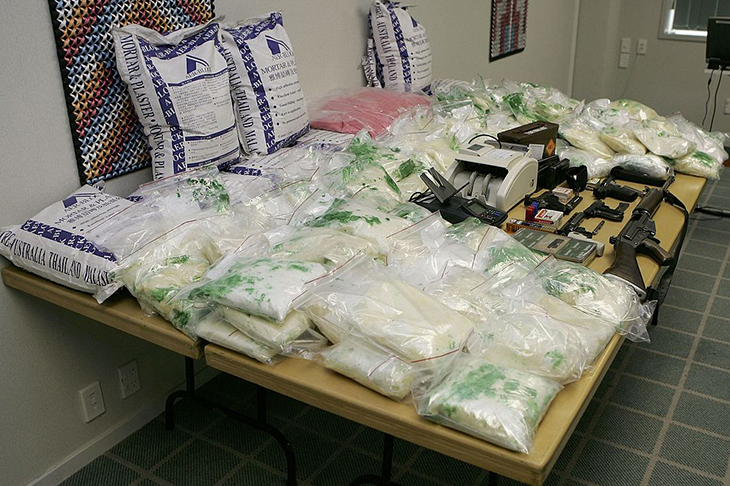
Drug traffickers exploit Australia’s vast and porous coastline, using Indonesian fishing boats to smuggle narcotics into the country. Upon arrival, motorcycle gangs distribute the drugs throughout the country. It’s easy to see why: with a kilogram of meth costing as little as A$700 to produce and a potential street value of A$280,000, the profit margin is massive.
While cocaine has long been the drug of choice for wealthy Westerners, methamphetamine has become a huge problem. The price of meth on Perth’s streets is reportedly as low as A$300 per gram, stimulating demand, no pun intended. In the year to July 2024, Australian Federal Police and Border Force officers seized almost 34 tonnes of hard drugs, with methamphetamine accounting for one-third of that total. Last week it was discovered that West Australian Police recovered 40kg of meth worth more than A$18 million between June and July.
Fighting the ‘war’ on drugs is difficult. As Carver says in The Wire, you can’t call this a war; wars end. Criminal gangs evolve, and more complex and sophisticated smuggling networks arise. Police and border officials are attempting to prevent a dam from bursting with sticky tape. Despite the commendable efforts, photo-ops, and high-profile arrests made by law enforcement, methamphetamine continues to flood onto the streets of Australia. Yet dealers sound more like Adam Smith than Pablo Escobar, promoting themselves as mere participants in a free market, catering to the demands of individual choice.
Meth is one hell of a drug. Long-term users may experience chronic psychosis, schizophrenia, congestive heart failure, myocardial necrosis, and of course, immediate cessation of life. A friend of mine took his own life because he could not cope with the withdrawal. It’s one reason why I’m not a libertarian.
Thank you for speaking out, Jeremy, but I still can’t forgive you for My Dad’s Christmas Date.
Got something to add? Join the discussion and comment below.
You might disagree with half of it, but you’ll enjoy reading all of it. Try your first month for free, then just $2 a week for the remainder of your first year.