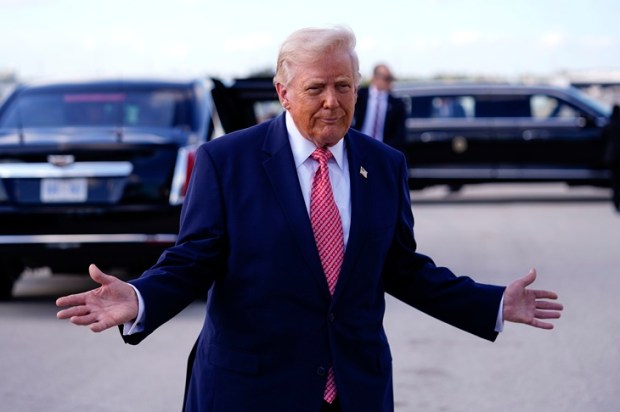
Of all the nation states in the Middle East, Syria has been the longest and most implacable enemy of Israel. Even Iran, before the 1979 Islamic revolution, experienced friendly albeit informal relations with the Jewish state. And pre-Erdoğan Turkey was an actual ally of Israel. No such cordiality has ever existed between Syria and Israel. So what to make of the White House’s announcement it would be hosting ‘preliminary discussions’ with the two long-term foes? Trump even hinted at the possibility of Syria joining the Abraham Accords. Was it just a case of the Bullshitter-in-Chief making another play for the Nobel Peace Prize?
It’s true that, officially at least, neither Damascus nor Jerusalem are at the moment planning anything more than a potential security agreement between their two countries. That is, an updating of the 1974 Agreement on Disengagement in the aftermath of the Yom Kippur war. Moreover, the new Syrian President, Ahmed al-Sharaa, was formerly a key leader of the al-Qaeda affiliate known as the al-Nusra Front. His latest outfit, Hay’at Tahir al-Sham (HTS), turned against al-Qaeda. It ruled the province of Idlib, with Turkish assistance, for a number of years before sweeping into Damascus late last year and overthrowing the Assad regime.
Prime Minister Netanyahu was not alone in believing the new Syrian President would be no less inimical to Israel’s security interests than Assad. Although al-Sharaa, from the start, insisted he was eschewing transnational jihad in favour of national salvation, the HTS remains informed by strict Sunni concepts. Already, according to reports, the availability of alcohol in Damascus has tightened. Exchanging military fatigues for a statesman-like suit and tie, al-Sharaa insists he wants peace with his neighbours, including Israel, so Syria can recover from its hellish civil war. One area of agreement between al-Sharaa and Netanyahu is a shared enmity towards Isis on the one hand and the Iranian Revolutionary Guards/Hezbollah on the other. Regardless, Israel views HTS as a case of ‘Sunni extremism’ and created a buffer zone inside Syria adjacent to the Golan Heights when al-Sharaa seized power in Damascus late last year.
Al-Sharaa, for his part, has been keen to convince the world that over time he can deliver a democratic political transformation in Syria. His pledge is to unite its many religious and ethnic minorities, Alawites, Shiites, Druze, Christians, Kurds et al. And yet as recently as March this year, some 1,500 Alawites were brutally murdered over a few short days, presumably by gunmen associated with the HTS. Al-Sharaa registered his unhappiness at the whole business and promised to punish the perpetrators, ‘even among those closest to us’. Still, Trump’s initial assessment of the change of government in Damascus, back in December 2024, appeared to be confirmed: Syria was ‘a mess’ and the United States ‘should have nothing to do with it’.
What, then, accounts for Trump’s dramatic volte-face? In May, during his stopover in Saudi Arabia, Trump was persuaded by Crown Prince Mohammed bin Salaman (MBS) to meet face to face with a Western-attired al-Sharaa. Their relatively brief tête-à-tête was enough to convince the dangerously positive – the naysayers would say positively dangerous – Trump that the Syrian President, previously a ‘terrorist’ with a $10-million bounty on his head, happens to be a ‘young attractive tough guy’ who wants only to Make Syria Great Again. Impulsively, Trump made the unilateral decision to lift sanctions on Syria and give the country a ‘fresh start’.
There are a host of reasons to question Trump’s judgement. Netanyahu, for one, was reportedly distressed that America should give any kind of encouragement to al-Sharaa and the HTS. The hawkish John Bolton, along the same lines, wondered why Trump would surrender American leverage against Syria on the mere say-so of Erdoğan, who reviles Israel, MBS, who is yet to join the Abraham Accords, and the Emir of Qatar, host of the Al Jazeera network. Did Trump’s betrayal of Israel’s national security interests have anything to do with getting his hands on that ‘free’ Qatari Boeing 747-8 jetliner? Or maybe it was the prospect of the Trump Organisation building a luxury golf resort north of Doha that turned the US President’s head?
All these allegations, like so many accusations against Trump, are difficult to prove or disprove. Nonetheless, there must be something of merit in Trump’s overtures to al-Sharaa. Otherwise, why would Netanyahu enter into negotiations with him? Before now, at any rate, discussions of any kind between Damascus and Jerusalem have been non-starters because of Israel’s annexation of the Golan Heights, the elevated terrain dividing southern Syria from northern Israel. President al-Sharaa’s goodwill, if that is the right expression, was demonstrated by his readiness to bypass the issue of the Golan Heights in any Israel-Syria deal, no small matter considering he himself has ancestral connections with the region.
Ahmed al-Sharaa would like us to believe that he has experienced something of a ‘Road to Damascus’ awakening. Not a transformation in the Christian sense, of course, but a transformation, nonetheless. Somewhere along the line, the violent, apocalyptic millenarianism of his younger al-Qaeda days gave way to a kind of non-sectarian Syrian patriotism. Maybe the death of as many as 650,000 of his fellow Syrians, the displacement of 13 million more, the laying waste to villages, towns and cities in very direction, was enough to convince the militant with the nom de guerre Abu Mohammad al-Julani that ethnic tribalism and religious dogmatism were the problem and not the solution to the hellscape that has been modern-day Syria. In any case, the Kurds in the north (Rojava) are unlikely to make common cause with Damascus unless al-Sharaa’s regime proves to be genuinely inclusive.
How does any of this fit with the Trump Doctrine? The Wall Street Journal, at the time of Trump’s meeting with al-Sharaa, editorialised that the US President ‘doesn’t much care what kind of government countries run as long as they want good relations with the US’. That is true as far as it goes but ‘good relations’ involves more than trade and investment, as the ‘preliminary discussions’ between Israel and Syria imply. If Syria were to sign up to the Abraham Accords, and bring along Lebanon with it, we would be talking about a world historical achievement. That said, Trump is still not going to get his Nobel Peace Prize.
Got something to add? Join the discussion and comment below.
You might disagree with half of it, but you’ll enjoy reading all of it. Try your first month for free, then just $2 a week for the remainder of your first year.