Catholics make up the largest Christian denomination in Australia. The Catholic Church runs thousands of schools, hospitals, aged care facilities and charities across the country; however, only around 400,000 Catholics in Australia regularly attend Sunday Mass, less than the population of Tasmania. So, what is the future of the Catholic Church in Australia?
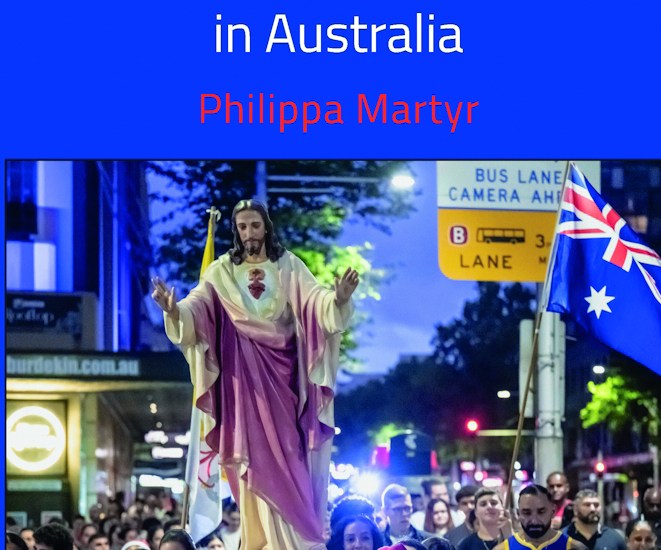
Catholic academic Philippa Martyr seeks the answer in her book Witness: The Future Catholic Church in Australia. It is based on published research, statistical reports commissioned by the Australian Catholic Bishops Conference and others, and numerous contributions from individuals, both clergy and laity, about their experience ‘on the ground’. It is a much-needed analysis of the problems facing the Catholic Church in Australia, but also a call for young Catholics to, in the words of Pope Benedict XVI, build a Church that, while smaller, will be more spiritual, more committed to Catholic teaching and practice, and thus less worldly.
Structured in seven chapters, the book covers in great detail the Catholic population of Australia and its changing cultural mix; family life; parish life; clergy; religious life and the new apostolates, and the business arm of Catholic-origin organisations. The final chapter suggests possible ways forward. The first chapter presents an overview – how did the Church get here? Interviews with lay Catholics point to a disconnect between the majority of bishops and many boomer-age lay Catholics who want to ‘blend in’ with the secular world and a younger generation of Catholics seeking faith because it is counter-cultural. While the number of lay Mass attendees is decreasing, the more ‘spiritually orthodox’ dioceses are growing. Indeed, as Martyr discusses in chapter 2, younger, serious practising Catholics are marrying each other and having larger families than their parents. They are also marrying across ethnic and cultural boundaries. These families are prepared to travel or move house to worship in a community that takes faith seriously. Not for them are the liturgical and spiritual ‘innovations’ of their parents’ generation, which reduce worship to, as Martyr puts it, a ‘cocktail lounge experience’. They are seeking a return to tradition and an encounter with the living God in their lives.
The author points out, based on empirical evidence, that there is no shortage of clergy in Australia; the problem is their uneven distribution. What is required is restructuring since parish locations are a relic of the ‘one church every square mile’ mentality that prevailed in pre-war days when not everyone owned a car. In chapter 4, the author considers the clergy and the bishops, and in chapter 5 she addresses the general decline in religious orders. Her research leads her to conclude that priests in dioceses throughout the country are demoralised. The sexual abuse crisis and the overreach of the police and the judiciary in its aftermath have taken their toll. Many clergy have been badly trained in seminaries in past years (here it should be noted that the more orthodox seminaries and religious orders have the highest number of students and growth), and some of those born in and formed overseas struggle with secular Western culture. The secularisation of the Church, both in its structure and in the assimilation of secular doctrine and morals, has taken a toll on priests. They are sheep without a shepherd, unsupported by the bishops, who lack clarity.
Too many bishops display weak leadership. They behave more like corporate CEOs than pastoral shepherds. They hide behind the chancery walls and are not accessible to their parish clergy and laity, surrounding themselves with like-minded ‘gatekeepers’ who protect them and filter the information flowing to them. Many of these gatekeepers are lay people from the corporate world, with all the baggage that brings. The bishops cede control of Church institutions to these lay people who have little concern for the things that are most important to the faithful, namely, the Mass and the sacraments. Martyr addresses this in detail in chapter 6, appropriately titled ‘The Business Arm of the Church’.
The main problem is that Catholic schools, universities, healthcare facilities and charities are heavily funded by governments, which, consequently, are not afraid of controlling them through legislation. Moreover, they are governed by boards of mainly laity who may not regularly attend Mass or obey Catholic doctrine and morals (witness the recent controversy surrounding Australian Catholic University). Most do not act as if they are part of the Church’s mission, even though they may claim to be.
Catholic schools are well known to be a powerful force, destroying the Catholic faith in most of their students. As one priest once told me, ‘Catholic schools serve only to inoculate their students against Catholicism.’ This is because humanism in Catholic wrapping paper is passed off as the Catholic faith. The Religious Study program in schools is often taught by nominal, non-Mass-attending Catholics, or even Protestants. Martyr produces detailed research demonstrating that the number of reverts to Catholic practice is far higher among those not educated in Catholic schools than those who were.
In the final chapter, ‘Where To From Here?’, the author notes that there is hope for the Church in Australia because its younger cohort is one that is genuinely giving witness to their faith. She cites developments in America as to what can be achieved, with signs of a Catholic revival, especially among young people who eschew ‘trendiness’ for belief. Martyr suggests areas where further research should be done ‘on the ground’ to help do what the Church has done over two millennia, bypass obstacles (mainly from those in charge) and re-form through people committed to holiness and the tenets of its faith.
The publication of this book is a timely clarion call to all Catholics, especially bishops, not that many of them will read it, even if it were obligatory.
Got something to add? Join the discussion and comment below.
Rocco Loiacono is a Perth-based legal academic
You might disagree with half of it, but you’ll enjoy reading all of it. Try your first month for free, then just $2 a week for the remainder of your first year.