In the world of opinion-based journalism, few topics capture attention more than the public’s reactions to fear, whether genuine or perceived. The mere existence of Donald Trump helped Anthony Albanese win a second term, whilst green activists’ mass hysteria over hydrocarbons has fed the absurd belief that billions are going to die. There are occasionally stories that underscore not only this moral panic but also our irreversible decline as a species.
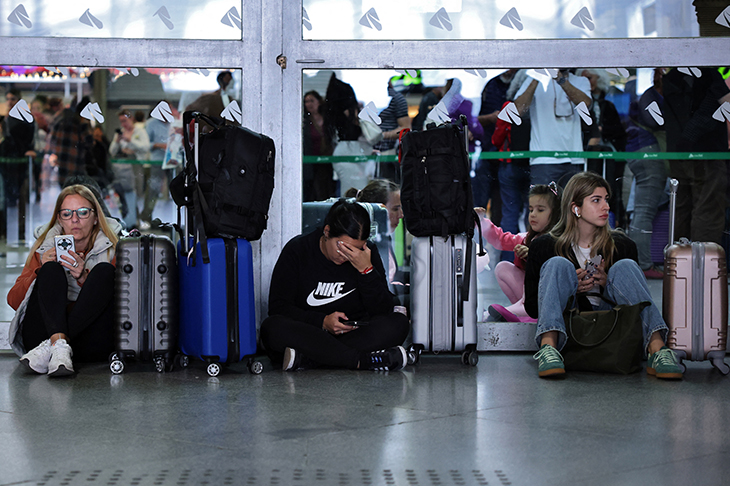
On Monday, 28 April, at 12.30 pm local time, a mass blackout swept through Spain and Portugal, causing chaos. Within five seconds, 15GW of generation, or 60 per cent of Spain’s total demand, was wiped off the grid. In what is thought to be the biggest power outage in Europe for a generation, tens of millions of people lost their electricity. A national emergency was declared by Spain’s Interior Ministry, and the army was called in to quell unrest. The entire Iberian Peninsula’s transportation network came to a complete standstill: 35,000 passengers were left stranded in the sweltering midday heat as Madrid’s Metro system went dark, flights were cancelled, and electrified trains came to a complete stop.
The outage’s precise cause is still unknown. At first, Spanish socialist Prime Minister Pedro Sánchez seemed to imply it was the result of a cyberattack, but this seems to have been ruled out. Portugal’s grid operator, REN, hypothesised that the network’s high-voltage lines might have been strained by ‘extreme temperature variations’.
Yet these technical conjectures mask an indisputable reality: the energy grid of the Iberian peninsula, which is heavily dependent on intermittent renewables, is exceedingly vulnerable. Spain, which supports green energy, generated 56 per cent of its electricity in 2024 from renewable sources, mostly solar and wind.
To put it simply, a power grid must constantly respond to supply and demand fluctuations; it must remain tight like a rope. This tension is known as high inertia, which essentially means stability. Conventional energy sources like coal and nuclear have a high level of inertia. Renewable energy sources have lower inertia, making them less reliable and less adaptable to sudden changes. About 20 per cent of Spain’s power comes from coal and nuclear, but they cut off gradually in the event of a fault, lessening the inertia loss. Renewables immediately come to a stop when they trip. At the time of the blackout, wind and solar photovoltaic energy were providing 80 per cent of Spain’s electricity.
Hospitals were forced to use backup generators, creating an environment akin to a war zone. Long lines formed outside Spanish stores as panicked buyers rushed to acquire candles, battery-operated radios, and toilet paper – always the first item purchased during turmoil. The lack of electricity meant ATM screens went dark, and supermarkets were forced to close due to electronic payment system failures.
Although this is a horrifying illustration of what happens when your entire life is dependent on a government ideologically captured by eco-zealotry, I also came to another, perhaps less obvious, realisation. During this massive power outage that disrupted millions of people’s daily lives, I couldn’t help but notice how the internet going down left young Spaniards totally confused and enraged. Such histrionic moral panics hold a lot of satirical potential.
The Simpsons is frequently cited when discussing how art can predict reality. The show has been able to make some intriguing predictions over the last thirty years. The Simpsons prophesied the Super Bowl Champion, a crazy billionaire who wanted to block out the sun, and, of course, Donald Trump winning the US presidency. In this instance, it’s South Park, not the Simpsons. The internet goes down in an episode titled ‘Over Logging’ which was first aired in 2008. People are suddenly unable to handle the fallout; they are transported back to the 1990s, when the infrastructure was non-existent. It depicts a chaotic scene, with residents anxiously refreshing websites and pacing around with their laptops in hand trying to make sense of the situation. The Marsh family moves west in a lovely parody of The Grapes of Wrath, not for a job or desire for independence, but for a Wi-Fi connection.
You can’t get what you want when you want it when you’re thrust back into a world without instant gratification. We now have Gen Z, who grew up with the internet and are accustomed to having all of their material needs met with a single click. We didn’t have the internet when I was growing up, so if you liked a song on the radio, you had to physically walk to a store to buy it. All of your favourite songs are now available for download. The same is true for movies, TV shows and books. Imagine a society in which you could only access entertainment by waiting or queueing up. That is delayed gratification. As a member of Gen X, I am the last generation to understand this concept. We had to be present when the show aired if we wanted to watch our favourite TV program. You had to wait a week for the next episode, so you couldn’t binge-watch the series. A generation wired for instant gratification would not understand the concepts of tension, suspense, and social bonding that this fostered.
While power was restored the next day, it is a brief but powerful illustration of our failure to deal with the second-order effects of technology. We’ve given up tradition for the convenience of Amazon and 24-hour food delivery apps. As for the secular evangelism of the environmental movement, George Carlin was right. The planet is fine; people are screwed!
Over four and a half billion years, the planet has been through much worse than us: plate tectonics, continental drifts, bombardment by comets, asteroids, and meteors, worldwide floods, recurring ice ages and we have the audacity to believe we are a threat? Save the planet? We don’t even know how to communicate anymore.
Got something to add? Join the discussion and comment below.
You might disagree with half of it, but you’ll enjoy reading all of it. Try your first month for free, then just $2 a week for the remainder of your first year.