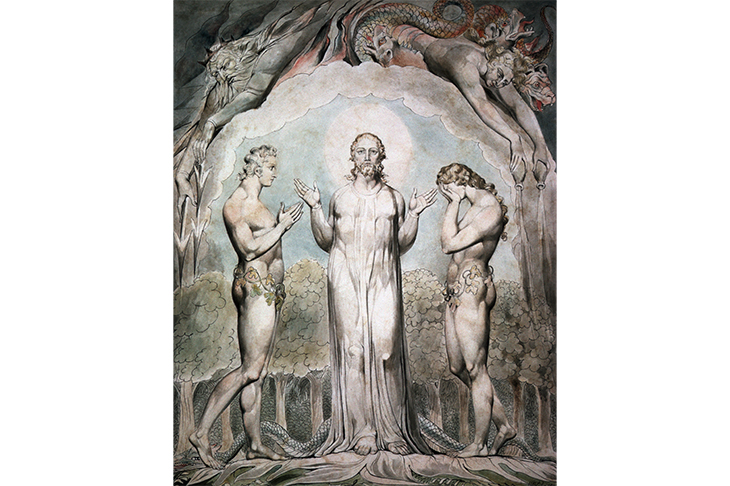
Of all the Gospel parables, I’ve always thought the one that would be hardest to pitch to Hollywood would be that of the Prodigal Son. A tale about a kid who confesses to having blown his inheritance in a foreign fleshpot but gets treated better by his father than his clean-living, hard-working sibling, might have impressed a few first-century Jews, but it just wouldn’t cut it with modern focus groups. Even those of us with a sneaking suspicion there might be a God no longer accept that the ways in which He moves must needs be mysterious. What do we want? Closure. When do we want it? Now – or at least pretty soon. And who cares how slowly the wheels of justice grind when you can binge the miniseries over a weekend? Most of us worry more about the earthly punishment of the fictional sins of fictional people than we do about the posthumous prospects of our own benighted souls. We have swapped the possibility of The Day of Judgement and Divine Retribution for the certainty of the Emmys and Rotten Tomatoes.
But even the most secular of us believes in the value of confession, and this is not lost on politicians, whose lives are subject to more rigorous and frequent audit than yours or mine. So they know, or should know, that the smallest, least consequential gaffe (like falling off a stage) can reflect exponentially badly on you if you keep denying it in the face of compelling evidence (like network news footage). And that, conversely, the right kind of mea culpa can turn a career-ending gangplank into a springboard. That, at least, is what David Speirs, the ex-leader of the South Australian Liberal party clearly believes. Why else, after being convicted of supplying cocaine, and admitting that the video of him snorting it which he’d previously dismissed as ‘deepfake’ is actually kosher, would he have given such an exhaustive post-trial interview to the Australian? If ‘interview’ is the right word for what read more like an unprompted, uninterrupted monologue. But while it went some considerable way beyond ‘it’s a fair cop’, Mr Speirs’ repeated insistence to the Oz that ‘I stuffed up, I made mistakes’ and his qualifying assurance that ‘I’ve got no real regrets in terms of my professional life’, fell some way short of an apology to the people who elected him and whose taxes paid his salary. Equally conspicuous by its absence from this cataract of contrition was any reference to the crime of which he has been convicted; not taking the drug himself but supplying it to a much younger colleague who Speirs knew at the time to be trying to break a cocaine habit. It is because of this preoccupation with the sinner rather than the sin, with himself rather than the people whose trust he has betrayed, that when Speirs says – in response to a question the reader must infer – that he ‘has not ruled out’ the possibility of a return to public life at some time in the future, it is hard not to hear it as ‘I want my job back’.
While Mr Speirs’ Wikipedia page identifies him as a Christian, the Pentecostal church with which he has had most truck doesn’t do confession. John Profumo was not a Catholic either, and like Speirs he was a Conservative who resigned a senior government post in disgrace after being caught out in a lie. But that’s where the similarity ends. Profumo was never accused or convicted of any crime. He simply had an extra-marital affair with a younger woman who had dubious connections. The only confession he made was to his wife, and he never subsequently gave an interview to any of the newspapers who asked for one. Neither did he ever make any attempt to revive his political career. Instead, a few days after resigning, and still dressed in his Savile Row suit, he offered his unpaid services at one of London’s homeless centres. He continued to do that for the rest of his working life. There have been at least three dramatisations of the Profumo affair: The short-lived Andrew Lloyd Weber musical Stephen Ward, the critically acclaimed movie Scandal, and the excellent BBC miniseries The Trial of Christine Keeler. The writers of each of these scripts and screenplays made no attempt to extend their respective narratives into the thirty years which John Profumo spent quietly atoning for his era-defining sin. And you can’t blame them: it would have made for very dull viewing. But if there is a God, we can be sure that He watched every second of it.
Got something to add? Join the discussion and comment below.
You might disagree with half of it, but you’ll enjoy reading all of it. Try your first month for free, then just $2 a week for the remainder of your first year.