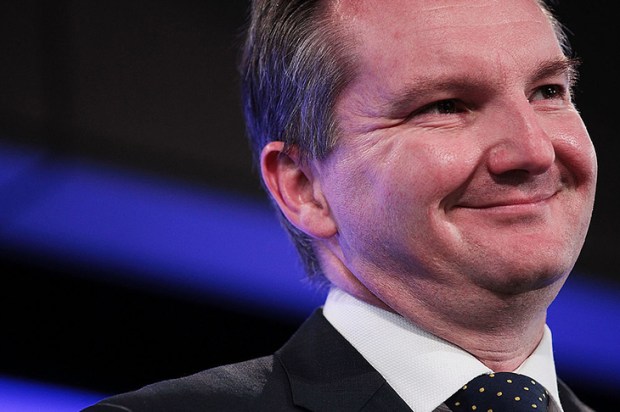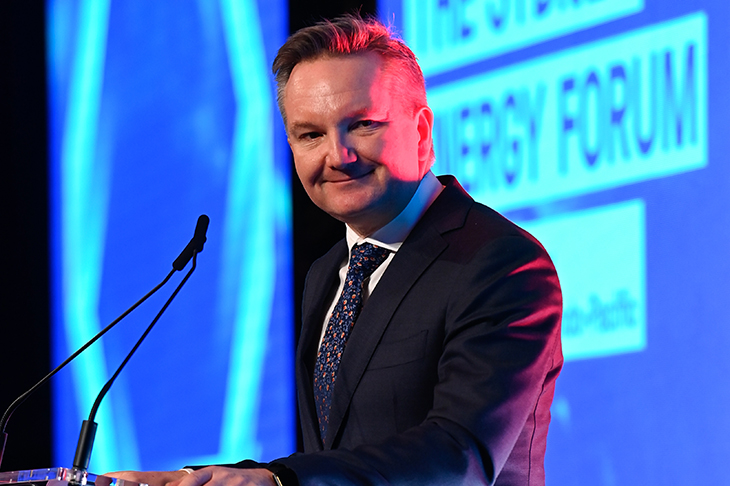
You might think I’m obsessed with Climate Change and Energy Minister, Chris Bowen – B1 to me and Speccie readers. But for an economics commentator, he is the gift that keeps giving. He is simply comically bad.
How can one person utter so many incorrect statements, non sequiturs, illogical propositions – in a word, howlers? Although I was reminded of this fundamental truth written by Mark Twain that, ‘You can’t reason someone out of something that they weren’t reasoned into in the first place’.
B1 never had a clue and still doesn’t. It’s all about the politically correct vibe for him, plus a side dish of favours to green rent-seekers. He has never bothered to get on top of the physics, the engineering or the economics of the key issues in his portfolio.
His ignorance was on full display last week when he debated the shadow minister, Ted O’Brien, at the National Press Club. Anticipating that he might struggle with the debate, he brought along some props – a copy of a Frontier Economics report commissioned by the Coalition and some other inordinately lengthy official government reports. The point of the latter was to underscore the authority he brought to the topics being discussed – OK, it was his attempt to do so.
I’m absolutely sure he doesn’t understand any of them, particularly the Integrated System Plan (ISP) of the Australian Energy Market Operator (AEMO). The only take-out from the ISP that B1 will grab is that renewables plus storage are the cheapest option. Actually, the AEMO makes it clear that it doesn’t model all the options, including nuclear.
Indeed, it takes the government’s plans – think 82 per cent renewables by 2030 in the National Electricity Market – as the basis for its calculations and works from there. The AEMO is not saying the strategy is cheap or indeed cheaper than the position we had in 2015, say.
But even within this restricted framework, the AEMO’s planning is a complete crock. One key assumption is that green hydrogen will be a major activity by the middle of next decade and that it will release a great deal of ‘free’ renewable energy which will have been massively expanded to run the electrolysers. It’s absolutely clear in 2025 that green hydrogen will be a tiny niche play at best. This makes the ISP utterly worthless.
But let’s get back to B1 and his handling of the questions about the price of electricity during last week’s debate. He now says ‘no one would have a punt on that’, thus declining to put any sort of figure on electricity prices in the future.
Was I hearing that correctly? This was the man who told us that electricity prices would be $275 per year cheaper by this year because of the government’s energy plan. It wasn’t between $200 and $300 per year, perhaps. It was $275 precisely and we could trust this figure because it came from the most comprehensive modelling ever commissioned by an opposition.
(Of course, he was backed up by the know-nothing Anthony Albanese who confidently told everyone that the $275 figure was absolutely in the bag. ‘I don’t think, I know’ was his hilarious remark.)
We are now expected to believe that it was never Labor’s modelling, it was the modelling of Reputex. And the modelling of Reputex has now been junked, thrown away like a discarded child’s toy. Even so, B1 is sticking with the key parameters in the Reputex model – go figure.
In its place, there is nothing apart from the cliché that renewables plus storage are the cheapest means of generating electricity. The fact that there is not a country on earth that has high (non-hydro) renewable energy penetration and cheap electricity prices is seen as irrelevant to B1.
And didn’t you love him trying to make Ted look a mug by using his well-rehearsed line about the Coalition’s energy plan resembling a menu in a Chinese restaurant? Apart from the offence that this quip might give to some in the community, how good was Ted’s unrehearsed reply? He compared the government’s energy plan to the fatuous single line in a Chinese fortune cookie – ouch and touché, all at once.
Sensing perhaps that his policy offerings were a bit light on, B1 has also come out with the hare-brained idea of handing out $4,000 a pop to higher income households to install batteries to complement their rooftop solar panels. In this way, power can be stored for use when the sun goes down, thereby allowing these households to save on their electricity bill.
Of course, you need to be able to afford another $5,000 or $6,000 to buy the battery and have it installed. So apart from owning your home and having solar panels, significant dollars are also required. I might be missing something here, but this doesn’t really sound like the Labor way.
B1 has also made the heroic claim that because there will be less demand on the grid during the early evening then everyone should benefit from the policy, even though there are no numbers on the likely take-up of the scheme. I don’t want to sound picky here, but to prove this proposition would require very detailed modelling – there’s that word – and Labor has turned its back on modelling.
Working on the assumption that Labor holds on and forms a majority government, a key question would be whether B1 retains the portfolio of climate change and energy. If Albanese had any sense, he would move him to an area where he can do much less harm – local government and territories would be a possibility. (Of course, this also assumes that B1 holds his seat. He appears to have some stiff local competition.)
One of the problem areas already looming large is the New Vehicle Emissions Scheme. There have been some major changes made to a similar scheme in the UK, including substantially watering down the penalties for manufacturers failing to meet the average emissions target. Some smaller automotive firms have been exempted altogether. And, of course, Trump ditched Biden’s version of the scheme by Executive Order in his first week in office.
What we can look forward to in the future is B1’s autobiography – it’s very unlikely that any reputable author would be inclined to review his life. Perhaps he can tell us about the mistakes he made when he was immigration minister – the Malaysian solution anyone? Another chapter could recount those happy days of battling the defenders of cash refunds for franking credits while all the time not understanding the basic principles of franking.
And one of his most memorable lines – ‘If you don’t like our policy, don’t vote for us’ – should be printed in large font in bold on a separate page. Thanks, B1, very many people took your advice in 2019.
Whether I or Speccie readers will miss him when he’s gone remains to be seen. Sadly, there is a large cohort of incompetents emerging from all sides of politics with acres of badly conceived policy proposals in their knapsacks. At least there will be plenty of fodder for finicky economics commentators.
Got something to add? Join the discussion and comment below.
You might disagree with half of it, but you’ll enjoy reading all of it. Try your first month for free, then just $2 a week for the remainder of your first year.