Australians are frequently reminded that we are facing ‘the most complex and challenging strategic environment since the second world war’. Yet given recent exercises by the Chinese People’s Liberation Army Navy (PLAN), Australia does not seem anywhere near prepared. It was left to a Virgin Airlines pilot to report live firing since apparently Australia lacks the capability to monitor potentially hostile warships in our backyard.
The primary role of a military is to deter, engage in, and win wars. When it comes to deterrence, former US Strategic Command chief General Kevin Chilton noted that deterrence the combination of will and capability. The Australian defence establishment’s lack of awareness and response to PLAN’s exercises underscores Australia’s weak deterrence posture, highlighting both a deficiency in will and a shortfall in capability. Rather, the Australian military seems to excel in the bureaucratic stakes.
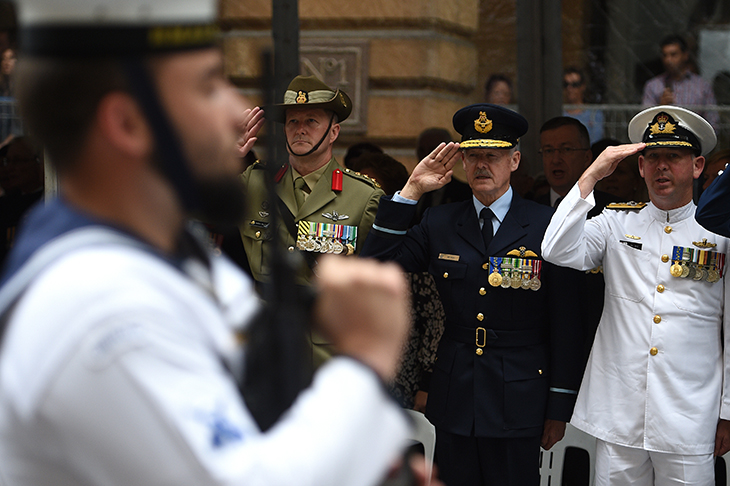
In a classic episode of Yes, Prime Minister, PM Jim Hacker is shocked to learn that the Royal Navy has more admirals than ships. Never want for reality to be outdone by comedy. The Royal Australian Navy has approximately 51 commission vessels and 78 admirals (one-star officers or higher).
This administocracy is not limited to the Royal Australian Navy. The Australian Army has 91 starred officers and the Royal Australian Air Force 69. In toto, the Australian Defence Force (ADF) has 238 starred officers for 57,000 active-duty personnel. This equates to approximately 1 starred officer per 240 ADF members.
In contrast, the US military comprises approximately 1.3 million active-duty personnel. To lead the US forces, there are approximately 650 starred officers or approximately one starred officer per 2,000 soldiers. Australian soldiers, it seems, require eight times more oversight and administration than do soldiers serving in arguably the most lethal military in the world.
It is not just the number of starred officers. The Chief of the Australian Defence Force earns approximately $1.1 million. The Chairman of the US Joint Chiefs of Staff earns approximately AU $420,000 per annum (US $260,000). Unless there is some unique Australian way of military organisation, it is unclear why the head of the Australian military, who oversees a force one-twentieth the size of the US military, earns two and a half times the salary of his American counterpart.
Writing recently on the recruitment and retention challenges faced by the US military, a challenge similarly faced by the Australian military, former US congressman Mike Gallagher wrote that, ‘America needs fewer bureaucrats and more warriors.’ It can only be imagined what might be Gallagher’s assessment of the Australian military. This is a relevant consideration given President Donald Trump’s emerging foreign and defence policies.
Trump has repeatedly declared his intent to end free riding off US military expenditure. He, and senior members of his administration, have continued to denounce Europe for its massive underinvestment in defence. Trump’s Secretary of State Marco Rubio recently criticised Europe’s defence preparedness stating, ‘What can’t continue to happen is the United States basically is (Europe’s) security blanket so they only spend 2 per cent on defence and then build up this massive social safety net.’
Trump will in due course make the same critique of Australia, particularly in light of China’s recent exercises.
Yet while the drumbeats of increased defence spending are already pounding, with calls to increase spending from two per cent of GDP to three per cent, it is far from clear that current spending is producing much. Trump is also unlikely to be mollified by the government’s promise to increase spending to 2.3 per cent of GDP by the 2030s.
For the current financial year, the Commonwealth has budgeted spending $48 billion on defence. To achieve a 3-per-cent-of-GDP ratio would require an additional $24 billion expenditure this year alone. Over ten years, it would require an extra $300 billion allocation on top of what is currently envisaged.
One of the many reasons Australians are overtaxed, over-governed, and under-defended is that our political class have managed to convince the electorate that administrative effectiveness is measured through amounts spent rather than results achieved. This is especially the case in defence where it is easy to spend money, but harder to develop and maintain defence capability.
If there is any doubt that more government spending does not necessarily translate into better outcomes, a cursory review of Gonski education funding might be instructive. This is the program that sizeably increased per-student funding while educational outcomes have consistently declined.
A recent Royal New Zealand Navy incident is instructive on the difference between spending money and spending money effectively. In October last year, 25 per cent of the New Zealand navy was wiped out with the sinking of a $130-million vessel surveying reefs off Samoa. The commission of inquiry revealed that, unknown to the captain and crew, the ship was on autopilot when it plunged into the reef, caught fire and sank.
Defence and national security should be the top priorities of national government. But before a significant increase in defence spending is approved, perhaps there can be some effort to ensure that the current spending is effective.
Australia’s defence posture is at a crossroads. While calls for increased military spending grow louder, the real challenge lies in ensuring that such expenditures translate into genuine capability rather than expanding an already bloated bureaucracy. The current imbalance between administration and operational readiness suggests that simply throwing money at the problem will not be enough. It might even be counterproductive.
Instead, Australia must prioritise efficiency, strategic investment and a results-driven approach to defence. Australia needs to get serious about defending itself and upgrading its defences, including developing its almost non-existent drone program. Air and sea power must come before tank purchases. Once an enemy is on our shores, it will be too late.
Without serious reforms, Australia risks remaining underprepared in an increasingly dangerous world leaving its security, and its future, to chance.
Got something to add? Join the discussion and comment below.
Dimitri Burshtein is a principal at Eminence Advisory. Peter Swan AO is Emeritus Professor at the UNSW-Sydney Business School.
You might disagree with half of it, but you’ll enjoy reading all of it. Try your first month for free, then just $2 a week for the remainder of your first year.