In 2023 a constitutional referendum was held on an Indigenous Voice to parliament. Had the Yes vote carried the majority rather than a 60-to-40 per cent defeat, the following clauses would have been added to Australia’s constitution: ‘the Aboriginal and Torres Strait Islander Voice may make representations to the Parliament and the Executive Government of the Commonwealth on matters relating to Aboriginal and Torres Strait Islander peoples; the Parliament shall, subject to this Constitution, have power to make laws with respect to matters relating to the Aboriginal and Torres Strait Islander Voice, including its composition, functions, powers and procedures’. Had the referendum costing the taxpayer $450 million succeeded, race would have become the foundation-stone of our prized non-racial constitution which treats everyone equally without fear or favour. Not only are people banned from access to Mount Warning, the Grampians, the Ayers Rock climb and Lake Eyre, but these bans could well have been extended across much of Australia. Since it is hard to conceive of anything which does not relate to Aboriginal people, all parliamentary decisions would most likely have ended up giving control to an unelected group of city-based activists. The 25-per-cent increase in the number of people declaring themselves to be Aboriginal at the last referendum suggests that there is no guarantee that members of the Voice would actually be of genuine Aboriginal descent. Hence, perhaps the unexpected defeat of the Voice saved democracy.
The government-backed Vote Yes campaign began with over 80-per-cent support including virtually every large company, nearly all sporting and cultural organisations, most universities, trade unions, elite groups, and most of the media. It was the ultimate woke cause promoted by nearly all large corporations with no corporate opposition, the elites of every major organisation and an overwhelmingly large budget. There was late opposition from the Liberal party with the Institute for Public Affairs and Advance Australia supporting the No case. The Ramsay Foundation, which made the largest grant to the Yes cause, no longer represents the views of the conservative founder, Paul Ramsay, but deceased founders are exceedingly ineffective monitors of foundations they have established. Had the proposal succeeded it would have given one race in Australia power and privileges not shared by any other Australians. Indicating the difficulty of maintaining a philosophical system and governance/monitoring arrangements from beyond the grave, this is a prime example of O’Sullivan’s law: ‘All organisations that are not explicitly right-wing will over time become left-wing.’
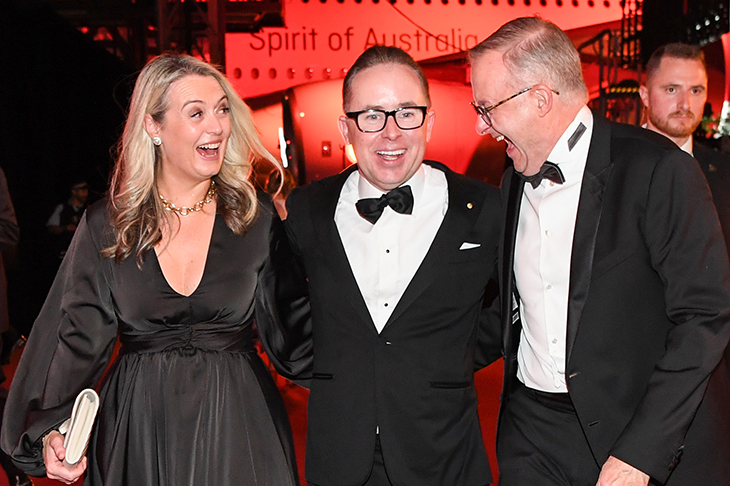
Qantas, and it’s now resigned CEO, Alan Joyce, was one of the main supporters of the Voice campaign with its planes sporting Yes decals while inflicting a ‘Welcome to Country’ announcement to passengers on arrival. Symptomatic of corporatism and crony capitalism, suggestions were made that this support was in return for the Albanese Labor government ceding to the lobbying demand by Alan Joyce who met with Albanese on 23 November 2022, to ban the Middle Eastern carrier, Qatar Airlines, from adding additional flights to Australia which was announced by the federal government in July 2023. The Qantas Governance Review Report (8/8/2024) found that, ‘There was not a specific Board approval requirement for major support of social issues or campaigns.’ It also found that, ‘the Group had a “command and control” leadership style with centralised decisions and an experienced and dominant CEO’. Reading between the lines, the board dominated by supposed ‘independents’ had little if any say on the CEO’s decision to support the Voice in such a spectacular fashion. Moreover, it was unable to stand up to or question the actions of the CEO. The new Qantas chair, John Mullen, has acknowledged that the campaign ‘backfired’, with businesses seen by the public as ‘high and mighty’ and ‘detrimental to the image of corporate Australia’. His working life started with ‘complete shareholder primacy’ in which you ‘walked over women, children and babies to deliver shareholder returns’. A kinder way of describing capitalism would have him say, ‘Prior to the current fixation on stakeholder value, we went out of our way to deliver shareholder returns in the interests of the widows and orphans who benefited.’ It is unsurprising that the only state or territory to vote overwhelmingly in favour of the Voice was the ACT where the number of federal bureaucrats would be greatly expanded to implement such a massive constitutional change. Our largest conglomerate and former owner of the Coles supermarket chain, Wesfarmers, is chaired by perhaps Australia’s most-experienced board chair, Michael Chaney. He stated during the Voice campaign that, ‘the Voice will make a difference. And it is a very simple change to the constitution, a very modest change in my view, and I am confident it will get up.’ Despite Chaney’s apparent confidence that the Yes campaign would succeed simply based on merit, Wesfarmers still donated $2 million to the Yes campaign, but the more corporates spent in favour of the Yes vote the more the disillusioned public seemed to switch from Yes to No. The public don’t like corporations telling them what to think or what is moral. Chaney underestimated the sophistication of Australian voters who clearly understood the possible devastating outcome should the referendum succeed.
Donald Trump has successfully led a war on woke in the US with an end to net zero, an almost global collapse in DEI, and the declaration that there are only two genders. Australian politicians and particularly Peter Dutton and the Coalition have dismally failed to capitalise on the failure of the Voice and Trump’s magnificent success. What is the takeaway from this summary of why the Vote Yes campaign failed so spectacularly when it had everything going for it? It is that many social causes taken up by activist corporations and foundations together with elite groups have very little support from the bulk of the population, sometimes referred to as ‘the silent majority’. Thus, when even mild and largely uncoordinated opposition arises, woke elitist views can be defeated at great cost to the reputations of companies that provided most of the woke support together with sizeable outlays. Go woke, go broke.
Got something to add? Join the discussion and comment below.
You might disagree with half of it, but you’ll enjoy reading all of it. Try your first month for free, then just $2 a week for the remainder of your first year.