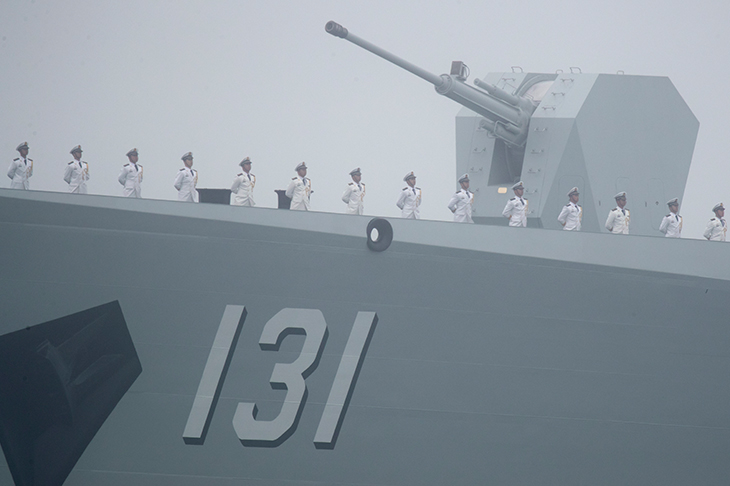
A Chinese naval flotilla perambulating down the east coast of Australia sends two messages. One is, ‘Here we are and we’re here to stay.’ The other is for Aussies to ponder, ‘Why are we so slack about defence, and what are we going to do about it?’
Firstly though, we need to understand there is not a lot to be done about Chinese ships. They are doing nothing in contravention of the United Nations Convention on the Law of the Sea. This convention says that participant nations will abide by rules, but also allow certain freedoms, one of them being the right of innocent passage. When these Chinese ships chose to exercise their weapons they were still doing nothing wrong, as they were hundreds of kilometres offshore when they did so. Having said that, we might accuse them of bad manners, particularly if their weapons radars ‘lit up’ nearby ships and aircraft. But then again, sailing through the Taiwan Strait, only 90 kilometres off the China coast, is something Western nations have done, much to the annoyance of the Chinese. So in many ways this is military chest beating. Is it anything to worry about? Yes, because it is sending signals to all nations concerned that they want dominance in the Pacific and that they are now capable of projecting power in our region. It is possible that the Chinese flotilla includes a nuclear-powered submarine. So what are we going to do as Australians to pull our weight in our righteous cause? One thing might be to crack on with real acquisition programs rather than pie-in-the-sky stuff. Our nuclear submarine program is too slow, and utterly unrealistic. We have said we want to acquire these boats, capable of immense underwater endurance, and therefore of deterring would-be aggressors. From the moment a submarine leaves port and submerges, the circle of probability as to where it could be gets wider and wider. Anywhere inside that circle the submarine could be lurking, and the enemy knows not where. That means its onboard cruise missiles, torpedoes and mines are all ready to be used. The diesel-electric sub has to almost surface now and again to run its diesel engines to charge its batteries through a snort mast – the nuclear submarine does not. That gives it the edge. The nuclear submarine has reach. It can move great distances at speed. One could rapidly intercept the Chinese ships off our coast and shadow them for weeks. Such action would be a great deterrent against future Chinese military chest beating.
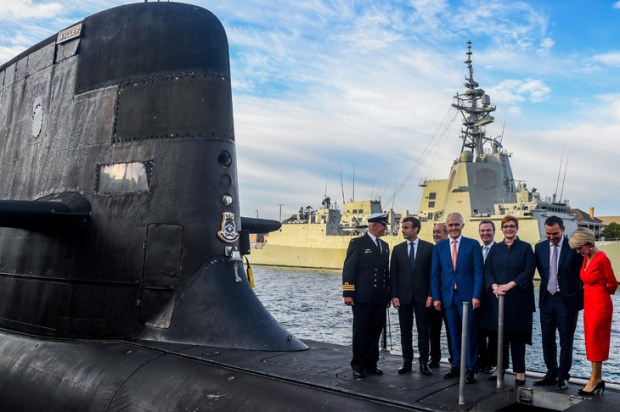
Australia is plodding down the road of nuclear submarine acquisition. But with the first HMAS Something to be delivered in the 2030s that is not good enough. And with a plan to build more nuclear submarines here, this is adding complications we don’t need at this moment. This country doesn’t even build motor cars any more. We can’t engineer tunnel building in the Snowy Mountains properly. For decades we have foolishly been a shrinking violet in the world of nuclear power stations. The last submarine Oz built was the Swedish Kockums-class version which became the Collins – and we ‘kocked’ it up to the extent the US Navy had to pull our chestnuts out of the fire. Instead, just get a few Virginia-class submarines second-hand from the Americans. To be sure, they’d go to sea with a US-dominated crew, but over a year or two that balance could be altered. And then a new one or two. We’re also in the market for new frigates. The best of them is the Japanese Mogami-class, but once again we are saying we want to complete most of the class of 11 here. The first three in the Sea 3000 program would be built in the chosen shipyard overseas – there are other nations competing for the bid – with the first delivered in 2029. The rest would follow from local construction. Like the submarine program, it is too slow, and too ambitious. The emphasis now must be on weapons platforms quickly, not local job generation. Go to the Japanese and say we can work with them to have the first Australian Mogami frigate by the end of 2025!
All of this is a warning from bygone days. In the early days of the 20th century a rampant German empire was causing ructions in Europe that in 1914 led to the first world war. The general public of the British Empire were quite rightly focused on the dangers. One of the cries they raised was, ‘We want eight, and we won’t wait!’ They were referring to the new naval dreadnought, the fast, armoured, powerful battleships that eventually the Royal Navy began building at speed. HMS Dreadnought, launched in 1906, made every other major warship in the world obsolete overnight. More followed. This was not so much about causing an arms race; it was about having enough weapons to cope if they were needed, as indeed they were when an aggressive invading force erupted from the Kaiser’s Germany. For too long Australia has neglected its defence. We did not put fixed-wing aircraft on our two capable helicopter carriers when we should have. We should have had nuclear submarines 30 years ago. We could have acquired a nuclear stand-off capability decades ago too – not because we want war but because we love peace, and a large armed presence is a guarantee of that. We messed up defence before the second world war and we’re doing it again. We had no Spitfires when enemy forces raided our northern coast for years. Enemy submarines and surface raiders harassed and sunk scores of ships off our coasts. That failure to arm ourselves cost thousands of lives. The largest loss of life for the Royal Australian Navy was in 1941 just 290 kilometres south-west of Carnarvon, where HMAS Sydney still lies today, the tomb of 645 men, sunk in the battle with the German raider Kormoran. I was at President Obama’s speech on the Darwin Esplanade back in November 2011. He concluded with the words, ‘We are a Pacific nation – and we are here to stay.’ So are we, and we need to step up and keep what we have.
Got something to add? Join the discussion and comment below.
Dr Tom Lewis is a military historian, whose latest book is The Secret Submarine, out in March from Big Sky. In December his publication Cyclone Warriors, the Armed Forces in Cyclone Tracy, was released by Avonmore.
You might disagree with half of it, but you’ll enjoy reading all of it. Try your first month for free, then just $2 a week for the remainder of your first year.