A sad legacy of Dark Emu, or rather of the embarrassing embrace of its ludicrous central thesis by our education establishment and national broadcaster, would be if its demolition by real historians were to cast doubt on less contestable claims about the heritage of indigenous Australians, the least contestable being that they comprise the world’s oldest continuous human cultures. It is important here to talk about culture rather than civilisation, because culture is a word with less imperialist baggage which applies to the mould on the cheese at the back of your fridge as well as it does to, say, the flowering of the Italian Renaissance. To identify the collective cultures of Australia’s Aboriginal clans as a civilisation would imply that their achievements are those of a single population – rather than that of many different tribes with as many distinct and unrelated languages, practices and beliefs. Calling it a civilisation would also suggest that those achievements have benefitted the rest of mankind in any significant way. While we disapprove of the Aztecs’ use of human sacrifice, we learnt a lot about town planning from them and we share their love of chocolate. While we disagree with the Romans on slavery, we are happy to borrow from their politics. Both gave the world things which the world could use, and as such they were more than discrete cultures; they were civilising influences. Unless your life has been improved by knowing that fire stimulates plant regrowth, or that if you throw a certain stick in a certain way it will come back to you, you could not honestly say the same about Aboriginal and Torres Strait Islander cultures. It is a truth as incontrovertible as it is inconvenient that when Europeans first arrived here, the societies they encountered were in a state of stagnation which the Old World had not seen for millennia. But this says less about the innate capacity of indigenous Australians to create, discover and innovate than it does about the importance of cultural interaction. Most of the factors which determine whether a culture evolves into a civilisation, like those which determine whether a child grows up into a healthy adult, are accidents of birth rather than genetic inheritance. The reason the Romans and Aztecs were able to achieve as much as they did – and to do so in hundreds rather than thousands of years – was that they had neighbours with whom they were obliged to interact constantly. If Rome had been an island in the middle of the Pacific, rather than one of many over-lapping fiefdoms on a landmass blessed with abundant food and a hospitable climate, it’s doubtful whether it would ever have invented the wheel, let alone the iambic pentameter.
With the unprecedented exposure to foreign cultures which European settlement brought, indigenous Australians learnt as quickly as any other human population. Within decades of seeing their first horse the native peoples of what we now called Queensland and Western Australia were stockmen of almost supernatural ability. To take a more current example, no engravings and paintings of early coastal encounters – or grainy photographic records of later meetings with more remote communities – show any Aboriginal wearing any kind of hat; the inference being that for the previous 60,000 years their best defence against the fiercest sunlight on the planet had been to sit under a tree. Today the broad-brimmed Akubra – a hat made from the fur of an animal species no less invasive than the people who introduced it – is as much a badge of indigenous community leadership as the long grey beard.
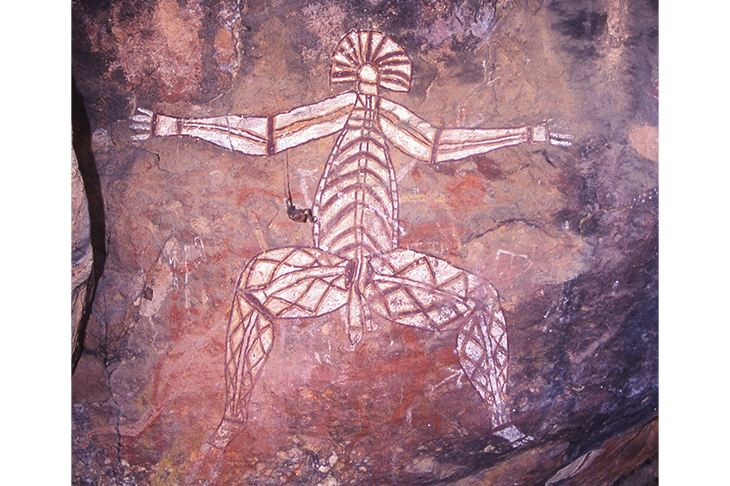
Despite not being able to benefit in any practical way from Aboriginal culture, most non-indigenous Australians have a default respect for its more numinous manifestations. Being more conscious than our grandparents of the historic ill-treatment of indigenous peoples, perhaps, we are keener to atone for it. Many of us put Aboriginal art on our dining room walls even though we can’t tell our dinner guests what the paintings mean or how well or badly they have been painted. And millions of us wanted to change our constitution to give indigenous Australians a disproportionate voice in our parliament. The same blind deference is observable in government responses to attempts by indigenous-interest activists to block the development of land for industrial purposes, or to ban leisure activities on land retrospectively deemed sacred. Politicians do not dare to ask obvious questions like, ‘But do blue-banded bees actually exist?’ or ‘But what exactly do you mean by dreaming?’ or ‘But how can climbing up a rock offend anybody who can’t see it?’ because they fear it would make them look racist.
Given the questionable provenance of so much Aboriginal lore, and the overwhelmingly one-way traffic of benefits from indigenous/non-indigenous interaction, you’d think that if Aboriginal heritage could be shown to be of unquestionable benefit not just to their non-indigenous compatriots but to all of humankind, all Australians would cheer. To be specific, if the study of the remains of the world’s oldest population is helping to unlock the mysteries of human existence, you’d think the people who purport to have that population’s descendants’ interests at heart would fight for the continuation of those studies. Instead, they want those remains be taken from the laboratories where they are so carefully preserved, buried in secret locations, and forgotten about. Doesn’t that make them the racists?
Got something to add? Join the discussion and comment below.
You might disagree with half of it, but you’ll enjoy reading all of it. Try your first month for free, then just $2 a week for the remainder of your first year.