I am a bit of a fan of public transport. In Melbourne, catching the train to the city is the quickest and cheapest means of transport. Driving the car can be slow and parking for several hours requires taking out a personal loan.
When the Melbourne public transport system works well, it works very well. It’s just a pity the same cannot be said of the ticketing system. It goes by the name of MYKI, and it has cost countless hundreds of millions of dollars to develop and run, notwithstanding the fact that large numbers of cities around the world had automated ticketing arrangements well before MYKI came into operation.
We were told at the time that MYKI was complicated because we had trains, trams and buses – not uncommon around the world – and that there are two zones with different fares – again not uncommon.
But let’s look at the time frame. The politicians started talking about MYKI in 2002. A contract was awarded in 2004 for $450 million and the system was due to be in place by 2007, at the latest. It was then slated for 2010 and, eventually in 2012, MYKI became fully operational. The costs had blown out to $1.5 billion.
Evidently, MYKI now needs an overhaul. But time has moved on when it comes to automated ticketing systems and all that is generally required is a tap of a credit card or a swipe of a mobile phone. But we are told that this possibility is beyond the capacity of MYKI. Patrons – at least those who bother to pay and that’s not everyone – will continue to need a dedicated card.
Reading about MYKI got me thinking about public policy catastrophes I have known. I have written before about the disastrous redevelopment of the North Sydney Olympic pool which is still not finished after over four years of faffing around. The original cost was estimated at $64 million. The best guess for the final cost is now over double that amount at $135 million. It is now expected to reopen in the second half of this year, perhaps. It was due to reopen at the beginning of last year. A steel construction to cover the smaller pool has had to be torn down and rebuilt.
The responsible local government took out a $51 million loan to finance the cost of the pool’s redevelopment and the interest rates are adding to the costs. A massive hike to the council rates levied on the locals has been flagged to cover the catastrophe.
Mind you, this looks like small beer when you consider some other public policy disasters. One of my favourites – I’m not sure that’s the right word – is the ordering of new ferries by the Tasmanian government to provide transport between the Apple Isle and the mainland. The announcement of the order was made with considerable fanfare. Two ferries would be built in Finland at the cost of $900 million.
The trouble was that no one asked a key question: could these larger ferries be accommodated by any of the existing wharves in the north of the state. Sadly, the answer to this question, which was posed late in the day, was a definite no.
The upshot is that the Tasmanian government has now had to attempt to lease out the completed ferry – the second one will be delivered this year – while the new berth is being built in Devonport. And the cost of the new berth has blown out by $130 million and will cost at least $240 million. It could be ready by 2027.
Talking of ferries, New Zealand has its own story to tell. Even though there is an efficient private sector competitor running a service between the North and South Islands, the New Zealand government ordered three new ferries though the agency, KiwiRail Interislander Services. The cost was expected to be $NZ 775 million.
With each passing year, the cost of the project escalated, reaching a current figure of $NZ 4 billion. Amazingly, only just over one-fifth of this figure is for the ferries themselves; the rest is for upgraded associated infrastructure. In the meantime, the private sector operator commands most of the market; runs profitably; and is investing in the service. There is surely a lesson there.
Getting back to public transport in Melbourne, the new underground loop could be opened this year – possibly. This was a necessary project because the current underground loop is at full capacity. But the mix of political considerations and rational transport policy is a completely toxic one, particularly when the CFMEU is effectively in charge of the project and a Labor state government is in power.
Of course, no one will ever know the real costs blowout because the Labor government has a lot to hide. For instance, it turned out the operation of MRI machines near the new underground loop would be disrupted and so they have had to be moved at the cost of over $100 million.
The final cost of the project will easily top $14 billion, but the real scoop is this. It was described as a twin-track rail tunnel, but to save costs, it won’t be a twin-track rail tunnel through the entire nine kilometres. So, any savings in terms of reduced travel times will be lost and we won’t really be better off than without this extension to the underground system.
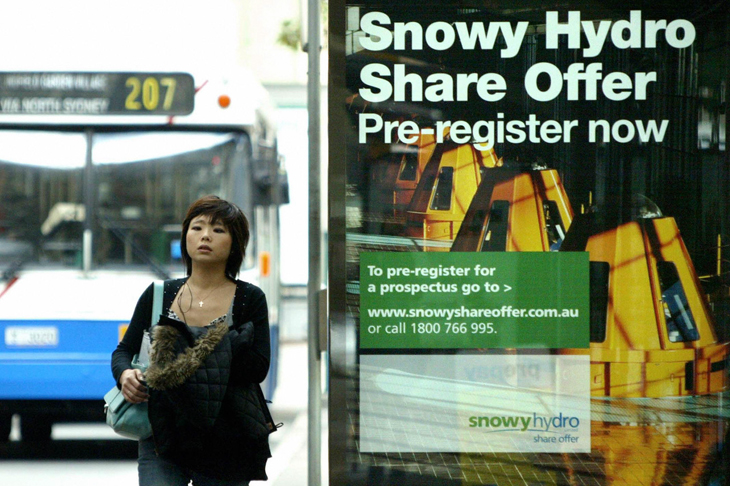
And who can go past Snowy 2.0? We always make fun of the Ruddster and Conroy working out the cost of the NBN on a drinks coaster on a plane trip to who knows where. But Malcolm Turnbull, who no doubt still regards himself as the smartest guy in the room, thought the cost of the ambitious pumped hydro project would come in at around $2 billion and would be up and running by now.
Including the costs of Florence, the tunneller, getting bogged a couple of times, the overall cost of Snowy 2.0 has now ballooned to at least $12 billion and the underlying organisation has had to be recapitalised by the Australian taxpayer. If Snowy 2.0 commences operation before 2027, we should really throw a party at Malcolm’s.
Of course, I could go on and on. There are just so many examples of massive cost blow-outs and delays in public projects – the Kurri Kurri gas project, the River Rail Crossing in Brisbane, the Royal Adelaide Hospital, every Big Build project in Victoria – and no one is ever held to account, no one ever loses their jobs.
Needless to say, there are also cost blowouts and delays in projects undertaken by the private sector. But the difference is that the responsible persons are held to account. There are also generally thorough processes to deal with possible contingencies that can affect the course of a project.
What set of dummies failed to ask the question about the size of the wharf in Devonport? What set of dummies failed to ask where the contaminated soil would go in the case of the second river crossing in Melbourne? What set of dummies failed to include the nine bridges in the original plan that would be needed for the Regional Rail Link in Victoria?
Cost blow-outs and delays are bad enough, but incompetence is unforgivable. The relevant personnel have no doubt been promoted by now or retired on a fat pension.
Got something to add? Join the discussion and comment below.
You might disagree with half of it, but you’ll enjoy reading all of it. Try your first month for free, then just $2 a week for the remainder of your first year.