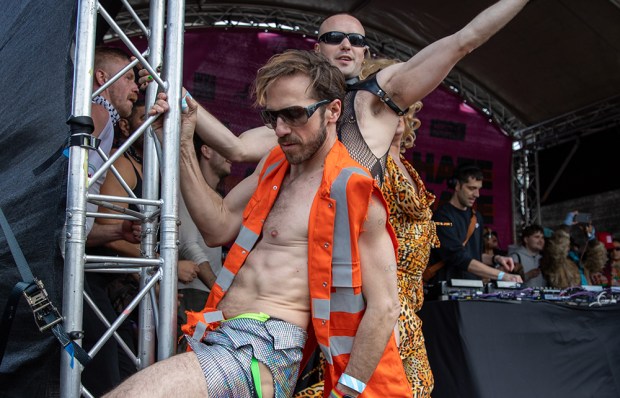
I have only been to Germany a few times.It is perfectly pleasant and well-ordered. The tendency of German people to walk around in their birthday suits in camping grounds and in the woods strikes me as unusual, but what the heck. Berlin is a great place to visit.
The German economy has always fascinated me. There is no doubting the depth of German skills in engineering in general, and in precision engineering, in particular. The educational and training system has a distinct vocational orientation which has produced very real benefits for the economy. Workers in Germany are generally well-paid and productive.
For many years after the formation of the European Union – the full version can be dated to the signing of the Maastricht Treaty in the early 1990s and the introduction of the common currency, the euro – Germany was the economic engine-room of the EU.
The value of the euro very much suited Germany because its value was effectively set by the low-productivity Mediterranean-hugging countries. The effect was to have a currency that significantly boosted German competitiveness and enabled the economy to become one mainly led by exports. These were the real salad days for the German economy.
The low value of the euro also helped Germany after a major error was made in the reunification process between east and west. Declaring one-for-one Deutschmarks between east and west – this involved a substantial transfer of wealth from the west to the low-productivity east – the introduction of the euro managed to paper over some of the problems. Additionally, many of the inefficient factories in the east simply closed.
To be sure, there have been a slew of disproportionate regulations affecting the economy and the labour market in Germany post the second world war. They include rules about the governance of companies as well as the protected role of trade unions. There are mandatory workers’ councils in addition to traditional company boards and industry-wide wage bargaining is the norm.
In the early 2000s, however, there was a significant easing of some of these regulatory arrangements, the main impact being the exemption of small businesses from most of the industrial relations rules. As a result, small businesses were able to flourish, including by picking up work outsourced from the larger companies.
This said, the German economy remains a relatively regulated one. The retail sector, for instance, has restrictions placed on it which are very uncommon in most other countries.
Now, in some circles Angela Merkel – who was Chancellor of Germany between 2005 and 2021 – is highly regarded. But the truth is that she was a disaster for the German economy and the consequences of her missteps are still playing out today. It’s important to recall that Merkel grew up in East Germany and Russian is her second language. She trained as a scientist but was really a career politician. Her party, the Christian Democratic Union, is ostensibly centre-right.
Her most substantial mistake, having panicked after the accident at the Fukushima plant in Japan in 2011, was to insist that Germany’s nuclear power plants should be closed. Bear in mind here that opposition to nuclear power has a long tradition in Germany, forming the basis of the green movement. At the time, there was strong public support for her decision. Merkel had also become gravely afflicted by the climate change disease and ushered in the economy-crushing Energiewende policy that sought to cover Germany with wind turbines and solar panels. Yes, solar panels in Germany’s bitterly cold winters.
For a time, the damage to the economy was camouflaged by the importation of cheap piped gas from Russia, an arrangement that Merkel found very useful and acceptable. The resulting low-priced electricity meant that German industry could remain competitive even as taxpayer subsidies flowed to renewable energy.
This cosy arrangement came to a grinding halt with Russia’s invasion of Ukraine in early 2022 and the loss of international political acceptability to Germany receiving gas from Russia. This left Germany scrambling for new sources of gas and prices soared. Some coal-fired electricity plants had to be recommissioned as the grid became strained through lack of generating capacity.
Even though there was some delay in closing the last of the nuclear plants, this has now happened, and the German economy is now dependent on expensive intermittent renewable energy as well as some plants run on fossil fuels. The interconnectors to other European countries are useful. There is, of course, a high degree of irony that electricity is ultimately sourced from nuclear power generated in Sweden and France. Power prices in Germany remain high.
Another unforgivable mistake of Merkel’s was the welcome mat she put out for migrants fleeing war-torn Syria in 2015. In the final tally, at least one million low-skilled migrants without German language skills entered the country, and not just from Syria. They were fed and watered at taxpayer expense. There has been a disappointing lack of integration of these migrants into mainstream German society.
This comes on top of the decades-long mishandling of guest workers, mainly from Turkey, who were invited to come to Germany to meet worker shortages but declined to return home when they were no longer needed. Many have brought in wives from their villages and their German language skills remain inadequate. There is also a fair degree of residential segregation of migrants in many parts of Germany, leading to a significant loss of social cohesion.
The last several years have been brutal for the German economy. There has been two years of negative growth, and the overall size of the economy is struggling to regain its pre-Covid level. The rate of unemployment is currently 6 per cent but is much higher among those not born in Germany.
After some equivocation, the final nuclear plant was closed, although some coal-fired ones remain. Energy prices are now very high which is undermining the competitiveness of German industry. One dopey minister in Olaf Scholz’s coalition government even made the extraordinarily naive suggestion that plants could close on the days when power prices are exceptionally high.
The backbone of German manufacturing, the automotive industry, is under immense pressure with Volkswagen announcing the closure of three of its ten plants in the country. ThyssenKrupp, a major engineering company and steel manufacturer, has revealed that some 40 per cent of jobs are to be cut. In a major blow to the current coalition government led by Olaf Scholz of the centre-left Social Democratic party, Germany’s constitutional court ruled that taxpayer monies related to Covid could not be used for the purposes of the energy transition. This has left the program on hold and without funding. More generally, the debt-lock that constrains Germany’s public finances means that unfunded government spending is strictly limited.
The Scholz coalition has now collapsed, and an election is expected within the next three to six months. All expectations are that Scholz will lose and the anti-immigration party, AfD (Alternative for Germany), will win strong support.
The broader lessons are obvious. Governments that oversee expensive energy transitions run the risk of rapidly rising energy prices and the loss of manufacturing jobs. And governments that fail to control their borders and welcome in low-skilled migrants who have little intention of integrating rapidly lose broad political support.
Got something to add? Join the discussion and comment below.
You might disagree with half of it, but you’ll enjoy reading all of it. Try your first month for free, then just $2 a week for the remainder of your first year.