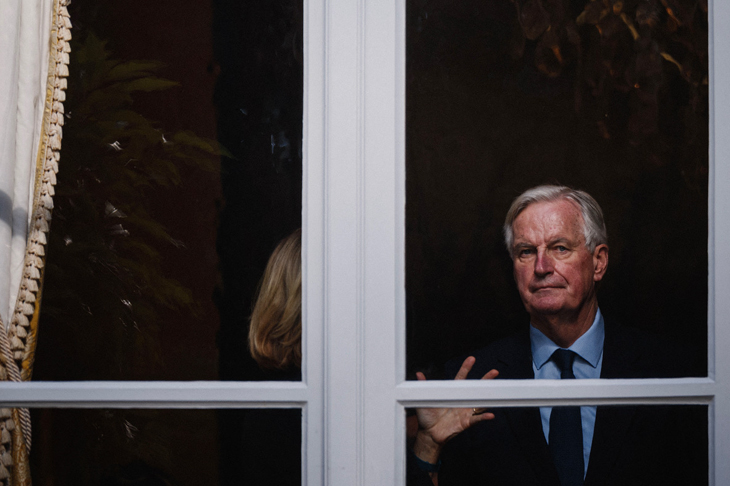
When French Prime Minister Michel Barnier addressed parliament for the first time in October, he warned higher taxes and spending cuts were needed to tackle Paris’s budget deficit and ‘colossal’ debt, which, at 112 per cent of GDP, leaves the ‘sword of Damocles hanging over the head of France and every French person’. The administration intends to halve the budget deficit to 3 per cent of GDP by 2029. But that’s not soon enough for bond investors, and French government yields are climbing.
New UK Chancellor Rachel Reeves spoke of on finding a fiscal ‘black hole’ amid warnings London’s debt at 102 per cent of output needs to be tackled. Her tax-spend-and-borrow budget in October, however, upset bond investors by adding to this debt and stifling economic growth.
Two former US treasury secretaries, Timothy Geithner and Henry Paulson, in a joint interview in July warned of the fiscal challenges awaiting the next White House administration. Democrat-appointed Geithner called Washington’s debt at a record 121 per cent of GDP a ‘dark shadow’. Republican-chosen Paulson said the US$36 trillion of debt ‘is ultimately going to destroy our prosperity’.
Such warnings are ubiquitous as government debt ratios almost everywhere have soared in recent years, as political parties of all ideologies have proven spendthrift. While Australia’s federal debt is only 49 per cent of GDP, eurozone public debt extends to 88 per cent of output. China’s ratio at 90 per cent hinders Beijing’s efforts to support the country’s ailing economy. Japan’s national debt stretches to a world-record 251 per cent of GDP – debt repayments now consume 24 per cent of Tokyo’s budget. Public debt in emerging markets is a record 70 per cent of output. The IMF estimates ‘general’ government debt stands at a record 93 per cent of global output – and could be higher due to hidden debt.
History is replete with episodes when excessive debt sparked a crisis. When forced to act, governments have three standard ways to tackle debt burdens. (A fourth would be asset sales. A fifth would be Nazi-style conquest and plunder. A sixth would be ransom-like ‘tributes’ from other countries. A seventh would be reparations à la World War I. An eighth would be stealing foreign reserves; as was done to Russia to help Ukraine.)
The first conventional cure is to raise taxes and reduce spending. Countries with high government spending compared to GDP such as France (59 per cent) have room to cut outlays. Countries with low government revenue to output such as the US (34 per cent) might need to raise taxes. The handbrake here is that austerity – shifting from fiscal deficit to surplus – is politically fraught and can savage economies so much it backfires on government debt ratios.
A second, and the most appealing, option is to ensure economies flourish in a way that erodes real debt burdens over time – this is how countries reduced debt after the second world war.
The formula is to ensure that growth in nominal output (GDP unadjusted for inflation) exceeds the average interest rate on public debt – a historic norm. A variation on this recipe is that debts are manageable if inflation-adjusted interest repayments stay below 2 per cent of GDP.
By these formulas, the record low (even negative) rates of recent years justified government splurges. Bond yields above 4 per cent, however, don’t. A repeat of the post-1945 drawdown in debt will be hard to replicate because back then pent-up demand, low regulation, a baby boom and free trade drove economies. These advantages are gone now.
Within the second conventional option to reduce debt, governments can choose to allow some inflation and supress interest rates. The benefit here is nominal GDP growth enables tax windfalls via higher nominal business profits and by propelling individuals into higher tax brackets.
Post-war governments practised such ‘financial repression’, the term for when policymakers keep interest rates artificially low. But capital controls, fixed exchange rates, restrictions on bank lending and ceilings on interest rates would entail a U-turn from the liberalised bent of recent decades. Low rates would encourage companies and consumers to add to their record debt loads that come primed with risks too.
Permitting inflation is tricky. Officials might lose control of prices. Interest rates would rise, which would hamper economies and add to repayment burdens. Government might then pressure central banks not to raise rates, as US presidents Lyndon Johnson and Richard Nixon did to help fund the Vietnam war. But that would demolish central bank independence to fight inflation, perhaps the policy most responsible for recent prosperity.
The third conventional option for indebted governments is to default – any ‘restructuring’ is a default. Japan’s debt ratio shows advanced countries with national currencies can rely on their central banks to stave off default for a long time.
Indebted eurozone countries, however, have no bespoke currency to print. A tempting way out of any crisis would be for a government to default and reinstall a more export-competitive national currency – especially when there’s a first-mover advantage to claim. More upheavals in the eurozone are likely and a euro departure is possible.
To avoid a default, policymakers could resort to accounting tricks. Central banks could cancel government debt they have bought under quantitative-easing programs. Treasury departments could print trillion-dollar coins and reduce debts by the same amount. But bond investors would be appalled.
Emerging countries, which are less stable economically and politically, are most likely to default. The candidates are many. The ones that have borrowed from foreigners are the most at risk, and it matters little whether they have borrowed in local or foreign currency. Any burst of defaults in emerging countries would spark a global crisis.
Higher global bond yields are pressuring governments to choose from among these options. A world of endless deficits and record public debt will soon become an era of tough choices for indebted governments, lower living standards for their citizens, and one of sporadic crises. No one should be surprised that the era of easy money comes with a brutal ending.
There’s nothing bad about government debt per se, to be clear. Among benefits, debt is a Keynesian tool for managing the economy. The flaw here, however, is few governments post budget surpluses and debt must be repaid sometime.
Steeper borrowing costs are already puncturing the complacency that ever-expanding government debts are manageable.
That realisation is tormenting France and the UK. It will distress elsewhere soon enough.
Got something to add? Join the discussion and comment below.
You might disagree with half of it, but you’ll enjoy reading all of it. Try your first month for free, then just $2 a week for the remainder of your first year.