In a Georgia courtroom earlier this year, University of Michigan computer scientist Professor J. Alex Halderman opened his testimony by asking the prosecutor for a pen. Duly produced, Halderman took the pen and walked over to a well-known type of voting machine. He held the pen down on one of the machine’s buttons for a few long moments. Then, in front of the judge, he flipped the machine’s tabulations, changing the winner in a hypothetical election. Thus he highlighted the fallibility of a critical element of the US’s voting system, as yet unfixed in Georgia’s seven-year, still-unresolved Curling v. Raffensperger case concerning voting machine integrity.
You might say this is a one-off defect, in one state, in an election the federal watchdog Cybersecurity and Infrastructure Security Agency declared the most secure ever, and you would be misinformed. The Agency’s true 2020 election analysis was winkled out in an internal report obtained later through FOIA requests. It said 76 per cent of assessed digital election machinery was vulnerable to attacks by adversaries, 48 per cent had a critical or high severity vulnerability to attack and 39 per cent of digital entities ran at least one risky service on an internet accessible host. Most secure ever? Nope.
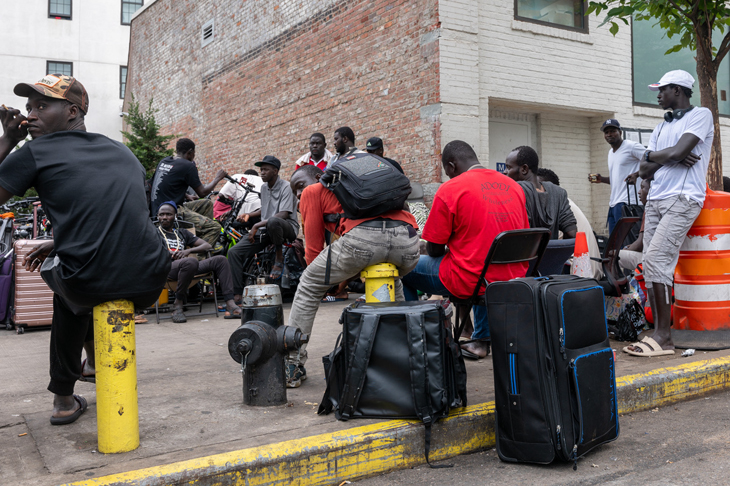
The USA’s election system is not like any other, even among nations with electronic voting machines. The Constitution mandates state control of elections, so there are 50 different systems, further customised by state courts, state election boards, local legal precedents and more. In 2020, the elections were modified in varying ways by a raft of new Covid laws allowing an avalanche of mail-in ballots, early voting and other changes. In 2024, the US election will be affected by a new X factor, namely the extraordinary influx of illegal migrants, estimated at 10 million-plus since 2020.
The GOP is awake to this danger, with Speaker Mike Johnson mounting an 11th-hour attempt to require proof of citizenship to vote in federal elections. But the Safeguard American Voter Eligibility Act has not passed, and at the moment voting is simply, as Johnson says, an honour system; say you’re a citizen, you get your vote.
And the Biden regime has been working overtime to turn illegals into registered voters; Elon Musk is one of many arguing that US borders have been opened for just this purpose. In March 2021, Biden issued Executive Order 14019, which directs every federal agency to register and mobilise voters. It’s now reported that welfare and other agencies in all but four states (North Dakota, New Hampshire, Wisconsin, Wyoming) are giving out voter registration forms to migrants without requiring proof of citizenship. And the rush to naturalise migrants is on, with some 3 million new citizens created under Biden. Processing times have halved, from nearly a year in 2021 to 5 months now, the New York Times reports.
How many illegal immigrants will come out to vote for their new benefactors is anyone’s guess. The non-profit Texas research body Just Facts, which has studied this issue since 2008, predicts up to 2.7 million illegals will vote in 2024, unless laws are tightened. It says 10 to 27 per cent of illegals, estimated at a minimum of 20 million in 2022, are registered to vote, and the vast bulk vote Democrat.
The Democrats’ mastery of the electoral ground game means they will have ample opportunity to use the ballots thus created, as required. Ballots are so much more flexible than votes. You don’t need to win hearts and minds if you can simply mark or duplicate or create or gather ballots at will.
The result of all this is an unprecedented outbreak of election lawsuits this year, with many cases still running, and state electoral laws still changing. The left’s effective legal strategist, Mark Elias, runs a site called Democracy Docket, which tallies the action in terms of ‘pro’ and ‘anti’ voting cases; in his world all efforts at election integrity amount to voter suppression. Last week he announced that the number of election lawsuits had now hit a ‘completely extraordinary’ high of 200. That’s on top of his existing scoreboard, in which he claims twice as many wins as losses in over 250 voting cases already decided.
Dirty voter rolls are a key battleground. Texas recently announced it had removed over a million people from its voter rolls since 2021. Oklahoma has recently removed 450,000 from its voter rolls, including 100,000 dead people and 15,000 duplicate registrations. North Carolina announced a week ago it had purged its rolls of 750,000, including 130,000 dead people and 290,000 duplicate registrations, over the last 20 months. That’s more than 10 per cent of that state’s registered voters. Both Florida and Alabama have complained that federal agencies are uncooperative in providing data on non-citizens, with Alabama now being sued by the Department of Justice for its efforts to cleanse its voter rolls. With the 2020 presidential election decided by some 80,000 votes altogether, these numbers are terrifyingly high.
Moreover, fighting against machines is hard. Data scientist and volunteer Kim Brooks, of a largely anonymous election integrity group called the Georgia Nerds, had been working to clean Georgia’s voter rolls, until she realised she was ‘riding a stationary bicycle’.
She concluded a program within the Georgia voter database was methodically adding back fake voters that she had had removed (dead, felon, stolen ID, etc) within a month. Sometimes those in charge pay the price. On the night of the 2020 election, Milwaukee Election Commission boss Claire Woodall-Vogg ‘misplaced’ a flash drive containing absentee votes and credible observers claimed that boxes of ballots were brought in and tabulated after staff had been sent home around 10.30 p.m. At 3 a.m. Woodall left in a police car, armed with the vote tally. An election colleague sent her an email saying: ‘Damn, Claire, you have a flair for drama, delivering just the margin needed at 3:00 am.’ She was ultimately fired, but not until May 2024.
Such is the anti-Trump vitriol in the US that a recent poll found 28 per cent of Democrats thought the country would have been better off if Trump had been assassinated. Amid such hatred, we can take a willingness to commit election fraud as a given. A Rasmussen poll found nearly two-thirds of Americans were concerned about vote cheating in 2024, with around one-in-five voters reporting having received a duplicate ballot in 2020.
Ballots are already flying out across various states, with Wisconsin admitting some one per cent of voters in a solidly blue county had already received duplicate ballots. So many areas of American life are run corruptly and incompetently, it requires impressive faith to argue the electoral system alone works properly.
Got something to add? Join the discussion and comment below.
You might disagree with half of it, but you’ll enjoy reading all of it. Try your first month for free, then just $2 a week for the remainder of your first year.