One of the greatest areas of misunderstanding is doubling. Is it penalty? Is it take out? Is it negative? Recently I heard about a pair who were playing exclusion blackwood (or at least one of them was) and ended up playing 5♣ (undoubled) in a 0-0 fit. True story. You need trumps to double a game (unless they have obviously screwed up) but it will usually cost a trick. Doubling a slam is a different story.
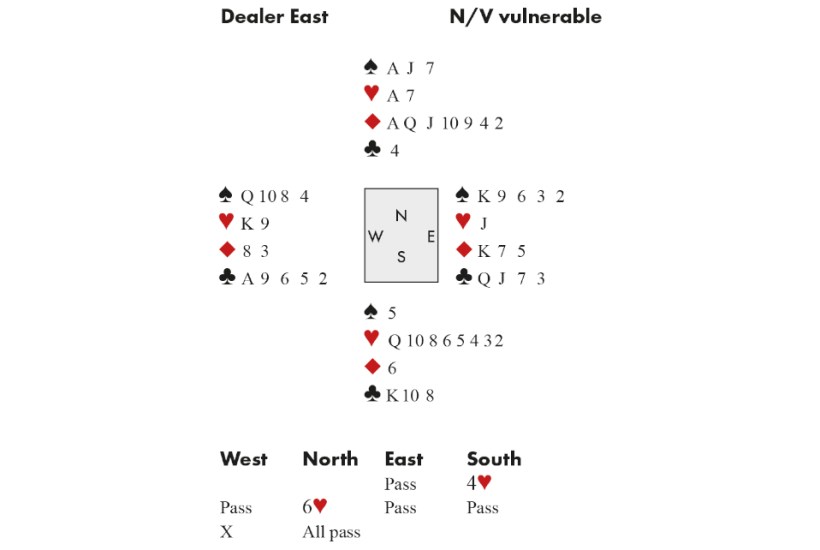
North expected a bit more from a second-in-hand vulnerable 4♥ opening and jumped to slam. West figured she probably had a trump trick in addition to her Ace, so gave it ‘the message’, but this was seriously unsound, as we shall see.
West led her ♣A and, disappointed to find the ♥A in dummy, tried another Club, hoping declarer would have to ruff. South won in hand and – because of West’s double – tried the ♥Q from hand. West ducked and the Jack dropping was a sight for sore eyes.
The remaining trump was drawn, after which South played ♠A and ruffed a Spade, East wasting his King. Six more trumps followed and – with West obviously clinging on to the ♠Q – there was no guessing in the end; East got thoroughly squeezed in the minors and the slam made.
Was West a bit unlucky? Perhaps, but let’s look at the maths, to understand what she’s risking. The other table made 650 in 4♥. If 6♥ had gone down, she would have increased her side’s profit by 1 IMP, (14 instead of 13). When she led declarer to the right path, it cost 27 (-14 instead of +13). To risk 27 IMPs in order to pick up 1 should tell us everything we need to know about speculative doubles.
Got something to add? Join the discussion and comment below.
You might disagree with half of it, but you’ll enjoy reading all of it. Try your first month for free, then just $2 a week for the remainder of your first year.