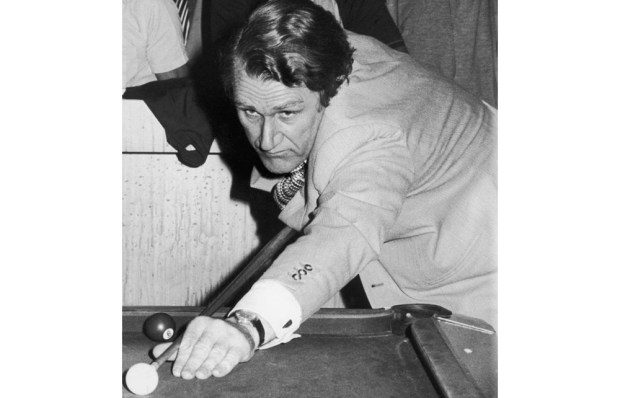
Whenever Paul Keating provides one of his frequent uninvited cantankerous contributions to the public debate, Australians should recognise the debt of gratitude owed to John Howard for removing, 28 years ago in a landslide election victory, Prime Minister Keating’s hands from the levers of political power. Doing so also excised what had remained, under his egocentric rule, of those behavioural constraints normally imposed by the responsibilities of office. This unleashed, in his post-politics life, the real Paul Keating. Not that he was ever Mr Nice Guy; just ask any of those, on all sides of politics, lacerated by his vicious tongue. But from then on, this political Dr Jekyll needed no potion other than the sour smell of defeat to turn into Mr Hyde.
Objects of his displeasure abound and the ABC along with the National Press Club are only too willing to provide pulpits for the blessed Paul’s epistles. His latest hostile burst on Taiwan (‘It is Chinese real estate. It is part of China’ and is ‘not a vital Australian interest’) ignored not only Taiwan’s role as Australia’s sixth-biggest export market, but much more importantly its strategic significance as a fellow democracy threatened by an increasingly aggressive authoritarian communist China. But as a Lowy Institute report demonstrated last week, Keating’s assertion that Taiwan is part of China ‘is neither a geographical nor legal fact…. The geographic content of “China” has changed over time…. The Chinese Communist Party government has never ruled Taiwan’. While the CCP revolution in 1949 did succeed in pushing the Republic of China’s elected government (that had ruled since 1912) off all of mainland China, it failed to do so in the province of Taiwan which became the sole remaining Chinese territory under ROC rule – and still is. That is why the Government of Taiwan still terms itself the Republic of China – and would only seek reunification with the mainland on its terms.
This Taiwan attack was just one of Keating’s many confrontational comments aimed at undermining the Australia-US relationship. They are welcomed in Beijing with the official Global Times describing him as ‘a visionary and insightful politician’ while US responses are more along the lines of former speaker Nancy Pelosi’s dismissive ‘stupid, crazy’.
In this category are his assaults on Aukus (‘the worst deal in history… is really about American military control of Australia’); on the US Alliance and military cooperation (‘turning Australia into the 51st US state….Australia is quite capable of defending itself. We don’t need to be basically a pair of shoes hanging out of the Americans’ backside’); on Asio (its chief, Mike Burgess, runs ‘a goon show’); on the Director-General of the Office of National Intelligence, Andrew Shearer (‘when the security agencies are running Australia’s foreign policy the nutters are in charge’); only last week on Nato’s ‘lurch east’ as ‘having no business in Asia’, stridently criticising Australian support for it, labelling its Nato chief Jens Stoltenberg a ‘supreme fool’; and deprecating ‘seriously unwise’ Defence Minister Marles. Then there are the personal attacks, like that on also ‘seriously unwise’ Foreign Minister Penny Wong (‘Rattling the China can…. Running around the Pacific with a lei around your neck, handing out money, is not foreign policy’). Add to the mix his frequent jabs at the Reserve Bank not implementing Labor employment policy (he once boasted as treasurer ‘They do as I say… I have them in my pocket’). And for a bit of variety, there is his unsolicited advice to European cities on how they should be smartened up.
Putting up with these outbursts is a small price to pay for the benefit of not having Keating as our unbeloved leader. Nevertheless, there is an element of regret that his current rants risk trashing his well-earned status as a vital part, but by no means the sole driver (despite his arrogant claims), of the Hawke-Keating-Kelty economic transformation of Australia (aided by the political consensus provided by a reformist Howard-Peacock coalition).
Keating became a crucial part of this reform despite initially being opposed to the Accord and Summit that were the foundations upon which reform was built. These had been developed by newly elected Hawke, the ACTU’s Bill Kelty and former shadow treasurer Ralph Willis (also from Victoria), who was Hawke’s choice as treasurer to implement the reforms on winning the 1983 election. But because the powerful NSW right wing of the ALP insisted that, with Hawke from Victoria as prime minister, NSW must have the next-most powerful position, treasurer.
On appointment to the job, and after first expressing the fear he may have accepted a poisoned chalice, Keating became a belated convert. He tamed his confrontational style to the consensus approach without which Hawke acknowledged significant economic reform was unachievable – and developped an understanding of the need to have the big end of town onside that had resulted from Hawke’s very close friendship with Sir Peter Abeles. Keating rode Hawke’s political coattails to the ultimate success of toppling him as prime minister, at which point what was left of consensus disappeared
Under the heading ‘In power, Keating was a gift. Now, at 80, he’s a tragedy’, the Sydney Morning Herald’s Peter Hartcher wrote earlier this year that Keating’s ‘towering ego that was a feature of his success became an illustration of the adage that one’s greatest strength can also be one’s greatest flaw…. His ego is an envious one that cannot share credit. He trampled others and dismissed their efforts…. In his need to be, in his own words, the “Placido Domingo of Australian politics”, singing solo, he never was able to acknowledge the vital work of others’. Hartcher asserts Keating was nothing without Hawke but only saw Hawke, his enabler and ally, as an obstacle, spending years as treasurer ‘furiously denouncing Hawke in obscene terms, not only to Labor colleagues, but to the press gallery and anyone who’d listen’ before defeating him in the party room.
There is nothing new about Keating’s anti-American pro-China stance. Former ALP colleague Graham Richardson agrees it was evident to an extent while he was PM. When John Howard was elected, concern about US perceptions that Australia under Keating had drifted towards China at the expense of the American alliance, prompted him to appoint former Liberal leader Andrew Peacock to Washington and me, his former parliamentary secretary and senior advisor, to New York with instructions to correct that perception. Within a year, Chinese official media was commenting that Australia under Howard had become ‘the bottom jaw of the US bite on China’, with Japan the top jaw.
For years, Keating has been on a campaign to reverse this pro-US stance that is cautious of China and that has largely been accepted by the Labor party he once led – and which now reflects a far more well-informed and realistic response to a China that has supercharged its aggressive capacity and authoritarian nature under President Xi over when Keating was last PM almost 30 years ago.
It has all changed except Keating – and his vicious tongue.
Got something to add? Join the discussion and comment below.
You might disagree with half of it, but you’ll enjoy reading all of it. Try your first month for free, then just $2 a week for the remainder of your first year.