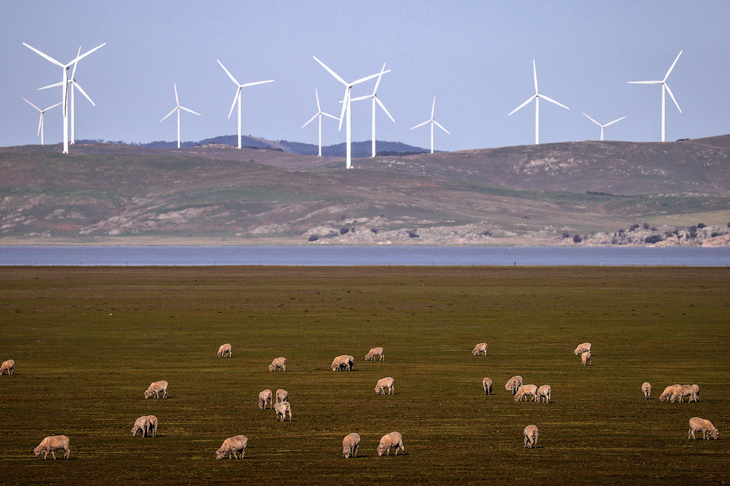
Australia’s rush to renewables (with its unachievable unrealistic targets) has generated an energy subservience to China. It creates the potential for an ever-worsening supply-line risk along with the prospect of a threat to the legislated emissions targets that are overwhelmingly dependent on Chinese equipment, like solar panels and wind turbines, in replacing the traditional fossil fuels on which Australia’s past prosperity depended.
The government subsidies and incentives that have prompted one-in-three Australian households to install rooftop solar panels (the world’s highest uptake) have served to boost Chinese solar dominance, with only one per cent of these panels made in Australia – and largely from imported components.
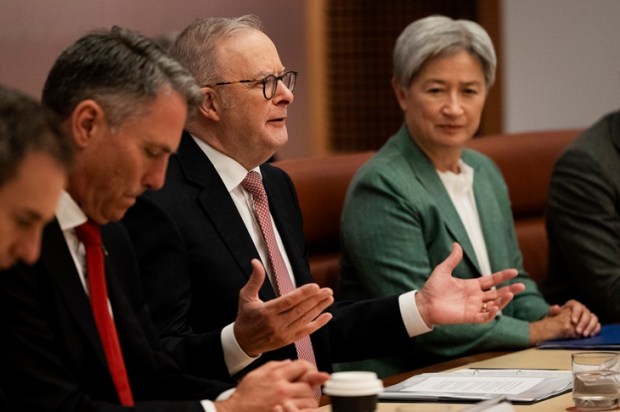
But the Albanese-Bowen climate catastrophist government has recognised this unintended consequence of energy subservience arising from the rush to renewables. To begin the massive task of lessening Australia’s energy dependence on China it will spend $1 billion hoping to help Australia ‘capture more of the global solar manufacturing supply chain through support, including production subsidies and grants’. This plan to ‘ensure more solar panels are made in Australia’ has the Albanese-Bowen grandiose wishful-thinking objective of ‘supercharging Australia’s ambition to become a renewable energy super power at home and abroad’ – on top of the political bonus of promising employment opportunities to coalminers about to lose their jobs in the climate transition.
But as an ABC report recently pointed out, the plan has a long list of sceptics.
Productivity Commissioner Danielle Wood is strongly opposed, arguing there is ‘nothing wrong’ with buying cheap solar panels from China, in line with the Treasury’s view of the economic benefits cheap imported panels bring. Likewise Rod Sims, (‘for lower cost energy we need the cheapest solar panels’) who added that, ‘While it may make sense to do a few other things here, it makes no sense to make solar panel modules.’ And in response to concerns about strategic risks of supply being concentrated in one country, Sims reckoned that China’s lowering of the costs of these vital products ‘had done the world a fantastic favour’ and that ‘as Europe and America are trying to diversify into these sectors, subsidised by their taxpayers, we should just ride on their coat tails’ for adequate supply diversity.
But simply relying on the hope of the US becoming a source of the diversity needed to diminish our energy subservience to China, requires the US, like Europe, appropriately dealing with its own problem of energy over-dependence on a world-dominating China. Last month’s annual North American Energy Inventory by the Institute of Energy Research lamented that, due to environmental policies, ‘Europe and the US are trading energy from abundant and affordable sources for energy dependence on China. This is despite the US’ status as the world’s largest producer of oil and natural gas, combined with the world’s largest coal resources, that ensure it could continue to rely upon those benefits for generations to come…. The geopolitical consequences of this [transition] seem to be lost on many of the current cast of elected leaders in Europe and the US.’
It points to the International Energy Agency’s warning on China’s domination of global solar PV supply chains, with ‘China’s share in all the key manufacturing stages of solar panels exceeding 80 per cent today for key elements including polysilicon wafers, which manufacturing capacity under construction indicates is set to increase to more than 95 per cent in the coming years’. It warns of the ‘considerable vulnerability’ of this level of concentration in any global supply chain.
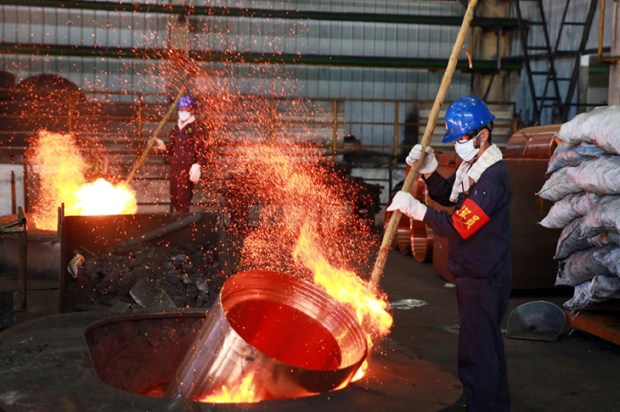
In addition, China leads the world in EV battery production, in inverters and transformers necessary for conversion of direct current to grid-ready alternating current and grid conversion generally. It also dominates in wind turbine manufacturing. It makes all these products for export to willing (environmental-policy-driven) foreign governments ‘by burning over half of all the world’s coal’.
This cheap coal-sourced energy (which the Western world by contrast is closing down in the name of climate purity) is a key factor in the recent calculations by a research unit of the European Commission that Chinese companies could make solar panels for 16 to 18.9 cents per watt of generating capacity. By contrast, it cost European companies 24.3 to 30 cents per watt, and American companies about 28 cents. They simply cannot compete.
China continues to build new coal-fired power stations to maintain this domestic power price advantage, with the Institute of Energy Research asserting that, despite its climate-friendly protestations and (extended) emissions targets, China chooses not to replace traditional reliable energy sources, but rather, to use renewable energy as a supplement to their grid, which has the largest capacity in the world.
The New York Times recently reported, under the heading ‘China to Dominate the World in Solar Energy’, that following last year’s 38 per cent rise in exports of fully assembled solar panels and the almost doubling of key components, the future promises ‘an even bigger display of China’s solar energy dominance’. Already solar module production capacity is almost five times that of the rest of the world combined, having tripled since 2021. China is now able to produce more than twice as many solar modules as the world installs each year.
However, China’s dominant solar exports have drawn urgent international responses, according to the NYT. In the US, the Biden administration has introduced subsidies that cover much of the cost of making solar panels and part of the much higher cost of installing them. A wave of bankruptcies swept the European industry, leaving the continent largely dependent on Chinese products.
China’s motives in decimating the Western world’s solar manufacturing industries, may, the NYT suggests, be more domestic than geopolitical. ‘With China’s economy stumbling, the ramped-up spending on renewable energy, mainly solar, is a cornerstone of a big bet on emerging technologies. China’s leaders say that a “new trio” of industries – solar panels, electric cars and lithium batteries – has replaced an “old trio” of clothing, furniture and appliances.’
But one issue that has prompted US action and requires the attention of the Australian government is the sourcing of solar panel polysilicon in the Xinjiang region of north-western China. Under its ban on imports made with materials or components manufactured by forced labour in Xinjiang, where China has repressed predominantly Muslim minorities like the Uighurs, the US has blocked some shipments of solar panels from China, while the European Union has been considering similar action.
A better way of diminishing Australia’s energy subservience to China, rather than hoping for supply diversity or throwing a $1 billion bucket of taxpayers’ money at local solar hopefuls, would be to follow China’s lead by moving, as the Coalition proposes, into nuclear power as an element in a rational integrated energy supply policy.
Got something to add? Join the discussion and comment below.
You might disagree with half of it, but you’ll enjoy reading all of it. Try your first month for free, then just $2 a week for the remainder of your first year.